Atoms & Nuclei

JEE Main level, single correct, medium

65 of 239

Question 65 of 239

The radiation corresponding to 3→23\rightarrow 2 transition of a hydrogen atom falls on a gold surface to generate photoelectrons. These electrons are passed through a magnetic field of 5×10⁻⁴T5\times {10}^{-4}T. Assume that the radius of the largest circular path followed by these electrons is 7mm7mm, the work function of the metal is:
(Mass of electron
=9.1×10⁻³¹kg=9.1\times {10}^{-31}kg)

Show answer and solution

Answer: (D) 0.82eV0.82eV


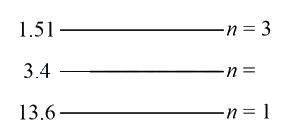
3→2⇒1.89eV3\rightarrow 2\Rightarrow 1.89eV
5×10⁻⁴Tr=7mm5\times {10}^{-4}Tr=7mm
r=mvqB⇒mv=qrBr=\dfrac{mv}{qB}\Rightarrow mv=qrB
⇒E=P22m=(qRB)22m\Rightarrow E=\dfrac{{P}^{2}}{2m}=\dfrac{(qRB{)}^{2}}{2m}
=(1.6×10−19×7×10−3×5×10−4)22×9.1×10−31Joule=\dfrac{{\left(1.6\times {10}^{-19}\times 7\times {10}^{-3}\times 5\times {10}^{-4}\right)}^{2}}{2\times 9.1\times {10}^{-31}Joule}
=3136×10−5218.2×10−31×1.6×10−19eV=\dfrac{3136\times {10}^{-52}}{18.2\times {10}^{-31}\times 1.6\times {10}^{-19}}eV
=1.077eV=1.077eV
We know work function
== energy incident −- (KE)electron(KE{)}_{\text{electron}}
ϕ=1.89−1.077=0.813eV\phi =1.89-1.077=0.813eV

Full year-wise papers: JEE Main question papers (PDF)

Explain it as a whiteboard videoStep-by-step, in Hinglish or English. The written solution is free, and so is your first video.Solved it on paper but got it wrong?Upload a photo of your working. Mistake Doctor marks the exact line that broke.
Learn Bohr's Atomic Model in depthA teacher-style lesson with diagrams, derivations and exam questions.Take a test on Bohr's Atomic ModelTimed questions, then a report on what to revise.

Learn the concept

Dual Nature, Atoms and Nuclei — Photoelectric effect and Bohr atomClass 12 Physics lesson with diagrams, worked examples and a quick check.
See it move: Atoms: Rutherford, Bohr and X-rays simulationDrag the sliders and watch the numbers in this question change.Revise Modern Physics firstFormula sheet, solved examples and the traps students fall into.

More questions on Bohr's Atomic Model