Capacitors

JEE Main level, single correct, medium

28 of 180

Question 28 of 180

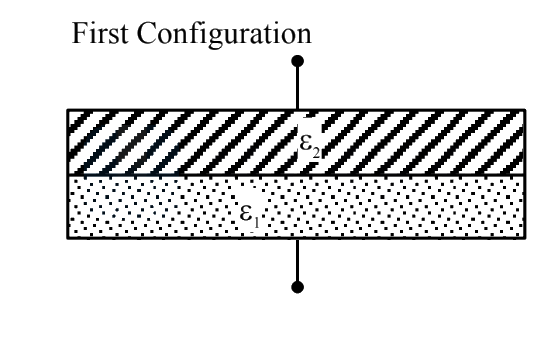
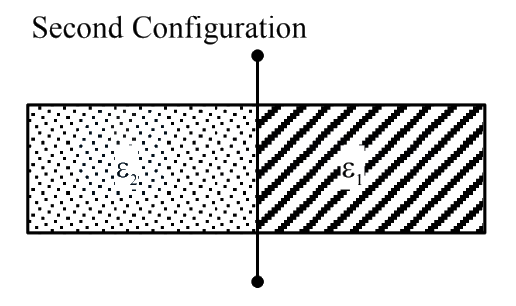
A parallel plate capacitor is filled equally (half) with two dielectrics of dielectric constant ε1\varepsilon_1 and ε2\varepsilon_2, as shown in figures. The distance between the plates is d and area of each plate is A. If capacitance in first configuration and second configuration are C1C_1 and C2C_2 respectively, then C1C2\frac{C_1}{C_2} is :
Figure for the Capacitors question: A parallel plate capacitor is filled equally (half) with two dielectrics of dielectric…

Show answer and solution

Answer: (B) 4ε1ε2(ε1+ε2)2\frac{4 \varepsilon_1 \varepsilon_2}{\left(\varepsilon_1+\varepsilon_2\right)^2}

Area of plate is
AA. then
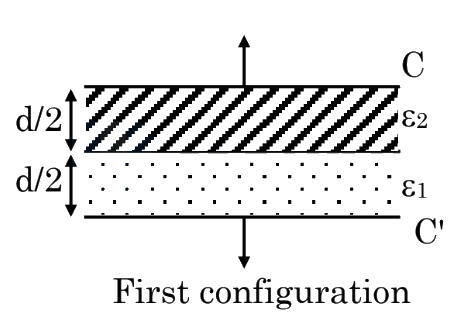
C=ε2ε0 A d/2=2ε2ε0 A dC′=ε1ε0 A d/2=2ε1ε0 A d\begin{aligned} & \mathrm{C}=\frac{\varepsilon_2 \varepsilon_0 \mathrm{~A}}{\mathrm{~d} / 2}=\frac{2 \varepsilon_2 \varepsilon_0 \mathrm{~A}}{\mathrm{~d}} \\ & \mathrm{C}^{\prime}=\frac{\varepsilon_1 \varepsilon_0 \mathrm{~A}}{\mathrm{~d} / 2}=\frac{2 \varepsilon_1 \varepsilon_0 \mathrm{~A}}{\mathrm{~d}} \end{aligned}
Let
C0=ε0 A d\mathrm{C}_0=\frac{\varepsilon_0 \mathrm{~A}}{\mathrm{~d}}
C=2ε2C0C′=2ε1C0\begin{aligned} & \mathrm{C}=2 \varepsilon_2 \mathrm{C}_0 \\ & \mathrm{C}^{\prime}=2 \varepsilon_1 \mathrm{C}_0 \end{aligned}
C&C′\mathrm{C} \& \mathrm{C}^{\prime} are in series
C1=CC′C+C′=4ε2ε1C022C0(ε2+ε1)\mathrm{C}_1=\frac{\mathrm{CC}^{\prime}}{\mathrm{C}+\mathrm{C}^{\prime}}=\frac{4 \varepsilon_2 \varepsilon_1 \mathrm{C}_0^2}{2 \mathrm{C}_0\left(\varepsilon_2+\varepsilon_1\right)}
=2ε2ε1C0(ε2+ε1)=\frac{2 \varepsilon_2 \varepsilon_1 \mathrm{C}_0}{\left(\varepsilon_2+\varepsilon_1\right)}
Here
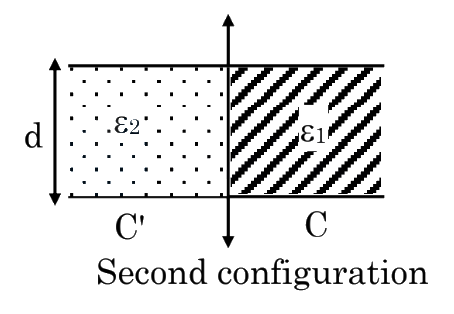
C=ε1ε0 A2 d=ε1C02\mathrm{C}=\frac{\varepsilon_1 \varepsilon_0 \mathrm{~A}}{2 \mathrm{~d}}=\frac{\varepsilon_1 \mathrm{C}_0}{2}
C′=ε2C02\mathrm{C}^{\prime}=\frac{\varepsilon_2 \mathrm{C}_0}{2}
C&C′\mathrm{C} \& \mathrm{C}^{\prime} are inparallel
C2=C′+C=(ε1+ε2)C02\mathrm{C}_2=\mathrm{C}^{\prime}+\mathrm{C}=\left(\varepsilon_1+\varepsilon_2\right) \frac{\mathrm{C}_0}{2}
Thus
C1C2=2ε2ε1C0(ε2+ε1)×2(ε1+ε2)C0\frac{\mathrm{C}_1}{\mathrm{C}_2}=\frac{2 \varepsilon_2 \varepsilon_1 \mathrm{C}_0}{\left(\varepsilon_2+\varepsilon_1\right)} \times \frac{2}{\left(\varepsilon_1+\varepsilon_2\right) \mathrm{C}_0}
=4ε2ε1(ε2+ε1)2=\frac{4 \varepsilon_2 \varepsilon_1}{\left(\varepsilon_2+\varepsilon_1\right)^2}

Full year-wise papers: JEE Main question papers (PDF)

Explain it as a whiteboard videoStep-by-step, in Hinglish or English. The written solution is free, and so is your first video.Solved it on paper but got it wrong?Upload a photo of your working. Mistake Doctor marks the exact line that broke.
Learn Grouping of capacitors in depthA teacher-style lesson with diagrams, derivations and exam questions.Take a test on Grouping of capacitorsTimed questions, then a report on what to revise.

Learn the concept

Electrostatic Potential and Capacitance — Potential and parallel-plate capacitorClass 12 Physics lesson with diagrams, worked examples and a quick check.
See it move: Capacitors, dielectrics and RC circuits simulationDrag the sliders and watch the numbers in this question change.

More questions on Grouping of capacitors