Capacitors

JEE Main level, single correct, medium

64 of 180

Question 64 of 180

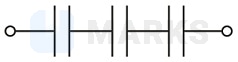
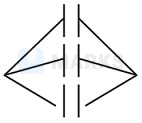
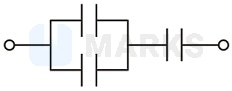
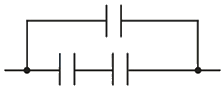
Three capacitances, each of 3 μF\mu \text{F}, are provided. These cannot be combined to provide the resultant capacitance of :

Show answer and solution

Answer: (B) 6μF6\mu \text{F}

Equivalent capacitance will be maximum for parallel combination and Minimum for series combination

∴∴ Possibilities are

1)
C=1μF\text{C}=1\mu \text{F}

2)
C=9μF\text{C}=9\mu \text{F}

3)
1C=16+13=36\dfrac{1}{\text{C}}=\dfrac{1}{6}+\dfrac{1}{3}=\dfrac{3}{6}

∴C=2μF∴\text{C}=2\mu \text{F}

4)
​ C=C2+C=32×C\text{C}=\dfrac{\text{C}}{2}+\text{C}=\dfrac{3}{2}\times \text{C}

=32=1.5μF=\dfrac{3}{2}=\text{1.5}\mu \text{F}

Full year-wise papers: JEE Main question papers (PDF)

Explain it as a whiteboard videoStep-by-step, in Hinglish or English. The written solution is free, and so is your first video.Solved it on paper but got it wrong?Upload a photo of your working. Mistake Doctor marks the exact line that broke.
Learn Grouping of capacitors in depthA teacher-style lesson with diagrams, derivations and exam questions.Take a test on Grouping of capacitorsTimed questions, then a report on what to revise.

Learn the concept

Electrostatic Potential and Capacitance — Potential and parallel-plate capacitorClass 12 Physics lesson with diagrams, worked examples and a quick check.
See it move: Capacitors, dielectrics and RC circuits simulationDrag the sliders and watch the numbers in this question change.

More questions on Grouping of capacitors