Capacitors

JEE Main level, single correct, medium

174 of 180

Question 174 of 180

In the following circuit the switch SSis closed at t=0t=0. The charge on the capacitor C1{C}_{1} as a function of time will be given by (Ceq=C1C2C1+C2)\left({C}_{eq}=\dfrac{{C}_{1}{C}_{2}}{{C}_{1}+{C}_{2}}\right)
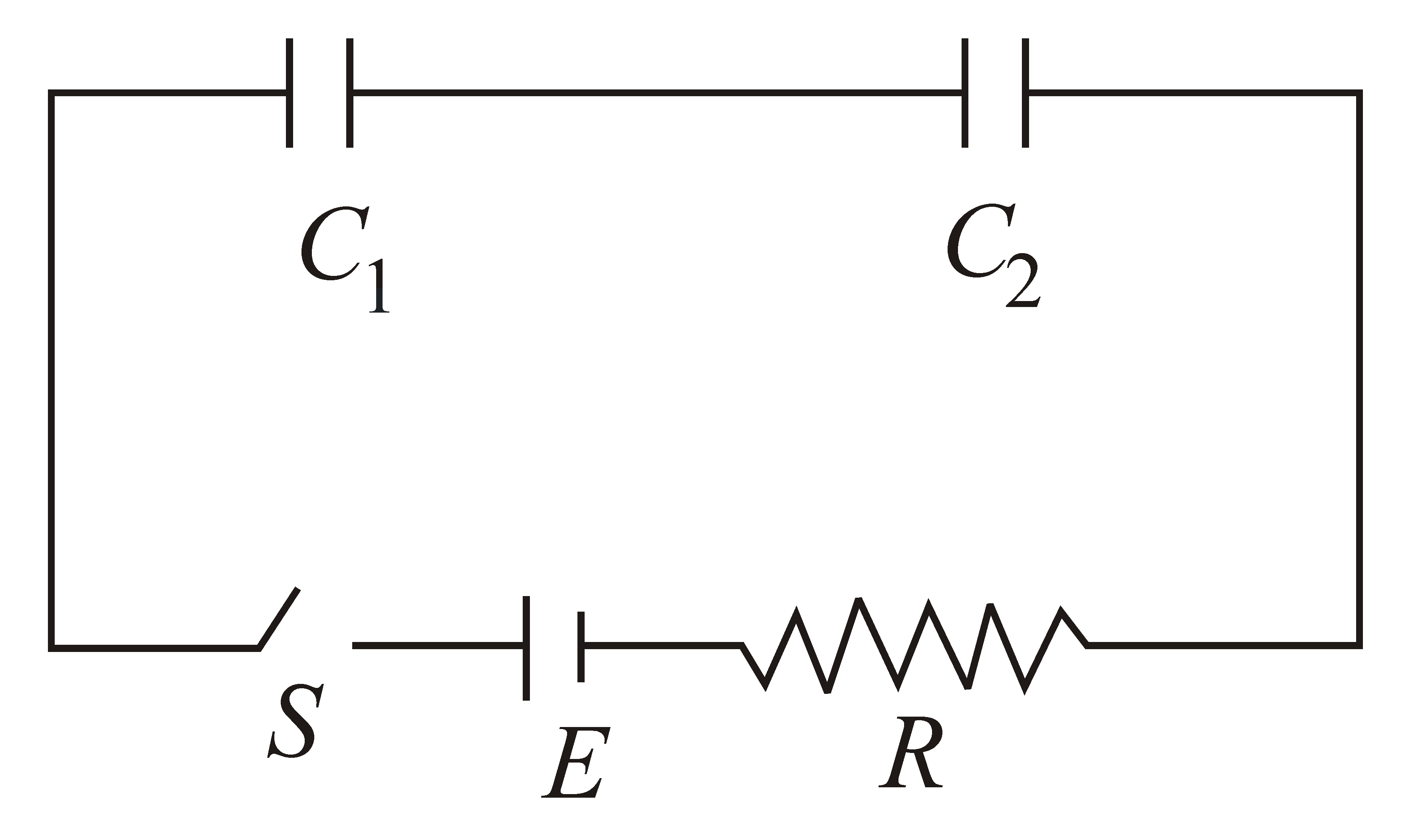
Figure for the Capacitors question: In the following circuit the switch Sis closed at t=0. The charge on the capacitor C1 as…

Show answer and solution

Answer: (C) CeqE[1−exp⁡⁡(−tRCeq)]{C}_{eq}E\left[1-\exp ⁡\left(-\dfrac{t}{R{C}_{eq}}\right)\right]

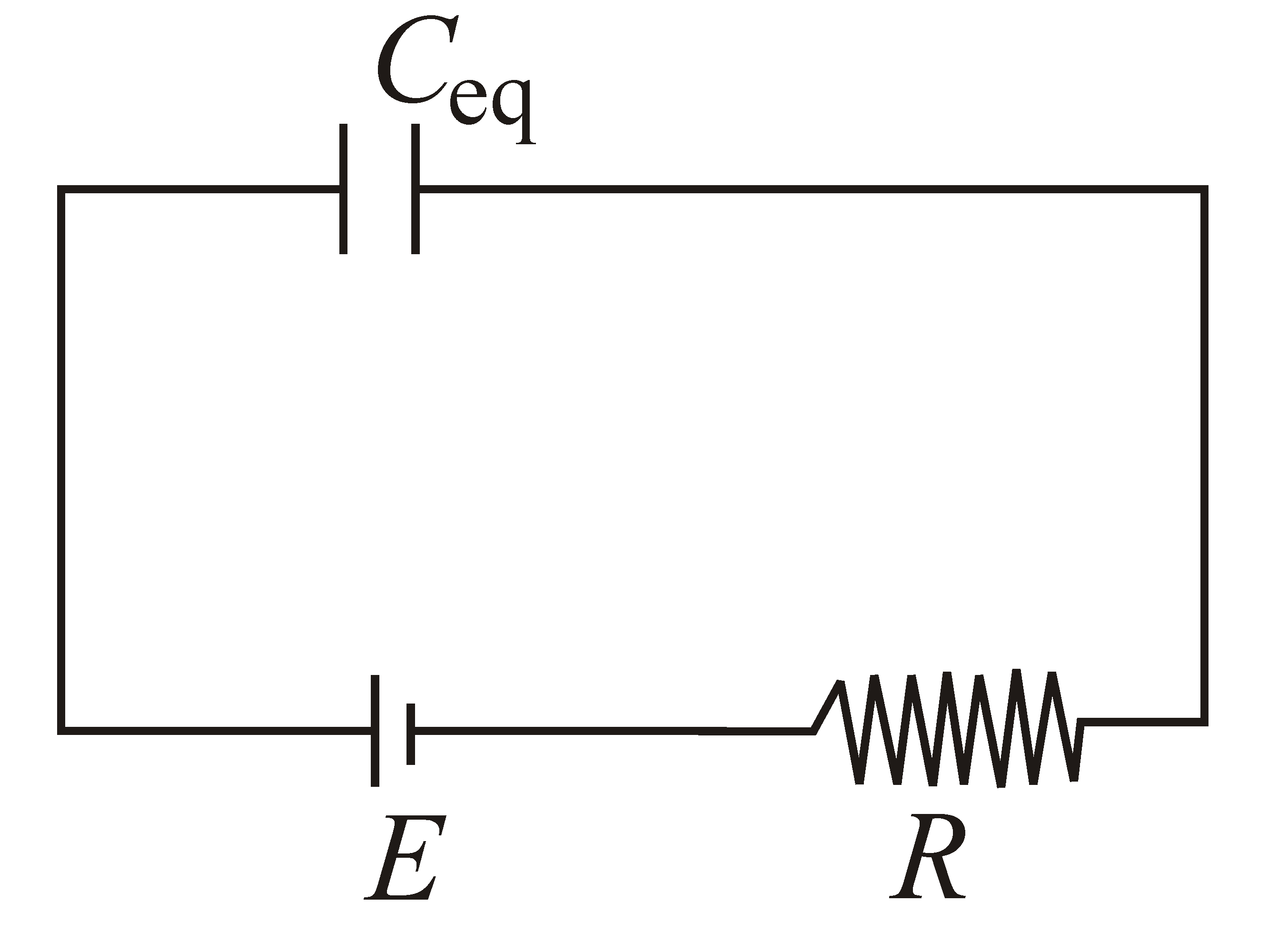
In given circuit capacitors C1{C}_{1} and C2{C}_{2} are connected in series , so equivalent capacitance will be
1Ceq=1C1+1C2⇒Ceq=C1C2C1+C2\dfrac{1}{{C}_{eq}}=\dfrac{1}{{C}_{1}}+\dfrac{1}{{C}_{2}} \Rightarrow {C}_{eq}=\dfrac{{C}_{1}{C}_{2}}{{C}_{1}+{C}_{2}}
at
t=0t=0, the switch is closed and capacitors start charged, at time tt
charge on the capacitor is given by

q=q0[1−e−t/τ]q={q}_{0}\left[1-{e}^{-t/\tau }\right]
where
q0{q}_{0} is the maximum charge on the capacitor at steady state and τ\tau is the time constant.
and
q0=CeqE{q}_{0}={C}_{eq}E and τ=RCeq\tau =R{C}_{eq}
Then from the above equation

q=CeqE[1−e−t/RCeq]q={C}_{eq}E\left[1-{e}^{-t/R{C}_{eq}}\right]
∴q=CeqE[1−exp(tRCeq)]∴q={C}_{eq}E\left[1-exp\left(\dfrac{t}{R{C}_{eq}}\right)\right]
Both capacitor will have same charge as they are connected in series
Full year-wise papers: JEE Main question papers (PDF)

Explain it as a whiteboard videoStep-by-step, in Hinglish or English. The written solution is free, and so is your first video.Solved it on paper but got it wrong?Upload a photo of your working. Mistake Doctor marks the exact line that broke.
Learn Charging and Discarging of capacitors in depthA teacher-style lesson with diagrams, derivations and exam questions.Take a test on Charging and Discarging of capacitorsTimed questions, then a report on what to revise.

Learn the concept

Electrostatic Potential and Capacitance — Potential and parallel-plate capacitorClass 12 Physics lesson with diagrams, worked examples and a quick check.
See it move: Capacitors, dielectrics and RC circuits simulationDrag the sliders and watch the numbers in this question change.

More questions on Charging and Discarging of capacitors