Current Electricity

JEE Main level, single correct, medium

39 of 380

Question 39 of 380

Paragraph:
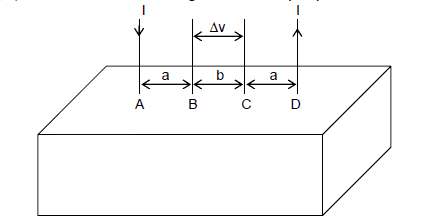
Consider a block of conducting material of resistivity '
ρ\rho ' shown in the figure. Current 'l' enters at 'A' and leaves from ' D\mathrm{D} '. We apply superposition principle to find voltage ' ΔV\Delta \mathrm{V} ' developed between ' B\mathrm{B} ' and ' C\mathrm{C} '. The calculation is done in the following steps:
(i) Take current 'l' entering from 'A' and assume it to spread over a hemispherical surface in the block.

(ii) Calculate field
E(r)E(r) at distance ' rr ' from AA by using Ohm's law E=ρjE=\rho j, where jj is the current per unit area at ' rr '.
(iii) From the '
rr ' dependence of E(r)E(r), obtain the potential V(r)V(r) at rr.
(iv) Repeat (i), (ii) and (iii) for current 'l' leaving '
DD ' and superpose results for ' AA ' and ' DD '.Figure for the Current Electricity question: Paragraph: Consider a block of conducting material of resistivity ' ρ ' shown in the…
Question:

For current entering at
AA, the electric field at a distance ' rr ' from AA is

Show answer and solution

Answer: (C) ρl2πr2\frac{\rho l}{2 \pi r^2}

No Solution Available

Full year-wise papers: JEE Main question papers (PDF)

Explain it as a whiteboard videoStep-by-step, in Hinglish or English. The written solution is free, and so is your first video.Solved it on paper but got it wrong?Upload a photo of your working. Mistake Doctor marks the exact line that broke.
Learn Electric Current and Drift of Electrons in depthA teacher-style lesson with diagrams, derivations and exam questions.Take a test on Electric Current and Drift of ElectronsTimed questions, then a report on what to revise.

Learn the concept

Current Electricity — Ohm’s law and resistivityClass 12 Physics lesson with diagrams, worked examples and a quick check.
See it move: Circuit builder simulationDrag the sliders and watch the numbers in this question change.Revise Current Electricity firstFormula sheet, solved examples and the traps students fall into.

More questions on Electric Current and Drift of Electrons