Current Electricity

JEE Main level, single correct, medium

205 of 380

Question 205 of 380

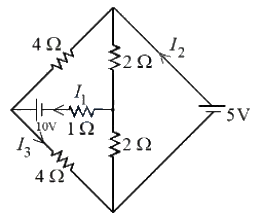
Refer to the figure given below. The values of I1I_1, I2I_2 and I3I_3 are __________.
Figure for the Current Electricity question: Refer to the figure given below. The values of I1, I2 and I3 are . <img…

Show answer and solution

Answer: (A) I1=2.5I_1 = 2.5 A, I2=1.875I_2 = 1.875 A, I3=1.875I_3 = 1.875 A

Using the principle of superposition, we analyse the circuit with one source active at a time.

Case 1: Only the
10 V10\text{ V} source is active (the 5 V5\text{ V} source is replaced by a short circuit).

With the
5 V5\text{ V} source shorted, the top and bottom nodes of the bridge are directly connected by a wire, forming a Wheatstone bridge.

Checking for balance:

Left arm ratio:
44=1\dfrac{4}{4} = 1
Right arm ratio:
22=1\dfrac{2}{2} = 1

The ratios are equal, so the bridge is balanced. Hence, no current flows through the middle branch connecting the two nodes, and the contribution to
I2I_2 from the 10 V10\text{ V} source is 0 A0\text{ A}.

Equivalent resistance of the balanced bridge:

(4+2) Ω∥(4+2) Ω=6 Ω∥6 Ω=3 Ω(4 + 2)\,\Omega \parallel (4 + 2)\,\Omega = 6\,\Omega \parallel 6\,\Omega = 3\,\Omega

Total resistance including the series
1 Ω1\,\Omega resistor:
Req=3+1=4 ΩR_{eq} = 3 + 1 = 4\,\Omega

Current drawn from the
10 V10\text{ V} source:
I1(10V)=104=2.5 AI_{1(10V)} = \dfrac{10}{4} = 2.5\text{ A}

This current splits equally between the two
6 Ω6\,\Omega branches, so the current through the bottom 4 Ω4\,\Omega resistor is:
I3(10V)=2.52=1.25 AI_{3(10V)} = \dfrac{2.5}{2} = 1.25\text{ A}

Case 2: Only the
5 V5\text{ V} source is active (the 10 V10\text{ V} source is replaced by a short circuit).

Now the
5 V5\text{ V} source is applied across the top and bottom nodes, and the 1 Ω1\,\Omega resistor lies in the middle branch between the left and centre nodes.

For the left branch (
4 Ω4\,\Omega and 4 Ω4\,\Omega in series), the potential at the midpoint is 52=2.5 V\dfrac{5}{2} = 2.5\text{ V}.
For the right branch (
2 Ω2\,\Omega and 2 Ω2\,\Omega in series), the potential at the midpoint is also 52=2.5 V\dfrac{5}{2} = 2.5\text{ V}.

Since both midpoints are at the same potential, no current flows through the
1 Ω1\,\Omega middle branch. Hence, the contribution to I1I_1 from the 5 V5\text{ V} source is 0 A0\text{ A}.

Equivalent resistance seen by the
5 V5\text{ V} source:
(4+4) Ω∥(2+2) Ω=8 Ω∥4 Ω=8×48+4=83 Ω(4 + 4)\,\Omega \parallel (2 + 2)\,\Omega = 8\,\Omega \parallel 4\,\Omega = \dfrac{8 \times 4}{8 + 4} = \dfrac{8}{3}\,\Omega

Total current supplied by the
5 V5\text{ V} source:
I2(5V)=58/3=158=1.875 AI_{2(5V)} = \dfrac{5}{8/3} = \dfrac{15}{8} = 1.875\text{ A}

Current through the left branch (which includes the bottom
4 Ω4\,\Omega resistor):
I3(5V)=58=0.625 AI_{3(5V)} = \dfrac{5}{8} = 0.625\text{ A}

Applying superposition:

I1=I1(10V)+I1(5V)=2.5+0=2.5 AI_1 = I_{1(10V)} + I_{1(5V)} = 2.5 + 0 = 2.5\text{ A}
I2=I2(10V)+I2(5V)=0+1.875=1.875 AI_2 = I_{2(10V)} + I_{2(5V)} = 0 + 1.875 = 1.875\text{ A}
I3=I3(10V)+I3(5V)=1.25+0.625=1.875 AI_3 = I_{3(10V)} + I_{3(5V)} = 1.25 + 0.625 = 1.875\text{ A}

Hence, the correct option is
(1) I1=2.5 A, I2=1.875 A, I3=1.875 A(1)\ I_1 = 2.5\text{ A},\ I_2 = 1.875\text{ A},\ I_3 = 1.875\text{ A}.

Full year-wise papers: JEE Main question papers (PDF)

Explain it as a whiteboard videoStep-by-step, in Hinglish or English. The written solution is free, and so is your first video.Solved it on paper but got it wrong?Upload a photo of your working. Mistake Doctor marks the exact line that broke.
Learn Kirchoffs Laws in depthA teacher-style lesson with diagrams, derivations and exam questions.Take a test on Kirchoffs LawsTimed questions, then a report on what to revise.

Learn the concept

Current Electricity — Ohm’s law and resistivityClass 12 Physics lesson with diagrams, worked examples and a quick check.
See it move: Circuit builder simulationDrag the sliders and watch the numbers in this question change.Revise Current Electricity firstFormula sheet, solved examples and the traps students fall into.

More questions on Kirchoffs Laws