Question 340 of 380
A student is provided with a variable voltage source , a test resistor , two identical galvanometers and and two additional resistors, and . For conducting an experiment to verify ohm's law, the most suitable circuit is:
Show answer and solution
Answer: (A) 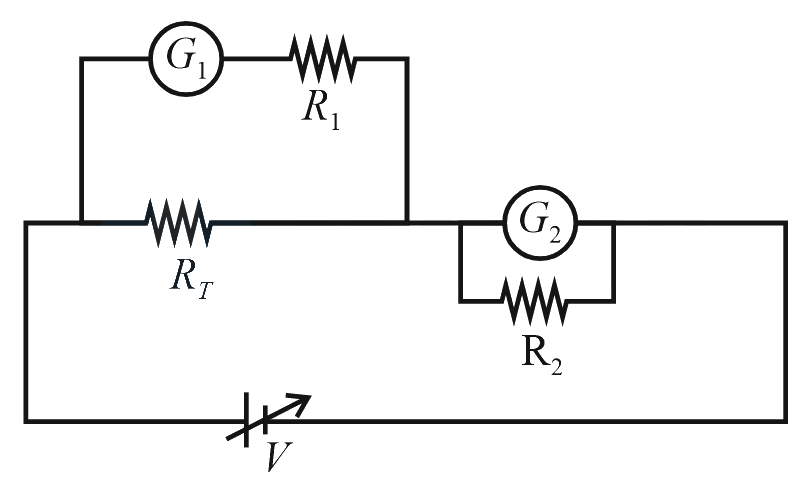
A galvanometer is a tool used to either detect or quantify an electric current. The movement of a magnetic needle or a coil in a magnetic field, which is an essential component of a galvanometer, typically indicates the current and its strength.
Depending up on the resistance and the connectivity in the circuit, galvanometer can be used either as voltmeter or as an ammeter.
Voltmeter should have very high resistance, while ammeter should be having very less resistance.
Hence, the high resistor should be connected in series with the galvanometer in order to measure the potential difference across the test resistor. Also, the low resistor should be connected in parallel with the galvanometer in order to measure the current across the test resistor.
Thus, this combination will work properly.
