Electrostatics

JEE Main level, single correct, medium

28 of 311

Question 28 of 311

Three identical charged balls each of charge 2C2C are suspended from a common point PP by silk threads of 2m2m each (as shown in figure). They form an equilateral triangle of side 1m1m.
The ratio of net force on a charged ball to the force between any two charged balls will be
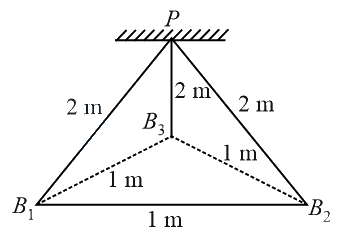
Figure for the Electrostatics question: Three identical charged balls each of charge 2C are suspended from a common point P by…

Show answer and solution

Answer: (A) 3:1\sqrt{3}:1


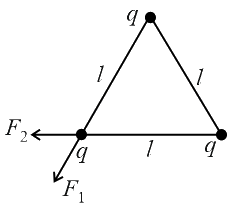
We have force between any two charge
F1=F2=q24πϵ0l2=F{F}_{1}={F}_{2}=\dfrac{{q}^{2}}{4\pi {\epsilon }_{0}{l}^{2}}=F
Resultant electrostatics force
FR=F12+F22+2F1F2cos⁡60∘{F}_{R}=\sqrt{{F}_{1}^{2}+{F}_{2}^{2}+2{F}_{1}{F}_{2}\cos 60^{\circ}}
=F2+F2+(2F2×12)=3F2=\sqrt{{F}^{2}+{F}^{2}+\left(2{F}^{2}\times \dfrac{1}{2}\right)}=\sqrt{3{F}^{2}}
So, the ratio of net force on a charged ball to the force between any charged balls is

⇒FRF=3\Rightarrow \dfrac{{F}_{R}}{F}=\sqrt{3}

Full year-wise papers: JEE Main question papers (PDF)

Explain it as a whiteboard videoStep-by-step, in Hinglish or English. The written solution is free, and so is your first video.Solved it on paper but got it wrong?Upload a photo of your working. Mistake Doctor marks the exact line that broke.
Learn Electric Charge and Coulomb's law in depthA teacher-style lesson with diagrams, derivations and exam questions.Take a test on Electric Charge and Coulomb's lawTimed questions, then a report on what to revise.

Learn the concept

Electric Charges and Fields — Coulomb’s law and electric fieldClass 12 Physics lesson with diagrams, worked examples and a quick check.
See it move: Electric field lines simulationDrag the sliders and watch the numbers in this question change.Revise Electrostatics firstFormula sheet, solved examples and the traps students fall into.

More questions on Electric Charge and Coulomb's law