Electrostatics

JEE Main level, numerical answer, medium

78 of 311

Question 78 of 311

A thin infinite sheet charge and an infinite line charge of respective charge densities +σ+\sigma and +λ+\lambda are placed parallel at 5m5m distance from each other. Points PP and QQ are at 3πm\dfrac{3}{\pi }m and 4πm\dfrac{4}{\pi }m perpendicular distances from line charge towards sheet charge, respectively. Ep{E}_{p} and Eq{E}_{q} are the magnitudes of resultant electric field intensities at point PP and QQ respectively. If EPEQ=4a\dfrac{{E}_{P}}{{E}_{Q}}=\dfrac{4}{a} for 2∣σ∣=∣λ∣,2|\sigma |=|\lambda |, then the value of aa is _____.

Show answer and solution

Answer: 6

Let's consider the following diagram:
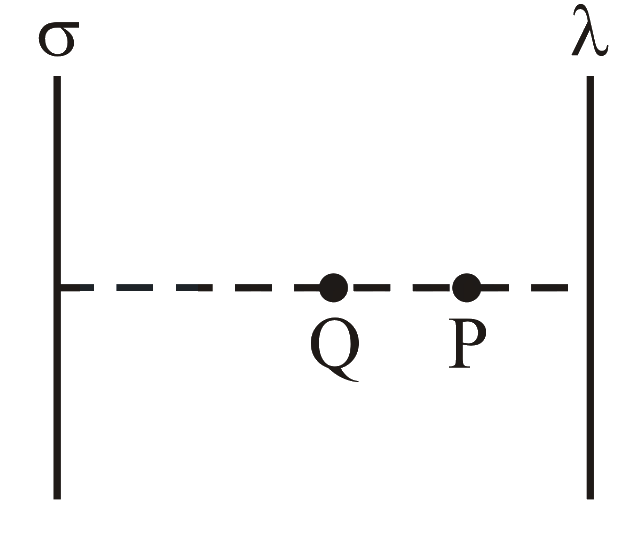
The formula to calculate the electric field due to an infinitely long charged sheet is given by

Es=σ2ϵ0...(1){E}_{s}=\dfrac{\sigma }{2{\epsilon }_{0}}...\left(1\right)
The formula to calculate the electric field due to an infinitely long line charge is given by

El=λ2πϵ0r...(2){E}_{l}=\dfrac{\lambda }{2\pi {\epsilon }_{0}r}...\left(2\right)
Using equations (1) and (2), the electric field at
PP can be calculated as follows:
EP=∣σ2ϵ0−14πϵ02λ3π∣=∣σ2ϵ0−λ6ϵ0∣=σ6ϵ0...(3)\begin{matrix}{E}_{P} & = & \left|\dfrac{\sigma }{2{\epsilon }_{0}}-\dfrac{1}{4\pi {\epsilon }_{0}}\dfrac{2\lambda }{\dfrac{3}{\pi }}\right| \\ & = & \left|\dfrac{\sigma }{2{\epsilon }_{0}}-\dfrac{\lambda }{6{\epsilon }_{0}}\right| \\ & = & \dfrac{\sigma }{6{\epsilon }_{0}}...\left(3\right)\end{matrix}
Similarly, the electric field at
QQ is given by
EQ=∣σ2ϵ0−14πϵ02λ4π∣=∣σ2ϵ0−λ8ϵ0∣=σ4ϵ0...(4)\begin{matrix}{E}_{Q} & = & \left|\dfrac{\sigma }{2{\epsilon }_{0}}-\dfrac{1}{4\pi {\epsilon }_{0}}\dfrac{2\lambda }{\dfrac{4}{\pi }}\right| \\ & = & \left|\dfrac{\sigma }{2{\epsilon }_{0}}-\dfrac{\lambda }{8{\epsilon }_{0}}\right| \\ & = & \dfrac{\sigma }{4{\epsilon }_{0}}...\left(4\right)\end{matrix}
Divide equation (3) by equation (4) to obtain the required ratio.

EPEQ=σ6ϵ0σ4ϵ0=46\begin{matrix}\dfrac{{E}_{P}}{{E}_{Q}} & = & \dfrac{\dfrac{\sigma }{6{\epsilon }_{0}}}{\dfrac{\sigma }{4{\epsilon }_{0}}} \\ & = & \dfrac{4}{6} \\ & & \end{matrix}
Hence,
a=6a=6.

Full year-wise papers: JEE Main question papers (PDF)

Explain it as a whiteboard videoStep-by-step, in Hinglish or English. The written solution is free, and so is your first video.Solved it on paper but got it wrong?Upload a photo of your working. Mistake Doctor marks the exact line that broke.
Learn Electric Field and Electric Field Lines in depthA teacher-style lesson with diagrams, derivations and exam questions.Take a test on Electric Field and Electric Field LinesTimed questions, then a report on what to revise.

Learn the concept

Electric Charges and Fields — Coulomb’s law and electric fieldClass 12 Physics lesson with diagrams, worked examples and a quick check.
See it move: Electric field lines simulationDrag the sliders and watch the numbers in this question change.Revise Electrostatics firstFormula sheet, solved examples and the traps students fall into.

More questions on Electric Field and Electric Field Lines