Electrostatics

JEE Main level, single correct, medium

207 of 311

Question 207 of 311

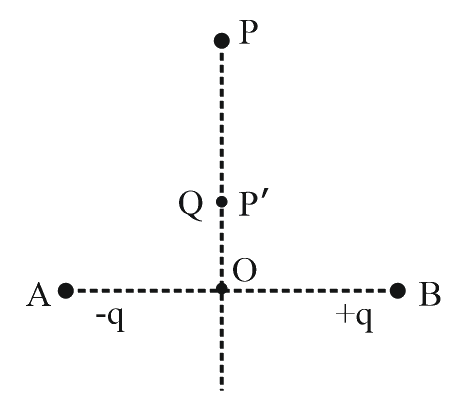
Charges −q-q and +q+q, located at AA and BB, respectively, constitute an electric dipole. Distance AB=2aAB=2a, OO is the mid point of the dipole and OPOP is perpendicular to ABAB. A charge QQ is placed at PP where OP=yOP=y and y≫2ay≫2a. The charge QQ experiences an electrostatic force FF. If QQ is now moved along the equatorial line to P′P' such that OP′=(y3)OP'=\left(\dfrac{y}{3}\right) the force on QQ will be close to(y3≪2a)\left(\dfrac{y}{3}≪2a\right)
Figure for the Electrostatics question: Charges -q and +q, located at A and B, respectively, constitute an electric dipole.…

Show answer and solution

Answer: (A) 27F27F.

Electric field intensity at the distance yy along the perpendicular bisector is

∣E1∣=KPy3\left|{E}_{1}\right|=\dfrac{KP}{{y}^{3}}

So, force at distance
yy on QQ,

F=Q(E1)=Q(KPy3)F=Q({E}_{1})=Q\left(\dfrac{KP}{{y}^{3}}\right) ...(1)(1)

F′=QKP(y3)3F'=Q\dfrac{KP}{{\left(\dfrac{y}{3}\right)}^{3}} ...(2)(2)
Dividing
(1)\left(1\right) by (2)\left(2\right), we get,
F′F=(3)3\dfrac{F'}{F}={\left(3\right)}^{3}

∴F′=27F∴F'=27F

Full year-wise papers: JEE Main question papers (PDF)

Explain it as a whiteboard videoStep-by-step, in Hinglish or English. The written solution is free, and so is your first video.Solved it on paper but got it wrong?Upload a photo of your working. Mistake Doctor marks the exact line that broke.
Learn Electric Potential and Potential Energy in depthA teacher-style lesson with diagrams, derivations and exam questions.Take a test on Electric Potential and Potential EnergyTimed questions, then a report on what to revise.

Learn the concept

Electric Charges and Fields — Coulomb’s law and electric fieldClass 12 Physics lesson with diagrams, worked examples and a quick check.
See it move: Electric field lines simulationDrag the sliders and watch the numbers in this question change.Revise Electrostatics firstFormula sheet, solved examples and the traps students fall into.

More questions on Electric Potential and Potential Energy