Electrostatics

JEE Main level, single correct, medium

258 of 311

Question 258 of 311

An electric dipole of moment p⃗=(−i^−3j^+2k^)×10−29C m\vec{\text{p}}=\left(-\hat{i}-3\hat{j}+2\hat{k}\right)\times {10}^{-29}\text{C m} at the origin (0,0,0)\left(0,0,0\right) . The electric field due to this dipole at r⃗=+i^+3j^+5k^\vec{\text{r}}=+\hat{i}+3\hat{j}+5\hat{k} (note that r⃗∙p⃗=0\vec{r}∙\vec{p}=0 ) is parallel to:

Show answer and solution

Answer: (C) (+i^+3j^−2k^)\left(+\hat{i}+3\hat{j}-2\hat{k}\right)
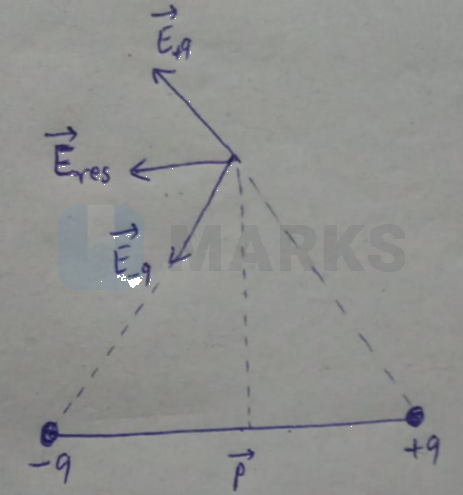

As
r⃗⋅p⃗=0\vec{r}\cdot \vec{p}=0, this means that r⃗\vec{r} is perpendicular to p⃗\vec{p}.
For an electric dipole, electric field at equatorial position is antiparallel to
p⃗\vec{p}.
⇒E⃗=−λp⃗\Rightarrow \vec{E}=-\lambda \vec{p},
where,
λ\lambda is an arbitrary positive constant.
⇒E⃗=−λ(−i^−3j^+2k^)×10−29Cm−2\Rightarrow \vec{E}=-\lambda \left(-\hat{i}-3\hat{j}+2\hat{k}\right)\times {10}^{-29}C{m}^{-2}
⇒E⃗=λ(i^+3j^−2k^)×10−29Cm−2\Rightarrow \vec{E}=\lambda \left(\hat{i}+3\hat{j}-2\hat{k}\right)\times {10}^{-29}C{m}^{-2}
For
λ=110−29\lambda =\dfrac{1}{{10}^{-29}}
⇒E⃗=(i^+3j^−2k^)Cm−2\Rightarrow \vec{E}=\left(\hat{i}+3\hat{j}-2\hat{k}\right)C{m}^{-2}

Full year-wise papers: JEE Main question papers (PDF)

Explain it as a whiteboard videoStep-by-step, in Hinglish or English. The written solution is free, and so is your first video.Solved it on paper but got it wrong?Upload a photo of your working. Mistake Doctor marks the exact line that broke.
Learn Electric Dipole in depthA teacher-style lesson with diagrams, derivations and exam questions.Take a test on Electric DipoleTimed questions, then a report on what to revise.

Learn the concept

Electric Charges and Fields — Coulomb’s law and electric fieldClass 12 Physics lesson with diagrams, worked examples and a quick check.
See it move: Electric field lines simulationDrag the sliders and watch the numbers in this question change.Revise Electrostatics firstFormula sheet, solved examples and the traps students fall into.

More questions on Electric Dipole