Experimental Physics

JEE Main level, single correct, medium

53 of 70

Question 53 of 70

In the experimental set up of metre bridge shown in the figure, the null point is obtaine data distance of 40 cm40 \mathrm{~cm} from

A. If a
10Ω10 \Omega resistor is connected in series with R1,\mathrm{R}_{1}, the null point shifts by 10 cm10 \mathrm{~cm}. The resistance that should be connected in parallel with (R1+10)Ω\left(\mathrm{R}_{1}+10\right) \Omega such that the null point shifts back to its initial position is
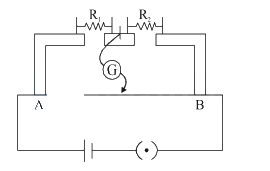
Figure for the Experimental Physics question: In the experimental set up of metre bridge shown in the figure, the null point is obtaine…

Show answer and solution

Answer: (C) 60Ω60 \Omega

Initially at null deflection R1R2=23\frac{\mathrm{R}_{1}}{\mathrm{R}_{2}}=\frac{2}{3}…(i)\ldots(\mathrm{i})

Finally at null deflection, when null point is shifted
R1+10R2=1⇒R1+10=R2\frac{\mathrm{R}_{1}+10}{\mathrm{R}_{2}}=1 \Rightarrow \mathrm{R}_{1}+10=\mathrm{R}_{2}...(ii)

Solving equations (i) and (ii) we get
2R23+10=R2\frac{2 R_{2}}{3}+10=R_{2}

10=R23⇒R2=30Ω10=\frac{\mathrm{R}_{2}}{3} \Rightarrow \mathrm{R}_{2}=30 \Omega

&R1=20Ω\& R_{1}=20 \Omega

Now if required resistance is
R\mathrm{R} then 30×R30+R30=23\frac{\frac{30 \times \mathrm{R}}{30+\mathrm{R}}}{30}=\frac{2}{3}

R=60Ω\mathrm{R}=60 \Omega

Full year-wise papers: JEE Main question papers (PDF)

Explain it as a whiteboard videoStep-by-step, in Hinglish or English. The written solution is free, and so is your first video.Solved it on paper but got it wrong?Upload a photo of your working. Mistake Doctor marks the exact line that broke.
Learn Experimental Physics in depthA teacher-style lesson with diagrams, derivations and exam questions.Take a test on Experimental PhysicsTimed questions, then a report on what to revise.

Learn the concept

Units and Measurement — Physical quantities and SI unitsClass 11 Physics lesson with diagrams, worked examples and a quick check.
Revise Modern Physics firstFormula sheet, solved examples and the traps students fall into.

More questions on Experimental Physics