Laws of Motion

JEE Main level, single correct, medium

24 of 210

Question 24 of 210

A block AA takes 2s2s to slide down a frictionless incline of 30∘30^{\circ} and length ll, kept inside a lift going up with uniform velocity vv. If the incline is changed to 45∘45^{\circ}, the time taken by the block, to slide down the incline, will be approximately:

Show answer and solution

Answer: (C) 1.68s1.68s
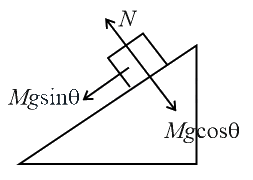

As per the information given in the question the lift is moving upward with uniform velocity. Therefore, the frame of reference attached to the lift is an inertial frame of reference. The acceleration of the block down the incline will be,

a=gsin⁡θa=g\sin \thetaUsing equation of motion for constant acceleration,
s=ut+12at2s=ut+\dfrac{1}{2}a{t}^{2}
⇒l=12gsin⁡30∘(2)2...(1)\Rightarrow l=\dfrac{1}{2}g\sin 30^{\circ}{\left(2\right)}^{2}...\left(1\right)
When the inclination is changed to
45∘45^{\circ},
l=12gsin⁡45∘t2...(2)l=\dfrac{1}{2}g\sin 45^{\circ}{t}^{2}...\left(2\right)
Equating the above equations,

12gsin⁡30∘(2)2=12gsin⁡45∘(t)2\dfrac{1}{2}g\sin 30^{\circ}{\left(2\right)}^{2}=\dfrac{1}{2}g\sin 45^{\circ}{\left(t\right)}^{2}
⇒(12)(4)=12t2⇒t=22=1.68s\Rightarrow \left(\dfrac{1}{2}\right)\left(4\right)=\dfrac{1}{\sqrt{2}}{t}^{2} \Rightarrow t=\sqrt{2\sqrt{2}}=1.68s

Full year-wise papers: JEE Main question papers (PDF)

Explain it as a whiteboard videoStep-by-step, in Hinglish or English. The written solution is free, and so is your first video.Solved it on paper but got it wrong?Upload a photo of your working. Mistake Doctor marks the exact line that broke.
Learn Newton's laws of motion in depthA teacher-style lesson with diagrams, derivations and exam questions.Take a test on Newton's laws of motionTimed questions, then a report on what to revise.

Learn the concept

Laws of Motion — Newton's laws and frictionClass 11 Physics lesson with diagrams, worked examples and a quick check.
See it move: Laws of motion, friction and pulleys simulationDrag the sliders and watch the numbers in this question change.

More questions on Newton's laws of motion