Laws of Motion

JEE Main level, single correct, medium

26 of 210

Question 26 of 210

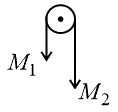
Two masses M1{M}_{1} and M2{M}_{2} are tied together at the two ends of a light inextensible string that passes over a frictionless pulley. When the mass M2{M}_{2} is twice that of M1{M}_{1}. the acceleration of the system is a1{a}_{1}. When the mass M2{M}_{2} is thrice that of M1{M}_{1}. The acceleration of The system is a2{a}_{2}. The ratio a1a2\dfrac{{a}_{1}}{{a}_{2}} will be
Figure for the Laws of Motion question: Two masses M1 and M2 are tied together at the two ends of a light inextensible string…

Show answer and solution

Answer: (B) 23\dfrac{2}{3}

In both cases m1>m2{m}_{1}\gt {m}_{2}. Therefore, m1{m}_{1} will accelerate downward and m2{m}_{2} will accelerate upward.
For
m1{m}_{1},
m1g−T=m1a{m}_{1}g-T={m}_{1}a
For
m2{m}_{2},
T−m2g=m2aT-{m}_{2}g={m}_{2}a
Adding the above equations we get,

a=m1−m2m1+m2ga=\dfrac{{m}_{1}-{m}_{2}}{{m}_{1}+{m}_{2}}g
⇒a1=m1−m2m1+m2g=2m2−m22m2+m2g=g3\Rightarrow {a}_{1}=\dfrac{{m}_{1}-{m}_{2}}{{m}_{1}+{m}_{2}}g =\dfrac{2{m}_{2}-{m}_{2}}{2{m}_{2}+{m}_{2}}g =\dfrac{g}{3}
and

⇒a2=m1−m2m1+m2g=3m2−m23m2+m2g=g2\Rightarrow {a}_{2}=\dfrac{{m}_{1}-{m}_{2}}{{m}_{1}+{m}_{2}}g =\dfrac{3{m}_{2}-{m}_{2}}{3{m}_{2}+{m}_{2}}g =\dfrac{g}{2}
⇒a1a2=23\Rightarrow \dfrac{{a}_{1}}{{a}_{2}}=\dfrac{2}{3}

Full year-wise papers: JEE Main question papers (PDF)

Explain it as a whiteboard videoStep-by-step, in Hinglish or English. The written solution is free, and so is your first video.Solved it on paper but got it wrong?Upload a photo of your working. Mistake Doctor marks the exact line that broke.
Learn Newton's laws of motion in depthA teacher-style lesson with diagrams, derivations and exam questions.Take a test on Newton's laws of motionTimed questions, then a report on what to revise.

Learn the concept

Laws of Motion — Newton's laws and frictionClass 11 Physics lesson with diagrams, worked examples and a quick check.
See it move: Laws of motion, friction and pulleys simulationDrag the sliders and watch the numbers in this question change.

More questions on Newton's laws of motion