Laws of Motion

JEE Main level, single correct, medium

28 of 210

Question 28 of 210

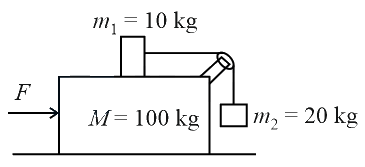
Three masses M=100kg,m1=10kgM=100kg,{m}_{1}=10kg and m2=20kg{m}_{2}=20kg are arranged in a system as shown in figure. All the surfaces are frictionless and strings are inextensible and weightless. The pulleys are also weightless and frictionless. A force FF is applied on the system so that the mass m2{m}_{2} moves upward with an acceleration of 2ms−22{ms}^{-2}. The value of FF is
(Take
g=10ms−2g=10{ms}^{-2})
Figure for the Laws of Motion question: Three masses M=100kg,m1=10kg and m2=20kg are arranged in a system as shown in figure. All…

Show answer and solution

Answer: (A) 3360N3360N

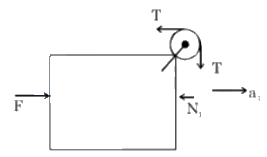
Let acceleration of 100 kg100 \mathrm{~kg} block =a1=a_1
FBD of
100 kg100 \mathrm{~kg} block w.r.t ground

F−T−N1=100a1\mathrm{F}-\mathrm{T}-\mathrm{N}_1=100 \mathrm{a}_1 ... (i)
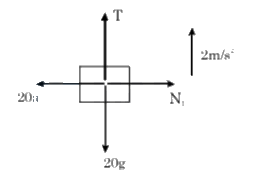
FBD of 20 block wrt
100 kg100 \mathrm{~kg}

T−20 g=20(2)\mathrm{T}-20 \mathrm{~g}=20(2)
T=240\mathrm{T}=240 ... (ii)
 N1=20a1\mathrm{~N}_1=20 \mathrm{a}_1 ... (iii)
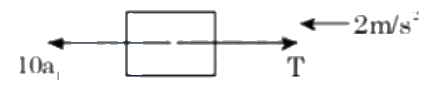
FBD of
10 kg10 \mathrm{~kg} block wrt 100 kg100 \mathrm{~kg}

10a1−240=10(2)10 \mathrm{a}_1-240=10(2)
a1=26 m/s2\mathrm{a}_1=26 \mathrm{~m} / \mathrm{s}^2
 F−240−20(26)=100×26\mathrm{~F}-240-20(26)=100 \times 26
⇒F=3360 N\Rightarrow \mathrm{F}=3360 \mathrm{~N}

Full year-wise papers: JEE Main question papers (PDF)

Explain it as a whiteboard videoStep-by-step, in Hinglish or English. The written solution is free, and so is your first video.Solved it on paper but got it wrong?Upload a photo of your working. Mistake Doctor marks the exact line that broke.
Learn Newton's laws of motion in depthA teacher-style lesson with diagrams, derivations and exam questions.Take a test on Newton's laws of motionTimed questions, then a report on what to revise.

Learn the concept

Laws of Motion — Newton's laws and frictionClass 11 Physics lesson with diagrams, worked examples and a quick check.
See it move: Laws of motion, friction and pulleys simulationDrag the sliders and watch the numbers in this question change.

More questions on Newton's laws of motion