Laws of Motion

JEE Main level, single correct, medium

44 of 210

Question 44 of 210

A vertical closed cylinder is separated into two parts by a frictionless piston of mass mm and of negligible thickness. The piston is free to move along the length of the cylinder. The length of the cylinder above piston is l1,{l}_{1}, and that below the piston is l2,{l}_{2}, such that l1>l2.{l}_{1}\gt {l}_{2}. Each part of the cylinder contains nn moles of an ideal gas at equal temperature T.T. If the piston is stationary, its mass mm will be given by:

(
RR is universal gas constant and gg is the acceleration due to gravity)

Show answer and solution

Answer: (B) nRTg[l1−l2l1l2]\dfrac{nRT}{g}\left[\dfrac{{l}_{1}-{l}_{2}}{{l}_{1}{l}_{2}}\right]
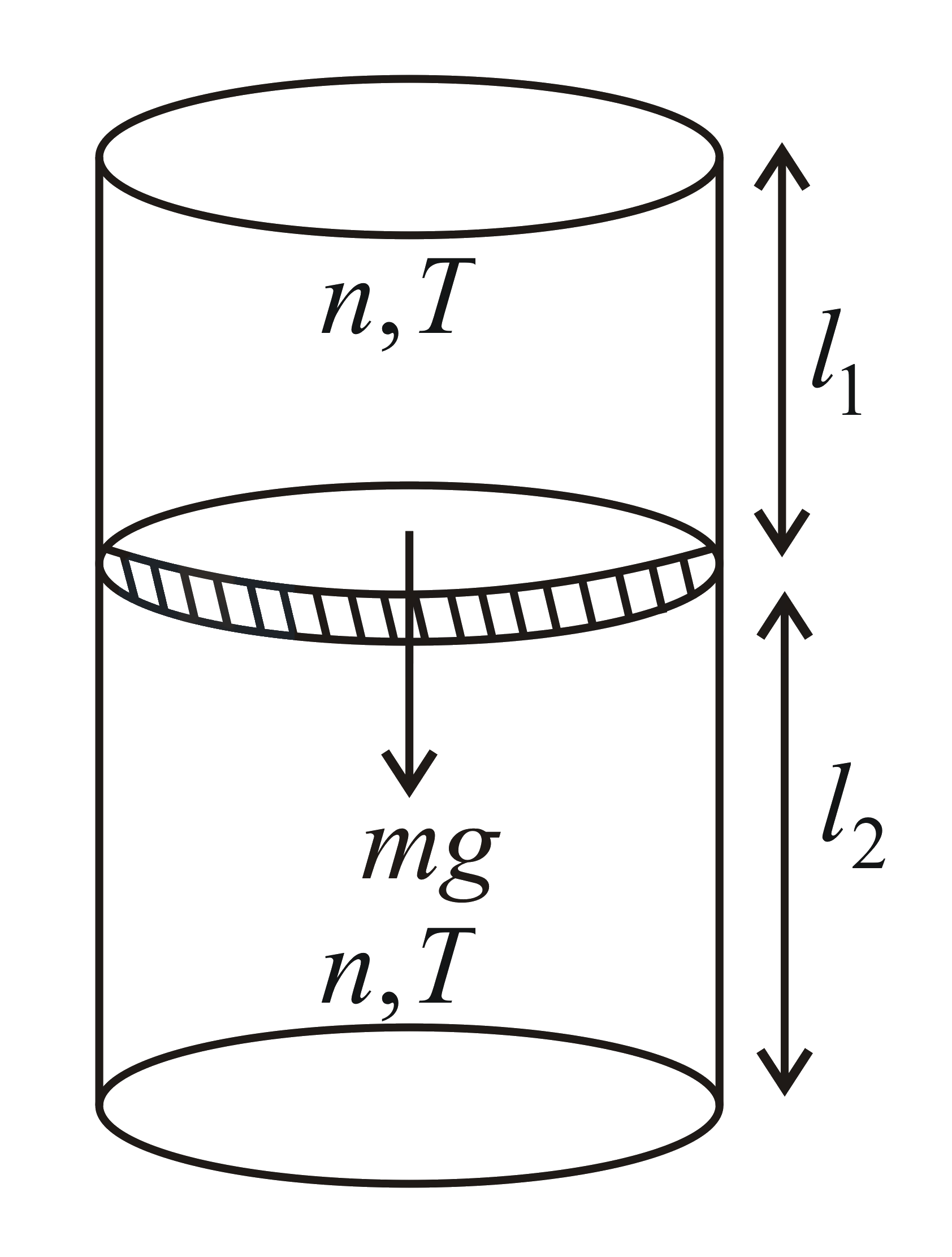

P1+mgA=P2{P}_{1}+\dfrac{mg}{A}={P}_{2}

⇒nRTl1A+mgA=nRTl2A\Rightarrow \dfrac{nRT}{{l}_{1}A}+\dfrac{mg}{A}=\dfrac{nRT}{{l}_{2}A}

⇒m=nRTg(1l2−1l1)\Rightarrow m=\dfrac{nRT}{g}\left(\dfrac{1}{{l}_{2}}-\dfrac{1}{{l}_{1}}\right)

=nRTg(l1−l2l1l2)=\dfrac{nRT}{g}\left(\dfrac{{l}_{1}-{l}_{2}}{{l}_{1}{l}_{2}}\right)

Full year-wise papers: JEE Main question papers (PDF)

Explain it as a whiteboard videoStep-by-step, in Hinglish or English. The written solution is free, and so is your first video.Solved it on paper but got it wrong?Upload a photo of your working. Mistake Doctor marks the exact line that broke.
Learn Newton's laws of motion in depthA teacher-style lesson with diagrams, derivations and exam questions.Take a test on Newton's laws of motionTimed questions, then a report on what to revise.

Learn the concept

Laws of Motion — Newton's laws and frictionClass 11 Physics lesson with diagrams, worked examples and a quick check.
See it move: Laws of motion, friction and pulleys simulationDrag the sliders and watch the numbers in this question change.

More questions on Newton's laws of motion