Laws of Motion

JEE Main level, single correct, medium

46 of 210

Question 46 of 210

The machine as shown has 22 rods of length 1m1m connected by a pivot at the top. The end of one rod is connected to the floor by a stationary pivot and the end of the other rod has roller that rolls along the floor in a slot. As the roller goes back and forth, a 2kg2kg weight moves up and down. If the roller is moving towards right at a constant speed, the weight moves up with a :
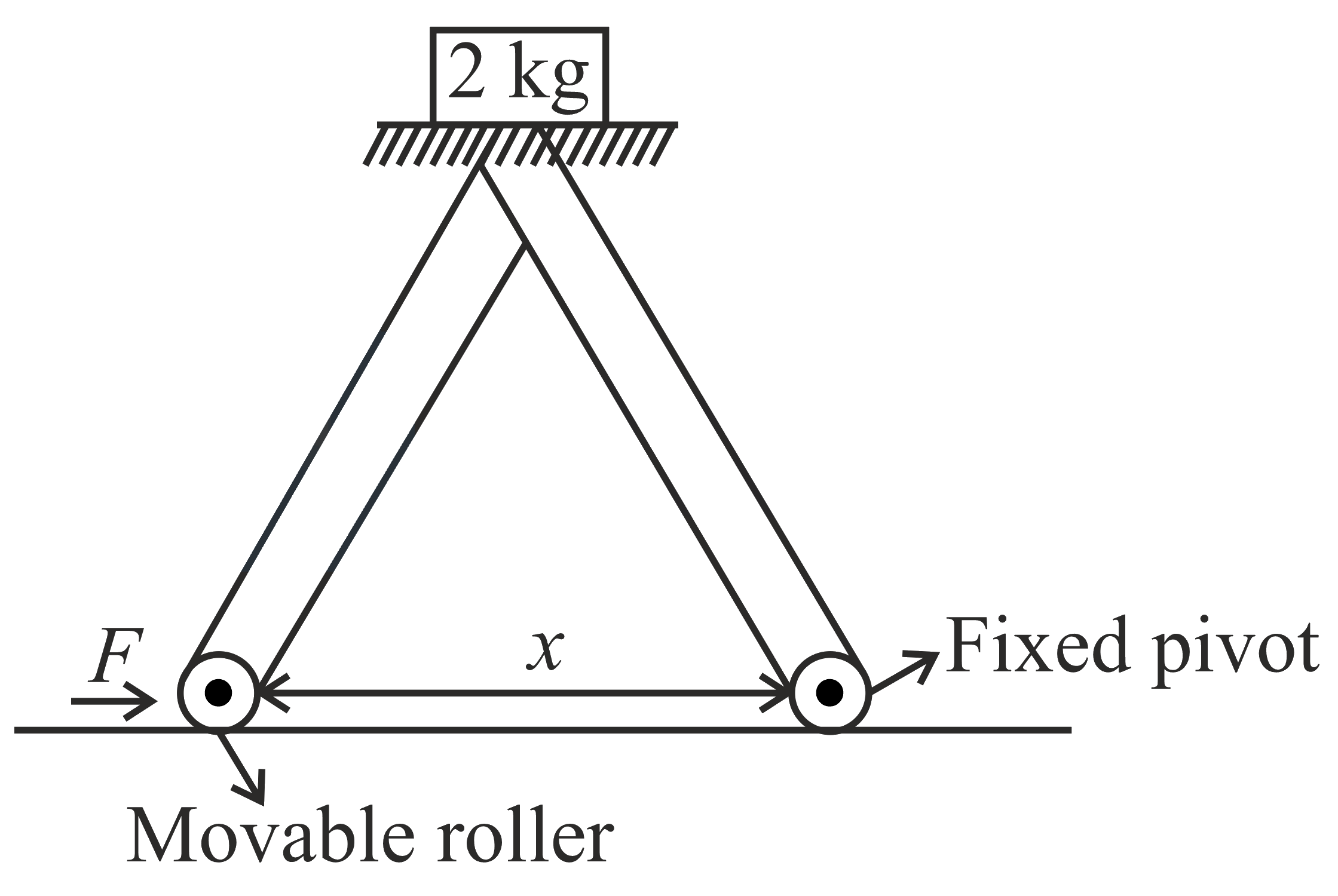
Figure for the Laws of Motion question: The machine as shown has 2 rods of length 1m connected by a pivot at the top. The end of…

Show answer and solution

Answer: (C) Decreasing speed
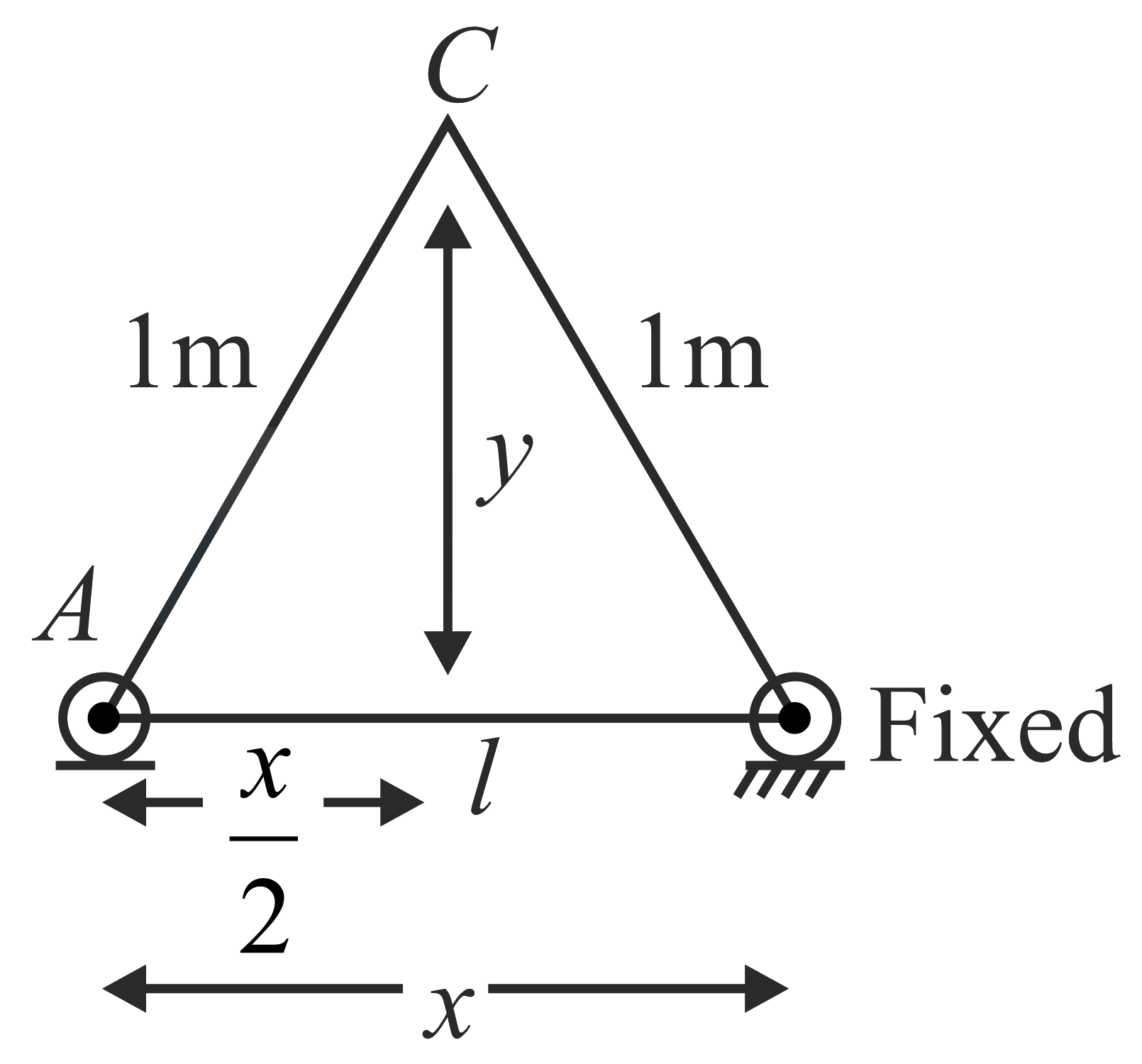


vA=dxdt=d[2lcos⁡(θ)]dt=−2lsin⁡(θ)dθdt{v}_{A}=\dfrac{dx}{dt}=\dfrac{d\left[2l\cos \left(\theta \right)\right]}{dt}=-2l\sin \left(\theta \right)\dfrac{d\theta }{dt} and
Vertical velocity of
BB, vB=dydt=d[lsin⁡(θ)]dt=lcos⁡(θ)dθdt{v}_{B}=\dfrac{dy}{dt}=\dfrac{d\left[l\sin \left(\theta \right)\right]}{dt}=l\cos \left(\theta \right)\dfrac{d\theta }{dt}
vAvB=−2tan⁡(θ)⇒vB=−vAcot⁡(θ)2\dfrac{{v}_{A}}{{v}_{B}}=-2\tan \left(\theta \right) \Rightarrow {v}_{B}=-\dfrac{{v}_{A}\cot \left(\theta \right)}{2}

θ→\begin{matrix}\theta \rightarrow \end{matrix}increase
cot⁡θ→\cot \theta \rightarrowdecrease
Hence,
∣vB∣→\left|{v}_{B}\right|\rightarrowdecrease.

Full year-wise papers: JEE Main question papers (PDF)

Explain it as a whiteboard videoStep-by-step, in Hinglish or English. The written solution is free, and so is your first video.Solved it on paper but got it wrong?Upload a photo of your working. Mistake Doctor marks the exact line that broke.
Learn Newton's laws of motion in depthA teacher-style lesson with diagrams, derivations and exam questions.Take a test on Newton's laws of motionTimed questions, then a report on what to revise.

Learn the concept

Laws of Motion — Newton's laws and frictionClass 11 Physics lesson with diagrams, worked examples and a quick check.
See it move: Laws of motion, friction and pulleys simulationDrag the sliders and watch the numbers in this question change.

More questions on Newton's laws of motion