Laws of Motion

JEE Main level, single correct, medium

59 of 210

Question 59 of 210

A particle of mass m\mathrm{m} is at rest at the origin at time t=0\mathrm{t}=0. It is subjected to a force F(t)=F0e−bt\mathrm{F}(\mathrm{t})=\mathrm{F}_0 \mathrm{e}^{-\mathrm{bt}} in the xx direction. Its speed v(t)v(t) is depicted by which of the following curves?

Show answer and solution

Answer: (C)
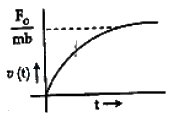
F=F0e−bt\mathrm{F}=\mathrm{F}_0 \mathrm{e}^{-\mathrm{bt}}
⇒a=Fm=F0 me−bt\Rightarrow \quad \mathrm{a}=\frac{\mathrm{F}}{\mathrm{m}}=\frac{\mathrm{F}_0}{\mathrm{~m}} \mathrm{e}^{-\mathrm{bt}}
⇒dvdt=F0 me−bt\Rightarrow \quad \frac{\mathrm{dv}}{\mathrm{dt}}=\frac{\mathrm{F}_0}{\mathrm{~m}} \mathrm{e}^{-\mathrm{bt}}
∫dv=∫0tFme−btdt\quad\int \mathrm{dv}=\int_0^{\mathrm{t}} \frac{\mathrm{F}}{\mathrm{m}} \mathrm{e}^{-\mathrm{bt}} \mathrm{dt}
⇒v=Fm[−1b][e−bt]0t\Rightarrow v=\frac{F}{m}\left[\frac{-1}{b}\right]\left[e^{-b t}\right]_0^t
⇒v=Fmb[e−bt]\Rightarrow \quad v=\frac{F}{m b}\left[e^{-b t}\right]
v=0 at t=0v=0 \text { at } t=0
and
v→Fmb\quad v \rightarrow \frac{F}{m b} as t→∞t \rightarrow \infty
So, velocity increases continuously and attains a maximum value of
v=Fmbv=\frac{F}{m b} as t→∞t \rightarrow \infty.

Full year-wise papers: JEE Main question papers (PDF)

Explain it as a whiteboard videoStep-by-step, in Hinglish or English. The written solution is free, and so is your first video.Solved it on paper but got it wrong?Upload a photo of your working. Mistake Doctor marks the exact line that broke.
Learn Newton's laws of motion in depthA teacher-style lesson with diagrams, derivations and exam questions.Take a test on Newton's laws of motionTimed questions, then a report on what to revise.

Learn the concept

Laws of Motion — Newton's laws and frictionClass 11 Physics lesson with diagrams, worked examples and a quick check.
See it move: Laws of motion, friction and pulleys simulationDrag the sliders and watch the numbers in this question change.

More questions on Newton's laws of motion