Laws of Motion

JEE Main level, single correct, medium

181 of 210

Question 181 of 210

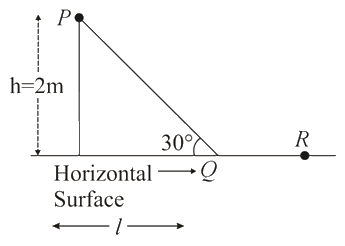
A point particle of mass m, moves along the uniformly rough track PQR as shown in the figure. The coefficient of friction, between the particle and the rough track equals μ\mu . The particle is released, from rest, from the point P and it comes to rest at a point R. The energies, lost by the ball, over the parts, PQ and QR, of the track, are equal to each other, and no energy is lost when particle changes direction from PQ to QR.
The values of the coefficient of friction
μ\mu and the distance x=(QR)x=\left(QR\right) , are respectively close to:

Figure for the Laws of Motion question: A point particle of mass m, moves along the uniformly rough track PQR as shown in the…

Show answer and solution

Answer: (A) 0.29 and 3.5 m


tan⁡⁡30o=hℓ\tan ⁡{30}^{o}=\dfrac{h}{\ell }

ℓ=h3=23m\ell =h\sqrt{3}=2\sqrt{3}m

WPQ=−μmgℓ{W}_{PQ}=-\mu mg\ell or WQR=−μmgx{W}_{QR}=-\mu mgx

μmgℓ=μmgx\mu mg\ell =\mu mgx
x=ℓx=\ell≈3.5m\approx 3.5m

x=23mx=2\sqrt{3}m
now according to work energy theorem

Wall=∆K{W}_{all}=∆K

mgh−μmgℓ−μmgx=0mgh-\mu mg\ell -\mu mgx=0

h−μℓ−μx=0h-\mu \ell -\mu x=0

2=μ(ℓ+x)⇒μ=2ℓ+x=243=123≈0.292=\mu \left(\ell +x\right) \Rightarrow \mu =\dfrac{2}{\ell +x}=\dfrac{2}{4\sqrt{3}}=\dfrac{1}{2\sqrt{3}}\approx 0.29

Full year-wise papers: JEE Main question papers (PDF)

Explain it as a whiteboard videoStep-by-step, in Hinglish or English. The written solution is free, and so is your first video.Solved it on paper but got it wrong?Upload a photo of your working. Mistake Doctor marks the exact line that broke.
Learn Frictional force in depthA teacher-style lesson with diagrams, derivations and exam questions.Take a test on Frictional forceTimed questions, then a report on what to revise.

Learn the concept

Laws of Motion — Newton's laws and frictionClass 11 Physics lesson with diagrams, worked examples and a quick check.
See it move: Laws of motion, friction and pulleys simulationDrag the sliders and watch the numbers in this question change.

More questions on Frictional force