Fluid Mechanics

JEE Main level, single correct, medium

20 of 192

Question 20 of 192

A thin uniform tube is bent into a circle of radius rr in the virtical plane. Equal volumes of two immiscible liquids, whose densities are ρ1\rho_1 and ρ2(ρ1>ρ2)\rho_2\left(\rho_1\gt \rho_2\right) fill half the circle. The angle θ\theta between the radius vector passing through the common interface and the vertical is

Show answer and solution

Answer: (A) θ=tan⁡−1[π2(ρ1−ρ2ρ1+ρ2)]\theta=\tan ^{-1}\left[\frac{\pi}{2}\left(\frac{\rho_1-\rho_2}{\rho_1+\rho_2}\right)\right]

Pressure at interface A must be same from both the sides to be in equilibrium.
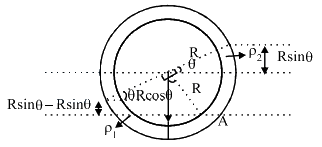

∴(Rcos⁡θ+Rsin⁡θ)ρ2 g=(Rcos⁡θ−Rsin⁡θ)ρ1 g\begin{aligned} \therefore \quad &(\mathrm{R} \cos \theta+\mathrm{R} \sin \theta) \rho_2 \mathrm{~g} \\ &=(\mathrm{R} \cos \theta-\mathrm{R} \sin \theta) \rho_1 \mathrm{~g} \end{aligned}
⇒ρ1ρ2=cos⁡θ+sin⁡θcos⁡θ−sin⁡θ=1+tan⁡θ1−tan⁡θ\Rightarrow \quad \frac{\rho_1}{\rho_2}=\frac{\cos \theta+\sin \theta}{\cos \theta-\sin \theta}=\frac{1+\tan \theta}{1-\tan \theta}
⇒ρ1−ρ1tan⁡θ=ρ2+ρ2tan⁡θ\Rightarrow \rho_1-\rho_1 \tan \theta=\rho_2+\rho_2 \tan \theta
⇒(ρ1+ρ2)tan⁡θ=ρ1−ρ2\Rightarrow \quad\left(\rho_1+\rho_2\right) \tan \theta=\rho_1-\rho_2
∴θ=tan⁡−1(ρ1−ρ2ρ1+ρ2)\therefore \quad \theta=\tan ^{-1}\left(\frac{\rho_1-\rho_2}{\rho_1+\rho_2}\right), soclosest answer is (a)

Full year-wise papers: JEE Main question papers (PDF)

Explain it as a whiteboard videoStep-by-step, in Hinglish or English. The written solution is free, and so is your first video.Solved it on paper but got it wrong?Upload a photo of your working. Mistake Doctor marks the exact line that broke.
Learn Pressure and thrust in depthA teacher-style lesson with diagrams, derivations and exam questions.Take a test on Pressure and thrustTimed questions, then a report on what to revise.

Learn the concept

Mechanical Properties of Fluids — Pressure, Pascal and ArchimedesClass 11 Physics lesson with diagrams, worked examples and a quick check.
See it move: Fluid mechanics simulationDrag the sliders and watch the numbers in this question change.

More questions on Pressure and thrust