Fluid Mechanics

JEE Main level, numerical answer, medium

60 of 192

Question 60 of 192

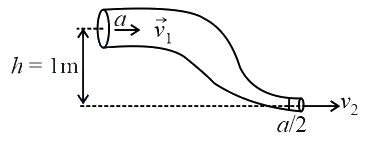
An ideal fluid of density 800kgm−3800kg{m}^{-3}, flows smoothly through a bent pipe (as shown in figure) that tapers in cross-sectional area from a to a2\dfrac{a}{2}. The pressure difference between the wide and narrow sections of pipe is 4100Pa4100Pa. At wider section, the velocity of fluid is x6ms−1\dfrac{\sqrt{x}}{6}{ms}^{-1} for x=x=_____ . (Given g=10ms−2g=10{ms}^{-2})
Figure for the Fluid Mechanics question: An ideal fluid of density 800kgm^(-3), flows smoothly through a bent pipe (as shown in…

Show answer and solution

Answer: 363


From equation of continuity,

av1=a2v2⇒v2=2v1a{v}_{1}=\dfrac{a}{2}{v}_{2}\Rightarrow {v}_{2}=2{v}_{1}
From Bernoulli's theorem,

P1+12ρv12+ρgh1=P2+12ρv22+ρgh2⇒P1−P2=ρ[g(h2−h1)+12(v22−v12)]⇒4100=800[10(−1)+123v12]⇒4100800+10=32v12⇒v1=1214×3=3636ms−1{P}_{1}+\dfrac{1}{2}\rho {{v}_{1}}^{2}+\rho g{h}_{1}={P}_{2}+\dfrac{1}{2}\rho {{v}_{2}}^{2}+\rho g{h}_{2} \Rightarrow {P}_{1}-{P}_{2}=\rho \left[g\left({h}_{2}-{h}_{1}\right)+\dfrac{1}{2}\left({{v}_{2}}^{2}-{{v}_{1}}^{2}\right)\right] \Rightarrow 4100=800\left[10\left(-1\right)+\dfrac{1}{2}3{{v}_{1}}^{2}\right] \Rightarrow \dfrac{4100}{800}+10=\dfrac{3}{2}{{v}_{1}}^{2} \Rightarrow {v}_{1}=\sqrt{\dfrac{121}{4\times 3}}=\dfrac{\sqrt{363}}{6}m{s}^{-1}
Therefore,
x=363x=363.

Full year-wise papers: JEE Main question papers (PDF)

Explain it as a whiteboard videoStep-by-step, in Hinglish or English. The written solution is free, and so is your first video.Solved it on paper but got it wrong?Upload a photo of your working. Mistake Doctor marks the exact line that broke.
Learn Hydrodynamics in depthA teacher-style lesson with diagrams, derivations and exam questions.Take a test on HydrodynamicsTimed questions, then a report on what to revise.

Learn the concept

Mechanical Properties of Fluids — Pressure, Pascal and ArchimedesClass 11 Physics lesson with diagrams, worked examples and a quick check.
See it move: Fluid mechanics simulationDrag the sliders and watch the numbers in this question change.

More questions on Hydrodynamics