Fluid Mechanics

JEE Main level, single correct, medium

152 of 192

Question 152 of 192

Assume that a drop of a liquid evaporates by a decrease in its surface energy so that its temperature remains unchanged. The minimum radius of the drop for this to be possible is. (The surface tension is TT, the density of the liquid isρ\rho and LL is its latent heat of vaporisation.)

Show answer and solution

Answer: (B) 2TρL\dfrac{2T}{\rho L}

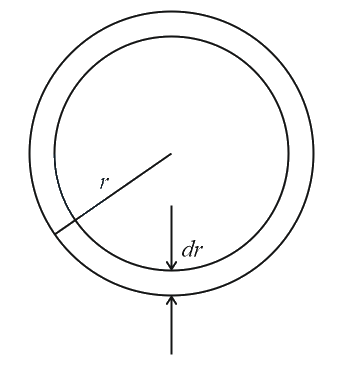
Let the radius of the drop at time t=tt=t be rr and at an instant t=t+dtt=t+dt be r−drr-dr

As surface area is given by,
A=4πr2A=4\pi {r}^{2},
∴∴ decrease in surface area is,
dA=4π(2rdr)dA=4\pi \left(2rdr\right)
∴∴ Decrease in surface energy during time dtdt is,
dU=TdA=T⋅8πrdr...(1)dU=TdA=T\cdot 8\pi rdr...\left(1\right)
Decrease in volume during time
dtdt is,
dV=4πr2drdV=4\pi {r}^{2}dr
∴∴ Decrease in mass during time dtdt is,
dm=ρdV=4πρr2drdm=\rho dV=4\pi \rho {r}^{2}dr
∴∴ Heat required in vaporisation is,
dQ=Ldm=4πρr2drL...(2)dQ=Ldm=4\pi \rho {r}^{2}drL...\left(2\right)
Apply conservation of energy,

decrease in surface energy
==heat required in vaporisation.
⇒dU=dQ\Rightarrow dU=dQ
⇒8Tπrdr=4πρr2drL\Rightarrow 8T\pi rdr=4\pi \rho {r}^{2}drL
⇒2T=ρrL\Rightarrow 2T=\rho rL
⇒r=2TρL\Rightarrow r=\dfrac{2T}{\rho L}
Hence, the minimum radius is
2TρL\dfrac{2T}{\rho L}

Full year-wise papers: JEE Main question papers (PDF)

Explain it as a whiteboard videoStep-by-step, in Hinglish or English. The written solution is free, and so is your first video.Solved it on paper but got it wrong?Upload a photo of your working. Mistake Doctor marks the exact line that broke.
Learn Surface tension in depthA teacher-style lesson with diagrams, derivations and exam questions.Take a test on Surface tensionTimed questions, then a report on what to revise.

Learn the concept

Mechanical Properties of Fluids — Pressure, Pascal and ArchimedesClass 11 Physics lesson with diagrams, worked examples and a quick check.
See it move: Fluid mechanics simulationDrag the sliders and watch the numbers in this question change.

More questions on Surface tension