Kinematics

JEE Main level, single correct, medium

109 of 308

Question 109 of 308

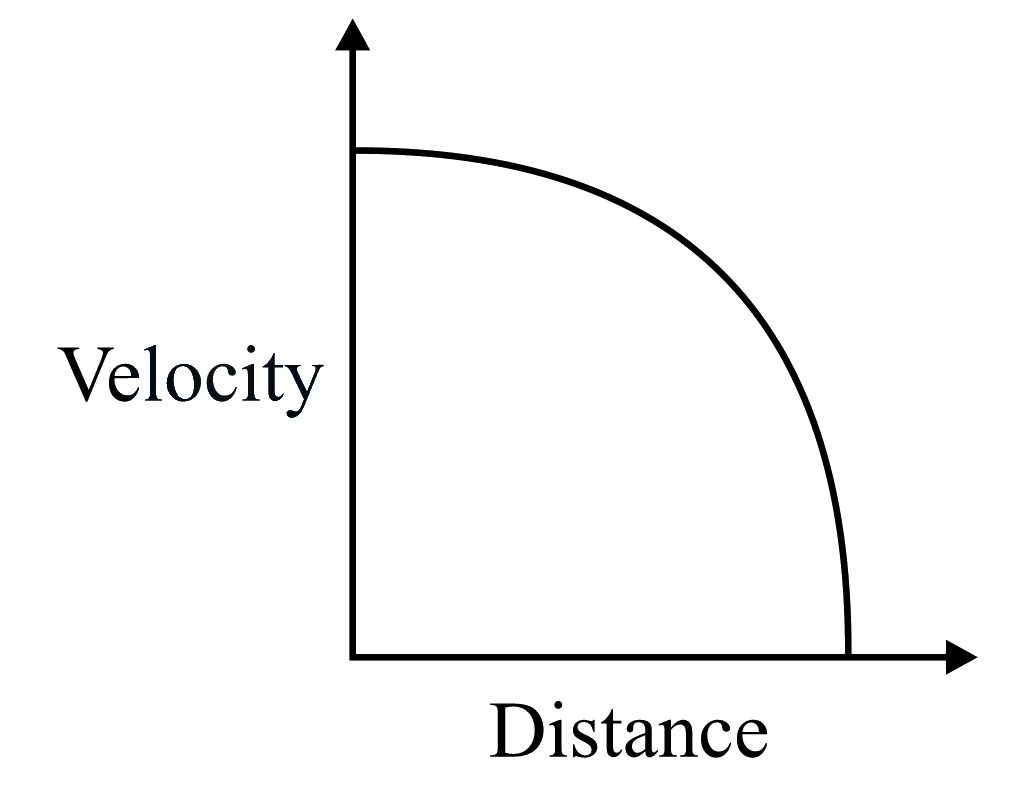
Which graph corresponds to an object moving with a constant negative acceleration and a positive velocity?

Show answer and solution

Answer: (C)
Let acceleration be aa.
Given that
a=−Ca=-C
We know that,
a=a=vdvdx=−C\dfrac{vdv}{dx}=-C
vdv=−Cdxvdv=-Cdx
Integrating the above equation,

v22=−Cx+k\dfrac{{v}^{2}}{2}=-Cx+k.
Thus, the velocity-distance graph is


The distance cover by the object is
x=−v22C+kCx=-\dfrac{{v}^{2}}{2C}+\dfrac{k}{C}.
Thus, with the increase in distance, velocity decreases.

Now,
a=−C=dvdta=-C=\dfrac{dv}{dt}
⇒dv=−Cdt⇒v=−Ct+u,(straight line)\Rightarrow dv=-Cdt \Rightarrow v=-Ct+u,\left(\text{straight line}\right)

Full year-wise papers: JEE Main question papers (PDF)

Explain it as a whiteboard videoStep-by-step, in Hinglish or English. The written solution is free, and so is your first video.Solved it on paper but got it wrong?Upload a photo of your working. Mistake Doctor marks the exact line that broke.
Learn Graphs of motion in one dimension in depthA teacher-style lesson with diagrams, derivations and exam questions.Take a test on Graphs of motion in one dimensionTimed questions, then a report on what to revise.

Learn the concept

Units and Measurement — Physical quantities and SI unitsClass 11 Physics lesson with diagrams, worked examples and a quick check.
See it move: Projectile motion simulationDrag the sliders and watch the numbers in this question change.Revise Kinematics & Projectile Motion firstFormula sheet, solved examples and the traps students fall into.

More questions on Graphs of motion in one dimension