Oscillations

JEE Main level, single correct, medium

22 of 194

Question 22 of 194

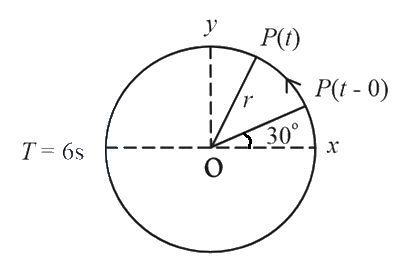
For particle PP revolving round the centre OO with radius of circular path rr and regular velocity ω\omega, as shown in below figure, the projection of OPOP on the xx-axis at time tt is
Figure for the Oscillations question: For particle P revolving round the centre O with radius of circular path r and regular…

Show answer and solution

Answer: (B) x(t)=rcos⁡(ωt+π6)x(t)=r\cos \left(\omega t+\dfrac{\pi }{6}\right)

As can be seen from the diagram, the initial phase of the particle is given by
ϕ=30∘=π6\begin{matrix}\phi & = & 30^{\circ} \\ & = & \dfrac{\pi }{6}\end{matrix}
The equation of motion of the particle at its initial position at time
t=0t=0 can be written as
x(t)=rcos⁡θ...(1)x\left(t\right)=r\cos \theta ...(1)
where,
θ\theta is the angular displacement of the particle at time t=tt=t.
Since, the position of the particle at a later instant of time always lags behind its initial position at time
t=0t=0, the equation of motion of the particle at any instant of time is given by
x(t)=rcos⁡(θ+ϕ)...(2)x\left(t\right)=r\cos \left(\theta +\phi \right)...\left(2\right)
Substitute the values of the known parameters into equation (2) to obtain the required expression

x(t)=rcos⁡(ωt+π6)x(t)=r\cos \left(\omega t+\dfrac{\pi }{6}\right)

Full year-wise papers: JEE Main question papers (PDF)

Explain it as a whiteboard videoStep-by-step, in Hinglish or English. The written solution is free, and so is your first video.Solved it on paper but got it wrong?Upload a photo of your working. Mistake Doctor marks the exact line that broke.
Learn Simple Harmonic Motion in depthA teacher-style lesson with diagrams, derivations and exam questions.Take a test on Simple Harmonic MotionTimed questions, then a report on what to revise.

Learn the concept

Oscillations — Simple harmonic motionClass 11 Physics lesson with diagrams, worked examples and a quick check.
See it move: Simple pendulum simulationDrag the sliders and watch the numbers in this question change.

More questions on Simple Harmonic Motion