Oscillations

JEE Main level, single correct, medium

32 of 194

Question 32 of 194

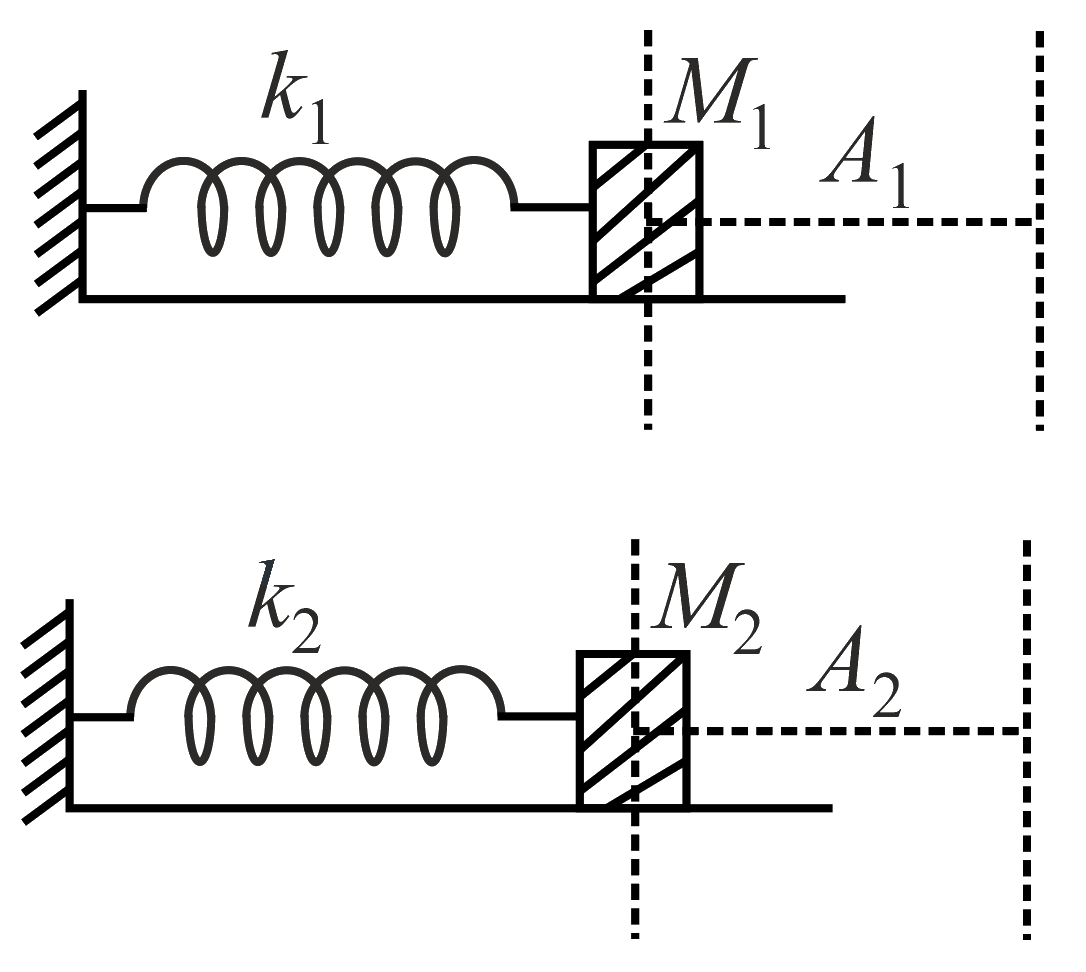
Two massless springs with spring constants 2k2k and 9k9k, carry 50g50g and 100g100g masses at their free ends. These two masses oscillate vertically such that their maximum velocities are equal. Then, the ratio of their respective amplitudes will be :

Show answer and solution

Answer: (A) 3:23:2

Maximum velocity is given by vmax⁡=ωA{v}_{\max }=\omega A =kmA=\sqrt{\dfrac{k}{m}}A

Here,
k1m1A1=k2m2A2\sqrt{\dfrac{{k}_{1}}{{m}_{1}}}{A}_{1}=\sqrt{\dfrac{{k}_{2}}{{m}_{2}}}{A}_{2}
⇒2k50×10−3A1=9k100×10−3A2\Rightarrow \sqrt{\dfrac{2k}{50\times {10}^{-3}}}{A}_{1}=\sqrt{\dfrac{9k}{100\times {10}^{-3}}}{A}_{2}
⇒2A1=3A2\Rightarrow 2{A}_{1}=3{A}_{2}
Thus, ratio of amplitude is
A1A2=32=3:2\dfrac{{A}_{1}}{{A}_{2}}=\dfrac{3}{2}=3:2.

Full year-wise papers: JEE Main question papers (PDF)

Explain it as a whiteboard videoStep-by-step, in Hinglish or English. The written solution is free, and so is your first video.Solved it on paper but got it wrong?Upload a photo of your working. Mistake Doctor marks the exact line that broke.
Learn Simple Harmonic Motion in depthA teacher-style lesson with diagrams, derivations and exam questions.Take a test on Simple Harmonic MotionTimed questions, then a report on what to revise.

Learn the concept

Oscillations — Simple harmonic motionClass 11 Physics lesson with diagrams, worked examples and a quick check.
See it move: Simple pendulum simulationDrag the sliders and watch the numbers in this question change.

More questions on Simple Harmonic Motion