Question 106 of 194
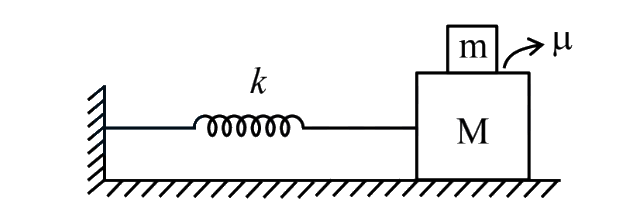
Two blocks of masses and , are placed on a frictionless table as shown in figure. A massless spring with spring constant k is attached with the lower block. If the system is slightly displaced and released then
( coefficient of friction between the two blocks)
(A) The time period of small oscillation of the two blocks is
(B) The acceleration of the blocks is ( displacement of the blocks from the mean position)
(C) The magnitude of the frictional force on the upper block is
(D) The maximum amplitude of the upper block, if it does not slip, is
(E) Maximum frictional force can be .
Choose the correct answer from the options given below:
Show answer and solution
Answer: (A) A, B, D Only
(A) As both blocks moving together so Time period where
(B) Let block is displaced by x in direction so force on block will be in(-ve) direction
(C) As upper block is moving due to friction thus
(D) This option is like two block problem in friction for maximum amplitude, force on block is also maximum, for which both blocks are moving together.
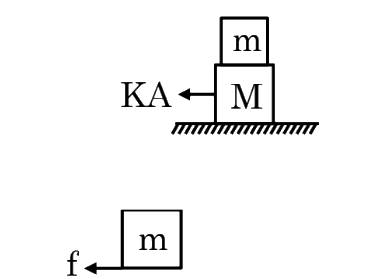
(E) Maximum friction can be as force is acting between blocks \& normal force here is mg.
(B) Let block is displaced by x in direction so force on block will be in(-ve) direction
(C) As upper block is moving due to friction thus
(D) This option is like two block problem in friction for maximum amplitude, force on block is also maximum, for which both blocks are moving together.
(E) Maximum friction can be as force is acting between blocks \& normal force here is mg.
%2C%20are%20placed%20on%20a%20frictionless%20table%20as%20shown%20in%20figure.%20A%20massless%20spring%20with%20spring%20constant%20k%20is%20attached%20with%20the%20lower%20block.%20If%20the%20system%20is%20slightly%20displaced%20and%20released%20then%20(%CE%BC%3D%20coefficient%20of%20friction%20between%20the%20two%20blocks)%20%3Cimg%20src%3D%22%2Fpractice%2Fpyq%2Foscillations1031329.png%22%3E%20(A)%20The%20time%20period%20of%20small%20oscillation%20of%20the%20two%20blocks%20is%20T%3D2%20%CF%80%20%E2%88%9A(((~m%2BM))%2F(k))%20(B)%20The%20acceleration%20of%20the%20blocks%20is%20a%3D(kx)%2F(M%2Bm)%20(x%3D%20displacement%20of%20the%20blocks%20from%20the%20mean%20position)%20(C)%20The%20magnitude%20of%20the%20frictional%20force%20on%20the%20upper%20block%20is%20(m%20%CE%BC%7Cx%7C)%2F(M%2Bm)%20(D)%20The%20maximum%20amplitude%20of%20the%20upper%20block%2C%20if%20it%20does%20not%20slip%2C%20is%20(%CE%BC(M%2Bm)%20g)%2F(k)%20(E)%20Maximum%20frictional%20force%20can%20be%20%CE%BC(M%2Bm)%20g.%20Choose%20the%20correct%20answer%20from%20the%20options%20given%20below%3A%0A(A)%20A%2C%20B%2C%20D%20Only%0A(B)%20B%2C%20C%2C%20D%20Only%0A(C)%20C%2C%20D%2C%20E%20Only%0A(D)%20A%2C%20B%2C%20C%20Only)