Ray Optics

JEE Main level, single correct, medium

174 of 295

Question 174 of 295

When a beam of white light is allowed to pass through convex lens parallel to principal axis, the different colours of light converge at different point on the principle axis after refraction. This is called :

Show answer and solution

Answer: (B) Chromatic aberration
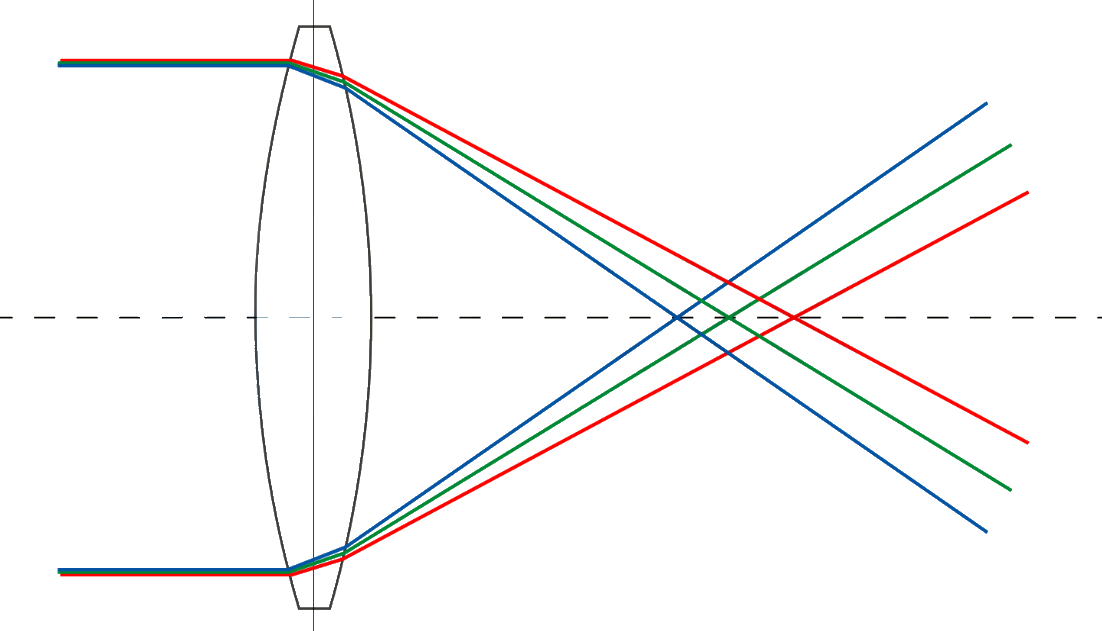

Due to difference in refractive index of a material for different wavelengths, the focal length will be different for different colours. This will cause a separation of parallel beam of white light. This phenomenon is known as chromatic aberration.

Polarisation is a property applying to transverse waves that specify the geometrical orientation of the oscillations.

When energy waves (such as light, sound, and various electromagnetic waves) are caused to depart from a straight path due to imperfections in the medium it is called Scattering.

Spherical aberration is present when the outer parts of a lens do not bring light rays into the same focus as the central part.

Full year-wise papers: JEE Main question papers (PDF)

Explain it as a whiteboard videoStep-by-step, in Hinglish or English. The written solution is free, and so is your first video.Solved it on paper but got it wrong?Upload a photo of your working. Mistake Doctor marks the exact line that broke.
Learn Lens Formula, Refraction of light from curved surface in depthA teacher-style lesson with diagrams, derivations and exam questions.Take a test on Lens Formula, Refraction of light from curved surfaceTimed questions, then a report on what to revise.

Learn the concept

Ray Optics — Mirror and lens formulasClass 12 Physics lesson with diagrams, worked examples and a quick check.
See it move: Lens ray diagram simulationDrag the sliders and watch the numbers in this question change.Revise Ray Optics firstFormula sheet, solved examples and the traps students fall into.

More questions on Lens Formula, Refraction of light from curved surface