Rotational Motion

JEE Main level, single correct, medium

228 of 280

Question 228 of 280

A particle of mass 2kg2kg is on a smooth horizontal table and moves in a circular path of radius 0.6m0.6m. The height of the table from the ground is 0.8m0.8m. If the angular speed of the particle is 12rads−112rad{s}^{-1} , the magnitude of its angular momentum about a point on the ground right under the center of the circle is:

Show answer and solution

Answer: (A) 14.4kgm2s−114.4kg{m}^{2}{s}^{-1}
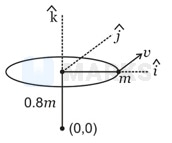


p⃗=mvj^=2×vj^=2×0.6×12=7.2×2=14.4j^(v=rω)\vec{p}=mv\hat{j}=2\times v\hat{j}=2\times 0.6\times 12=7.2\times 2=14.4\hat{j}\left(v=r\omega \right)

r⃗=(0.8k^+0.6i^)\vec{r}=(0.8\hat{k}+0.6\hat{i})⇒L⃗=r⃗×p⃗\Rightarrow \vec{L}=\vec{r}\times \vec{p}

=(0.6i^+0.8k^)×14.4j^=\left(0.6\hat{i}+0.8\hat{k}\right)\times 14.4\hat{j}

=0.6×14.4k^−0.8×14.4i^=0.6\times 14.4\hat{k}-0.8\times 14.4\hat{i}

=14.4(0.6k^−0.8i^)=14.4\left(0.6\hat{k}-0.8\hat{i}\right)

⇒∣L⃗∣\Rightarrow |\vec{L}|=14.4(0.6)2+(0.8)2=14.4\sqrt{{\left(0.6\right)}^{2}+{\left(0.8\right)}^{2}}

=14.40.36+0.64=14.4\sqrt{0.36+0.64}

=14.4×1=14.4\times 1

=14.4kgm2s−1=14.4kg{m}^{2}{s}^{-1}

Full year-wise papers: JEE Main question papers (PDF)

Explain it as a whiteboard videoStep-by-step, in Hinglish or English. The written solution is free, and so is your first video.Solved it on paper but got it wrong?Upload a photo of your working. Mistake Doctor marks the exact line that broke.
Learn Angular momentum and Angular impulse in depthA teacher-style lesson with diagrams, derivations and exam questions.Take a test on Angular momentum and Angular impulseTimed questions, then a report on what to revise.

Learn the concept

System of Particles and Rotational Motion — Centre of mass and torqueClass 11 Physics lesson with diagrams, worked examples and a quick check.
See it move: Rotational dynamics and rolling simulationDrag the sliders and watch the numbers in this question change.Revise Rotational Motion firstFormula sheet, solved examples and the traps students fall into.

More questions on Angular momentum and Angular impulse