Thermodynamics

JEE Main level, single correct, medium

78 of 190

Question 78 of 190

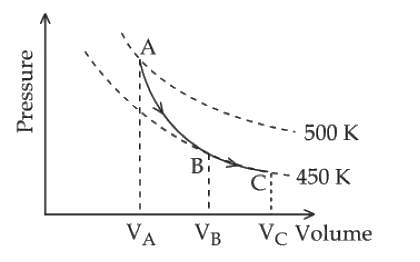
Figure for the Thermodynamics question: <img src="/practice/pyq/thermodynamics751167.png"> A poly-atomic molecule ( CV=3 R, CP=4…

A poly-atomic molecule (
CV=3R,CP=4RC_V=3 R, C_P=4 R, where RR is gas constant) goes from phase space point A(PA=105 Pa, VA=4×10⁻⁶ m3)\mathrm{A}\left(\mathrm{P}_{\mathrm{A}}=10^5 \mathrm{~Pa}, \mathrm{~V}_{\mathrm{A}}=4 \times 10^{-6} \mathrm{~m}^3\right) to point B(PB=5×10⁴ Pa, VB=6×10⁻⁶ m3)\mathrm{B}\left(\mathrm{P}_{\mathrm{B}}=5 \times 10^4 \mathrm{~Pa}, \mathrm{~V}_{\mathrm{B}}=6 \times 10^{-6} \mathrm{~m}^3\right) to point C(PC=104\mathrm{C}\left(\mathrm{P}_{\mathrm{C}}=10^4\right. Pa,VC=8×10⁻⁶ m3)\left.\mathrm{Pa}, \mathrm{V}_{\mathrm{C}}=8 \times 10^{-6} \mathrm{~m}^3\right). A to B is an adiabatic path and BB to CC is an isothermal path.
The net heat absorbed per unit mole by the system is :

Show answer and solution

Answer: (B) 450R(ln⁡4−ln⁡3)450 \mathrm{R}(\ln 4-\ln 3)

ΔQAB=0 adiabatic ΔQBC=ΔWBC=nRTℓn(VCVB)=450Rℓn(8×10−66×10−6)=450Rℓn(43)=450R(ln⁡4−ℓn3)∴ΔQ=ΔQAB+ΔQBCΔQ=450R(ℓn4−ℓn3)\begin{aligned} & \Delta \mathrm{Q}_{\mathrm{AB}}=0 \text { adiabatic } \\ & \Delta \mathrm{Q}_{\mathrm{BC}}=\Delta \mathrm{W}_{\mathrm{BC}} \\ & =\mathrm{nRT} \ell \mathrm{n}\left(\frac{\mathrm{V}_{\mathrm{C}}}{\mathrm{V}_{\mathrm{B}}}\right)=450 \mathrm{R} \ell \mathrm{n}\left(\frac{8 \times 10^{-6}}{6 \times 10^{-6}}\right) \\ & =450 \mathrm{R} \ell \mathrm{n}\left(\frac{4}{3}\right)=450 \mathrm{R}(\ln 4-\ell \mathrm{n} 3) \\ & \therefore \Delta \mathrm{Q}=\Delta \mathrm{Q}_{\mathrm{AB}}+\Delta \mathrm{Q}_{\mathrm{BC}} \\ & \Delta \mathrm{Q}=450 \mathrm{R}(\ell \mathrm{n} 4-\ell \mathrm{n} 3)\end{aligned}

Full year-wise papers: JEE Main question papers (PDF)

Explain it as a whiteboard videoStep-by-step, in Hinglish or English. The written solution is free, and so is your first video.Solved it on paper but got it wrong?Upload a photo of your working. Mistake Doctor marks the exact line that broke.
Learn Thermodynamic Processes in depthA teacher-style lesson with diagrams, derivations and exam questions.Take a test on Thermodynamic ProcessesTimed questions, then a report on what to revise.

Learn the concept

Thermodynamics — Zeroth and first lawsClass 11 Physics lesson with diagrams, worked examples and a quick check.

More questions on Thermodynamic Processes