Wave Optics

JEE Main level, single correct, medium

164 of 191

Question 164 of 191

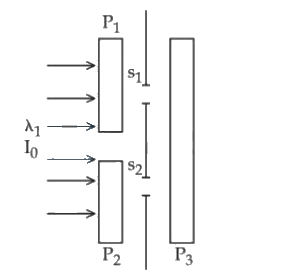
In a Young's double slit experiment, three polarizers are kept as shown in the figure. The transmission axes of P1P_1 and P2P_2 are orthogonal to each other. The polarizer P3P_3 covers both the slits with its transmission axis at 45∘45^{\circ} to those of P1P_1 and P2P_2. An unpolarized light of wavelength λ\lambda and intensity I0I_0 is incident on P1P_1 and P2P_2. The intensity at a point after P3P_3 where the path difference between the light waves from s1s_1 and s2s_2 is λ3\frac{\lambda}{3}, is
Figure for the Wave Optics question: In a Young's double slit experiment, three polarizers are kept as shown in the figure.…

Show answer and solution

Answer: (B) I04\frac{I_0}{4}


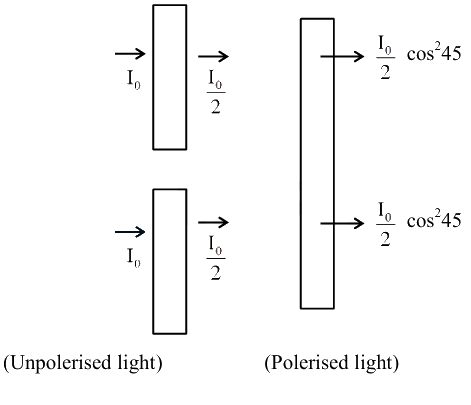
after passing through third poleriser, Intensity of both the waves must be
I04\frac{\mathrm{I}_0}{4}
now, at a point where path diff is
λ3\frac{\lambda}{3}, phase difference
Δϕ=2 K(Δxλ)=2π3∴Ires=(I04)2+(I04)2+2(I04)2cos⁡2π3=I04\begin{aligned} & \Delta \phi=2 \mathrm{~K}\left(\frac{\Delta \mathrm{x}}{\lambda}\right)=\frac{2 \pi}{3} \\ & \therefore \mathrm{I}_{\mathrm{res}}=\sqrt{\left(\frac{\mathrm{I}_0}{4}\right)^2+\left(\frac{\mathrm{I}_0}{4}\right)^2+2\left(\frac{\mathrm{I}_0}{4}\right)^2} \cos \frac{2 \pi}{3} \\ & =\frac{\mathrm{I}_0}{4} \end{aligned}

Full year-wise papers: JEE Main question papers (PDF)

Explain it as a whiteboard videoStep-by-step, in Hinglish or English. The written solution is free, and so is your first video.Solved it on paper but got it wrong?Upload a photo of your working. Mistake Doctor marks the exact line that broke.
Learn Polarization of Light in depthA teacher-style lesson with diagrams, derivations and exam questions.Take a test on Polarization of LightTimed questions, then a report on what to revise.

Learn the concept

Wave Optics — Young’s double-slit experimentClass 12 Physics lesson with diagrams, worked examples and a quick check.
See it move: Wave optics: YDSE, diffraction and polarisation simulationDrag the sliders and watch the numbers in this question change.

More questions on Polarization of Light