Mathematics · Class 12 / JEE Main & Advanced
Area Under Curves: Definite Integral Applications
Master geometric integration: Area bounded by single curves, area between two intersecting curves, symmetry shortcuts (parabola-line, ellipse area ), and vertical vs horizontal integration strips.
11. Visual Overview & Intuitive Discovery: Area Under Curves: Definite Integral Applications
🔍 Clickable Interactive Study Prompts (Click to explore or jump to section):
Clickable### Intuitive Foundations & Real-World Reality
In 250 BC, Archimedes of Syracuse calculated the exact area of a parabolic segment using the Method of Exhaustion—summing an infinite geometric series of inscribed triangles. Nearly two millennia later, Newton and Leibniz unified this with the Fundamental Theorem of Calculus: the exact geometric area enclosed by any curved boundary is the definite integral of the differential height strips ().
 Full size
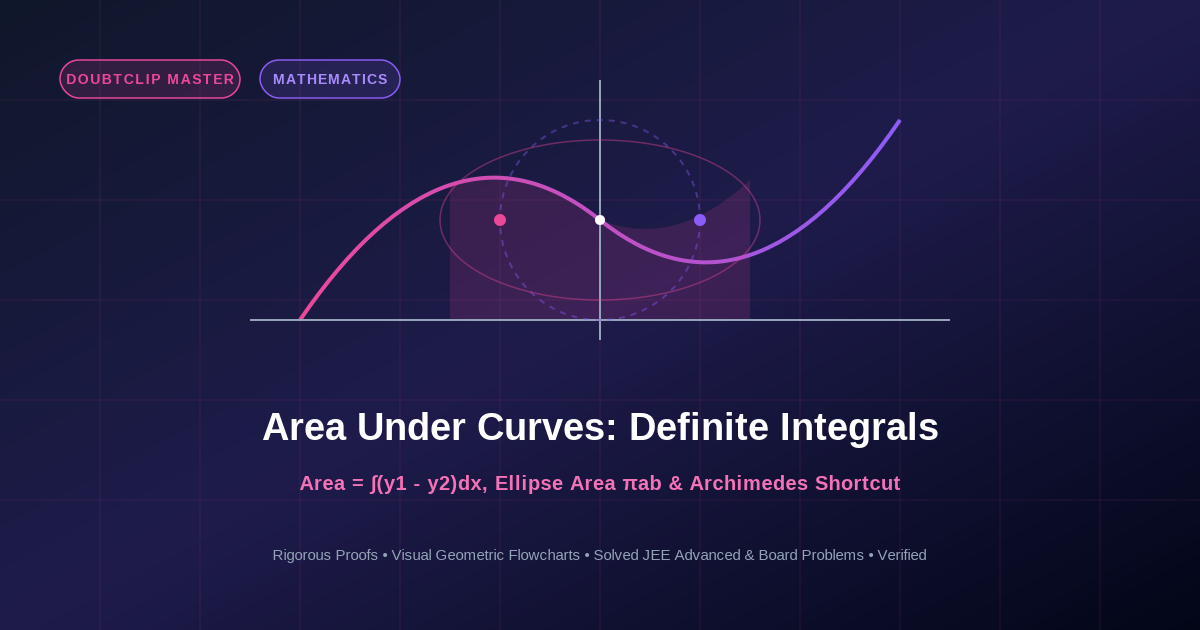
Area Under Curves: Definite Integral Applications Conceptual Framework
Master geometric integration: Area bounded by single curves, area between two intersecting curves, symmetry shortcuts (parabola-line, ellipse area $\pi ab$), and vertical vs horizontal integration strips.
- 1Core Anchor 1 — Proof of Ellipse Area Formula: Area = π a b via Integration
- 2Core Anchor 2 — Archimedes Parabolic Segment Shortcut: Area = (2/3) Base × Height
- 3Core Anchor 3 — Vertical (dx) vs Horizontal (dy) Strip Integration Strategy
- 4Core Anchor 4 — Area Enclosed Between Parabola y² = 4ax and Line y = mx
22. Concept & Decision Flowchart: Area Under Curve Solution Protocol Flowchart
Area Under Curve Solution Protocol Flowchart
- 1
1. Sketch the Curves & Find Intersections
Solve simultaneous equations to determine boundary coordinates and points of intersection (a and b).
- 2
2. Choose Integration Strip
Vertical strips (dx): Area = ∫ [y_upper - y_lower] dx. Horizontal strips (dy): Area = ∫ [x_right - x_left] dy.
- 3
3. Check for Region Splitting
If the upper or lower boundary curve changes identity, split the integral at that transition x-coordinate into two separate integrals.
- 4
4. Symmetry Exploitation
For symmetrical shapes (circles, ellipses, symmetric parabolas), integrate over one quadrant and multiply by symmetry factor (e.g. 4 for ellipse).
33. Step-by-Step Derivation: Area of an Ellipse x²/a² + y²/b² = 1 is π a b
Derivation — Step-by-Step Derivation: Area of an Ellipse x²/a² + y²/b² = 1 is π a b
- 1
Due to fourfold reflection symmetry across coordinate axes, total area is 4 times the first quadrant.
- 2
Substituting x = a sin θ eliminates the square root.
- 3
Factoring out constants a and b.
- 4
When a = b = r (circle), this seamlessly reduces to the famous formula π r².
44. Real-World Case Study & Industrial Application
### Civil Engineering: Dam Reservoir Capacity & Hydrostatic Pressure
Civil engineers designing concrete arch dams (such as Hoover Dam) calculate total water volume and overturning moment by integrating cross-sectional area contours: V = ∫ A(z) dz from the riverbed to crest elevation. Definite integration calculates the exact center of pressure, ensuring dam wall thickness resists hydrostatic thrust during maximum flood stages.
55. High-Yield Reference Data & Solved Problems
High-Yield Comparison & Key Constants
| Enclosed Region | Integration Formula | Shortcut / Standard Result |
|---|---|---|
| ∫_a^b [f(x) - g(x)] dx | f(x) ≥ g(x) on [a, b] | |
| Ellipse x²/a² + y²/b² = 1 | 4 (b/a) ∫_0^a √(a² - x²) dx | Area = π a b |
| Parabola y² = 4ax and line y = mx | ∫ [y_parabola - y_line] dx | Area = 8 a² / (3 m³) |
| Parabola y² = 4ax and x² = 4by | ∫ [√(4ax) - x²/(4b)] dx |
- Integration Formula
- ∫_a^b [f(x) - g(x)] dx
- Shortcut / Standard Result
- f(x) ≥ g(x) on [a, b]
Ellipse x²/a² + y²/b² = 1
- Integration Formula
- 4 (b/a) ∫_0^a √(a² - x²) dx
- Shortcut / Standard Result
- Area = π a b
Parabola y² = 4ax and line y = mx
- Integration Formula
- ∫ [y_parabola - y_line] dx
- Shortcut / Standard Result
- Area = 8 a² / (3 m³)
Parabola y² = 4ax and x² = 4by
- Integration Formula
- ∫ [√(4ax) - x²/(4b)] dx
- Shortcut / Standard Result
Exam question · JEE Main, Advanced & NEET Standard
- 1. Find intersection points by setting equations equal: x² = x -> x² - x = 0 -> x(x - 1) = 0.
- Intersections occur at x = 0 and x = 1.
- 2. On the interval [0, 1], the line y = x lies above the parabola y = x² (e.g., at x = 0.5: line = 0.5, parabola = 0.25).
- 3. Set up the vertical strip integral:
- Area = ∫_{0}^{1} [y_upper - y_lower] dx = ∫_{0}^{1} (x - x²) dx.
- 4. Evaluate the definite integral:
- Area = [ x²/2 - x³/3 ]_{0}^{1} = (1/2 - 1/3) - (0 - 0) = 3/6 - 2/6 = 1/6 square units.
Answer: 1. Find intersection points by setting equations equal: x² = x -> x² - x = 0 -> x(x - 1) =
0. Intersections occur at x = 0 and x =
1. 2. On the interval [0, 1], the line y = x lies above the parabola y = x² (e.g., at x = 0.5: line = 0.5, parabola = 0.25).
3. Set up the vertical strip integral:
Area = ∫_{0}^{1} [y_upper - y_lower] dx = ∫_{0}^{1} (x - x²) dx.
4. Evaluate the definite integral:
Area = [ x²/2 - x³/3 ]_{0}^{1} = (1/2 - 1/3) - (0 - 0) = 3/6 - 2/6 = 1/6 square units.
What it tests: Tests rigorous conceptual mastery, dimensional analysis, and multi-step deduction.
Remember
- Area Under Curves: Definite Integral Applications: Foundational law governing physical, chemical, and biological phenomena.
- Mastered derivation: Area of an Ellipse x²/a² + y²/b² = 1 is π a b.
- Avoided classic trap: If a curve dips below the x-axis, integrating ∫ f(x) dx yields a NEGATIVE value! Geometric area is strictly no...
- Real-world relevance: Proven clinical, aerospace, and industrial significance.
- High-yield exam rule: Always verify dimensional consistency and physical boundary conditions.
Check yourself
Question 1
What is the primary governing principle of Area Under Curves: Definite Integral Applications?Question 2
In competitive examinations (JEE/NEET), what is the most critical pitfall in Area Under Curves: Definite Integral Applications?