Chapter 25 · Class 11-12 & JEE Main/Adv
Area Under Curves
21 topics · 8 sections · beginner-friendly study notes · Updated
Areas between curves are computed by integrating the difference of upper and lower functions, or left/right functions with respect to y.
Sketching to find intersection points is mandatory.
Areas under polar curves and volumes of revolution (discs/shells) appear in extended syllabi; JEE Main focuses on Cartesian plane regions.
Fluency in Area under Curves means recognising which identity applies, executing algebra with domain discipline, and interpreting results so multi-step JEE problems become short chains of steps.
Area under Curves is a high-frequency JEE strand: weak technique here blocks multi-concept questions that mix geometric area via integration with algebra, calculus or coordinate geometry.
Applied STEM models routinely reduce to geometric area via integration; the same identities tested in classroom proofs appear in timed numericals.
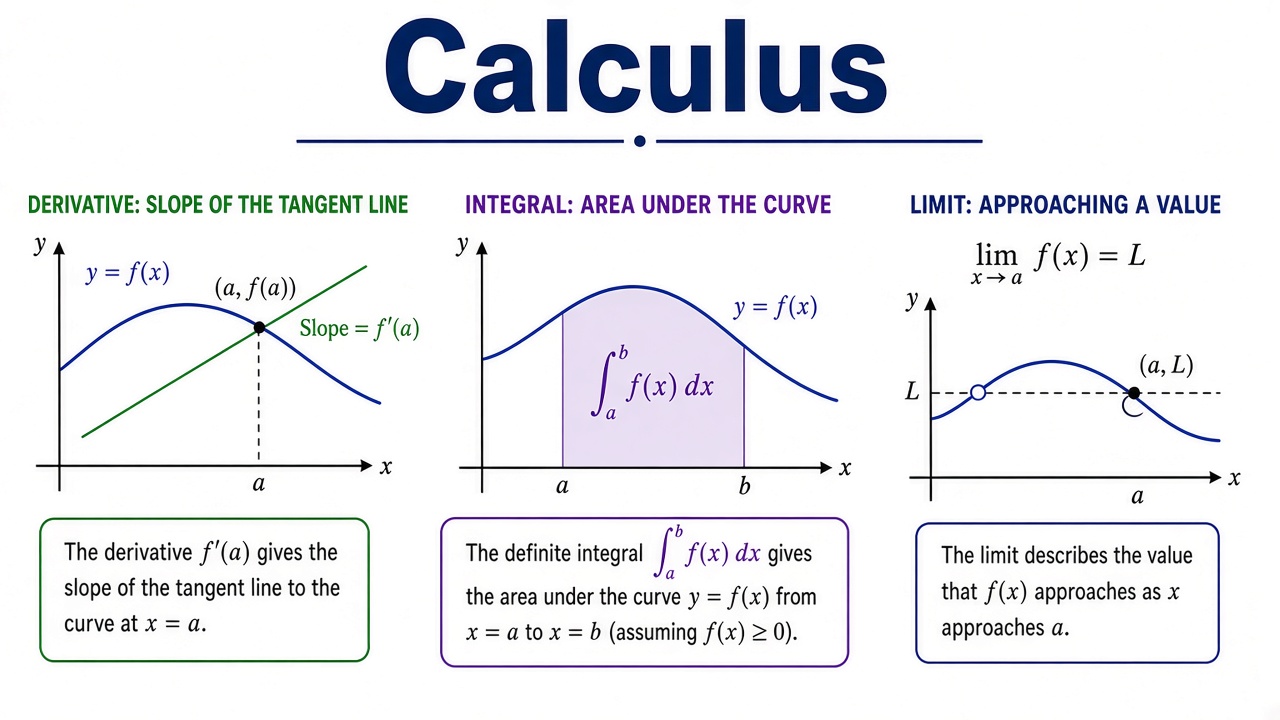
Area under y=f(x)
A=∫_a^b |f(x)| dx for area between curve and x-axis; split where f changes sign.
In short: Integrate height; absolute value for geometric area.
Think about it
Basic area. Area under Curves appears whenever geometric area via integration structures quantities or shapes.
Find zeros to split; do not cancel signed areas unintentionally.
Standard manipulations for Area under y=f(x) include clearing parameters carefully, checking equality cases, and rewriting expressions so the governing formula applies directly.
When several identities seem possible, prefer the one whose hypotheses are already verified by the given data in geometric area via integration.
A clean board layout names the identity, substitutes symbols, simplifies reversibly, and only then matches options — preventing the common error of using Area under y=f(x) outside its domain in geometric area via integration.
In exam solutions involving Area under y=f(x), state hypotheses first, rewrite into canonical form, and verify endpoints or extraneous roots before selecting an option.
Domain restrictions and equality cases for Area under Curves often separate the correct choice from near-miss algebra.
Keep equivalent forms ready (factored vs expanded, parametric vs Cartesian, exponential vs logarithmic) so mid-solution switches do not introduce errors.
A reliable layout is: domain note, governing identity, one idea per line, boxed answer, rejection of illegal candidates.
Typical JEE mistakes around Area under y=f(x) include dropping absolute values, ignoring restricted ranges, and applying a formula outside its hypothesis set — name the theorem you use and check every hypothesis explicitly before simplifying.
When a question mixes Area under y=f(x) with neighbouring ideas from Area under Curves, isolate the local identity first, finish that block, then reconnect to the global unknown; this compartmentalisation keeps algebra short and makes substitution errors obvious at the join points.
Numeric sanity checks (signs, dimensions, special values such as 0 or 1) catch many wrong options before you invest in heavy simplification.
Key points
- Hypothesis: Conditions required before applying Area under y=
f(x). - Canonical form: Standard shape matching the theorem statement.
- Write domain/hypotheses before transforming.
- Reject extraneous roots after back-substitution.
- Simplify to match JEE option formats.
Area under y=f(x)
- … — See definition (—)
Area Between Two Curves
A=∫_a^b |f−g| dx with a,b intersection abscissae; equivalently ∫|x_right−x_left| dy.
In short: Integrate the vertical (or horizontal) gap.
Think about it
Standard contest pattern. Area under Curves appears whenever geometric area via integration structures quantities or shapes.
Solve f(x)=g(x) for limits; sketch which is above.
Standard manipulations for Area Between Two Curves include clearing parameters carefully, checking equality cases, and rewriting expressions so the governing formula applies directly.
When several identities seem possible, prefer the one whose hypotheses are already verified by the given data in geometric area via integration.
A clean board layout names the identity, substitutes symbols, simplifies reversibly, and only then matches options — preventing the common error of using Area Between Two Curves outside its domain in geometric area via integration.
In exam solutions involving Area Between Two Curves, state hypotheses first, rewrite into canonical form, and verify endpoints or extraneous roots before selecting an option.
Domain restrictions and equality cases for Area under Curves often separate the correct choice from near-miss algebra.
Keep equivalent forms ready (factored vs expanded, parametric vs Cartesian, exponential vs logarithmic) so mid-solution switches do not introduce errors.
A reliable layout is: domain note, governing identity, one idea per line, boxed answer, rejection of illegal candidates.
Typical JEE mistakes around Area Between Two Curves include dropping absolute values, ignoring restricted ranges, and applying a formula outside its hypothesis set — name the theorem you use and check every hypothesis explicitly before simplifying.
When a question mixes Area Between Two Curves with neighbouring ideas from Area under Curves, isolate the local identity first, finish that block, then reconnect to the global unknown; this compartmentalisation keeps algebra short and makes substitution errors obvious at the join points.
Numeric sanity checks (signs, dimensions, special values such as 0 or 1) catch many wrong options before you invest in heavy simplification.
Key points
- Hypothesis: Conditions required before applying Area Between Two Curves.
- Canonical form: Standard shape matching the theorem statement.
- Write domain/hypotheses before transforming.
- Reject extraneous roots after back-substitution.
- Simplify to match JEE option formats.
Choosing dx vs dy
Prefer dx when functions of x are natural; dy when curves give x=g(y) more simply (e.g. sideways parabolas).
In short: Slice in the direction that makes one integral.
Think about it
Technique choice. Area under Curves appears whenever geometric area via integration structures quantities or shapes.
Sometimes split region into two dx integrals vs one dy.
Standard manipulations for Choosing dx vs dy include clearing parameters carefully, checking equality cases, and rewriting expressions so the governing formula applies directly.
When several identities seem possible, prefer the one whose hypotheses are already verified by the given data in geometric area via integration.
A clean board layout names the identity, substitutes symbols, simplifies reversibly, and only then matches options — preventing the common error of using Choosing dx vs dy outside its domain in geometric area via integration.
In exam solutions involving Choosing dx vs dy, state hypotheses first, rewrite into canonical form, and verify endpoints or extraneous roots before selecting an option.
Domain restrictions and equality cases for Area under Curves often separate the correct choice from near-miss algebra.
Keep equivalent forms ready (factored vs expanded, parametric vs Cartesian, exponential vs logarithmic) so mid-solution switches do not introduce errors.
A reliable layout is: domain note, governing identity, one idea per line, boxed answer, rejection of illegal candidates.
Typical JEE mistakes around Choosing dx vs dy include dropping absolute values, ignoring restricted ranges, and applying a formula outside its hypothesis set — name the theorem you use and check every hypothesis explicitly before simplifying.
When a question mixes Choosing dx vs dy with neighbouring ideas from Area under Curves, isolate the local identity first, finish that block, then reconnect to the global unknown; this compartmentalisation keeps algebra short and makes substitution errors obvious at the join points.
Numeric sanity checks (signs, dimensions, special values such as 0 or 1) catch many wrong options before you invest in heavy simplification.
Key points
- Hypothesis: Conditions required before applying Choosing dx vs dy.
- Canonical form: Standard shape matching the theorem statement.
- Write domain/hypotheses before transforming.
- Reject extraneous roots after back-substitution.
- Simplify to match JEE option formats.
Common Regions
Circle quadrants, ellipse area πab, parabola y²=4ax with line, common area of circle and parabola.
In short: Standard figures recur.
Think about it
Speed on classics. Area under Curves appears whenever geometric area via integration structures quantities or shapes.
Use symmetry to multiply a first-quadrant integral by 4 when justified.
Standard manipulations for Common Regions include clearing parameters carefully, checking equality cases, and rewriting expressions so the governing formula applies directly.
When several identities seem possible, prefer the one whose hypotheses are already verified by the given data in geometric area via integration.
A clean board layout names the identity, substitutes symbols, simplifies reversibly, and only then matches options — preventing the common error of using Common Regions outside its domain in geometric area via integration.
In exam solutions involving Common Regions, state hypotheses first, rewrite into canonical form, and verify endpoints or extraneous roots before selecting an option.
Domain restrictions and equality cases for Area under Curves often separate the correct choice from near-miss algebra.
Keep equivalent forms ready (factored vs expanded, parametric vs Cartesian, exponential vs logarithmic) so mid-solution switches do not introduce errors.
A reliable layout is: domain note, governing identity, one idea per line, boxed answer, rejection of illegal candidates.
Typical JEE mistakes around Common Regions include dropping absolute values, ignoring restricted ranges, and applying a formula outside its hypothesis set — name the theorem you use and check every hypothesis explicitly before simplifying.
When a question mixes Common Regions with neighbouring ideas from Area under Curves, isolate the local identity first, finish that block, then reconnect to the global unknown; this compartmentalisation keeps algebra short and makes substitution errors obvious at the join points.
Numeric sanity checks (signs, dimensions, special values such as 0 or 1) catch many wrong options before you invest in heavy simplification.
Key points
- Hypothesis: Conditions required before applying Common Regions.
- Canonical form: Standard shape matching the theorem statement.
- Write domain/hypotheses before transforming.
- Reject extraneous roots after back-substitution.
- Simplify to match JEE option formats.
Variable Limits / Parameter
Area as function of a parameter; maximise area via derivatives; inequalities on areas.
In short: Area expressions can themselves be optimised.
Think about it
Mixed calculus problems. Area under Curves appears whenever geometric area via integration structures quantities or shapes.
Differentiate under integral or differentiate the closed form.
Standard manipulations for Variable Limits / Parameter include clearing parameters carefully, checking equality cases, and rewriting expressions so the governing formula applies directly.
When several identities seem possible, prefer the one whose hypotheses are already verified by the given data in geometric area via integration.
A clean board layout names the identity, substitutes symbols, simplifies reversibly, and only then matches options — preventing the common error of using Variable Limits / Parameter outside its domain in geometric area via integration.
In exam solutions involving Variable Limits / Parameter, state hypotheses first, rewrite into canonical form, and verify endpoints or extraneous roots before selecting an option.
Domain restrictions and equality cases for Area under Curves often separate the correct choice from near-miss algebra.
Keep equivalent forms ready (factored vs expanded, parametric vs Cartesian, exponential vs logarithmic) so mid-solution switches do not introduce errors.
A reliable layout is: domain note, governing identity, one idea per line, boxed answer, rejection of illegal candidates.
Typical JEE mistakes around Variable Limits / Parameter include dropping absolute values, ignoring restricted ranges, and applying a formula outside its hypothesis set — name the theorem you use and check every hypothesis explicitly before simplifying.
When a question mixes Variable Limits / Parameter with neighbouring ideas from Area under Curves, isolate the local identity first, finish that block, then reconnect to the global unknown; this compartmentalisation keeps algebra short and makes substitution errors obvious at the join points.
Numeric sanity checks (signs, dimensions, special values such as 0 or 1) catch many wrong options before you invest in heavy simplification.
Key points
- Hypothesis: Conditions required before applying Variable Limits / Parameter.
- Canonical form: Standard shape matching the theorem statement.
- Write domain/hypotheses before transforming.
- Reject extraneous roots after back-substitution.
- Simplify to match JEE option formats.
Comparisons
Signed vs geometric area
| Signed ∫f | Geometric | |
|---|---|---|
| Below x-axis | Negative | Positive via |f| |
| Use | Net | Shading problems |
Educational Significance: Read the question: net or area?
Solved examples
Area under y=x from 0 to 2?
Answer
Formula Applied:—Approach note: Triangle.
Area of y=√x, x-axis, x=4?
Answer
Formula Applied:—Approach note: Standard.
Area of circle x²+y²=r²?
Answer
Formula Applied:—Approach note: Geometry.
Area between y=x and y=x²?
Answer
Formula Applied:—Approach note: Classic.
Real-world applications
Area under Curves outside the classroom
Applied STEM models routinely reduce to geometric area via integration; the same identities tested in classroom proofs appear in timed numericals.
Common mistakes
❌ Myth: ∫(f−g) without abs always geometric area
Why this is wrong: Only if f≥g on interval
✅ Verified Truth: Check which is above
⚠️ Exam Tip: Sketch
❌ Myth: Intersection limits optional
Why this is wrong: Wrong limits wrong area
✅ Verified Truth: Solve f=g
⚠️ Exam Tip: Mandatory
❌ Myth: Area always ∫dx
Why this is wrong: Sometimes ∫dy better
✅ Verified Truth: Choose slicing
⚠️ Exam Tip: Flexibility
Revision notes
Areas between curves are computed by integrating the difference of upper and lower functions, or left/right functions with respect to y. Sketching to find intersection points is mandatory. Areas under polar curves and volumes of revolution (discs/shells) appear in extended syllabi; JEE Main focuses on Cartesian plane regions. Fluency in Area under Curves means recognising which identity applies, executing algebra with domain discipline, and interpreting results so multi-step JEE problems become short chains of steps.
High-Yield Quick Revision Points
- |f| for geometric area
- Between curves |f−g|
- dx vs dy
- Symmetry
- Classic figures
Master Formula Cheat Sheet
Practice questions
Area under y=1 from 0 to 3?
∫_0^1 (1−x)dx?
Ellipse area πab with a=2,b=1?
Need intersections for between curves?
Area under sin x on [0,π]?
Signed ∫_0^{2π} sin x?