Chapter 10 · Class 11-12 & NEET
Photosynthesis in Higher Plants
28 topics · 11 sections · beginner-friendly study notes · Updated
Detailed notes with diagrams
A full topic lesson from this chapter — diagram, table, examples and a quick check.
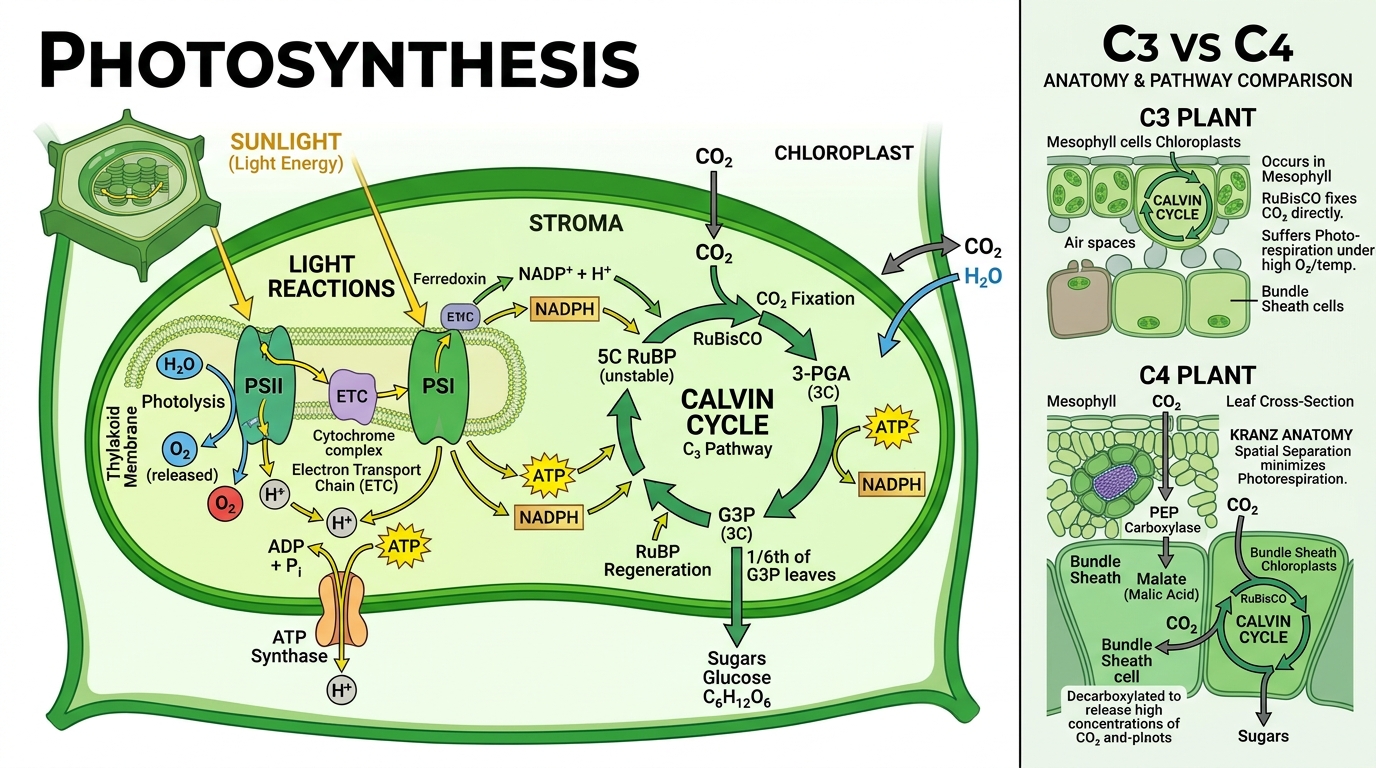
Photosynthesis in Higher Plants maps structures to mechanisms with comparison tables and at least one numeric landmark (18-related).
NEET items reward ordered pathways, site/product contrasts, and labelled diagrams rather than isolated keywords.
Photosynthesis in Higher Plants supplies steady marks through pathways, comparison tables and diagram labels in Class 11–12 · NEET papers.
Field and clinical applications reuse Photosynthesis in Higher Plants whenever the underlying process is measured, imaged or controlled.
Photosynthesis Overview
Light energy → chemical energy; chloroplast sites; overall equation.
In short: Plants build sugar using light, CO₂, water.
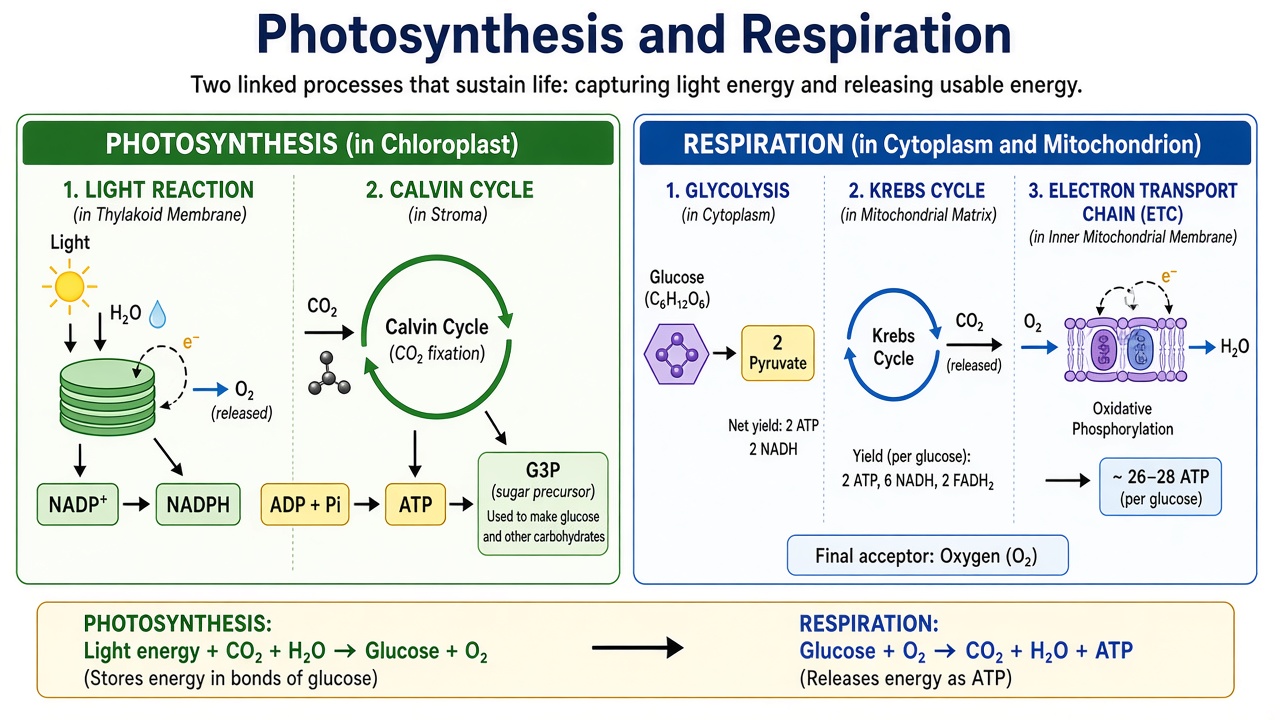
Think about it
NEET/boards repeatedly test Photosynthesis Overview via definitions, diagrams and contrasts inside Photosynthesis in Higher Plants. Applications of Photosynthesis Overview appear in medicine, agriculture, ecology or technology whenever Photosynthesis in Higher Plants concepts are measured or controlled.
Action vs absorption spectrum; Engelmann; Blackman limiting factors.
Exam pathway for Photosynthesis Overview: write site → inputs → steps → products → regulation/failure mode.
Contrast Photosynthesis Overview with the nearest confused neighbour before committing to an MCQ.
Keep one numeric landmark from Photosynthesis in Higher Plants on your revision sheet and attach units.
Redraw the standard diagram for Photosynthesis Overview from memory, then check labels.
In assertion–reason, demand that the reason actually explains the assertion.
Ordered recall beats scattered keywords: list intermediates, name the tissue or organelle, and state the condition (aerobic, illuminated, diploid, hormone-present) under which Photosynthesis Overview applies in Photosynthesis in Higher Plants.
Key points
- Photosynthesis Overview: Core heading under Photosynthesis in Higher Plants.
- Condition: State required for the process (site, oxygen, light, hormone, ploidy).
- Recite the pathway of Photosynthesis Overview without looking at notes.
- Attach one named example or numeric cue (18) where relevant.
- Write one cause
→effect sentence suitable as an assertion.
Read more
Light Reactions
PSII/PSI; Z-scheme; photolysis; ATP/NADPH formation.
In short: Light-driven electron flow on thylakoids.
Think about it
NEET/boards repeatedly test Light Reactions via definitions, diagrams and contrasts inside Photosynthesis in Higher Plants. Applications of Light Reactions appear in medicine, agriculture, ecology or technology whenever Photosynthesis in Higher Plants concepts are measured or controlled.
Non-cyclic vs cyclic photophosphorylation; chemiosmosis.
Exam pathway for Light Reactions: write site → inputs → steps → products → regulation/failure mode.
Contrast Light Reactions with the nearest confused neighbour before committing to an MCQ.
Keep one numeric landmark from Photosynthesis in Higher Plants on your revision sheet and attach units.
Redraw the standard diagram for Light Reactions from memory, then check labels.
In assertion–reason, demand that the reason actually explains the assertion.
Ordered recall beats scattered keywords: list intermediates, name the tissue or organelle, and state the condition (aerobic, illuminated, diploid, hormone-present) under which Light Reactions applies in Photosynthesis in Higher Plants.
Key points
- Light Reactions: Core heading under Photosynthesis in Higher Plants.
- Condition: State required for the process (site, oxygen, light, hormone, ploidy).
- Recite the pathway of Light Reactions without looking at notes.
- Attach one named example or numeric cue (18) where relevant.
- Write one cause
→effect sentence suitable as an assertion.
Read more
Calvin Cycle
Carboxylation, reduction, regeneration; Rubisco; 3-PGA.
In short: Dark reactions that fix carbon in stroma.
Think about it
NEET/boards repeatedly test Calvin Cycle via definitions, diagrams and contrasts inside Photosynthesis in Higher Plants. Applications of Calvin Cycle appear in medicine, agriculture, ecology or technology whenever Photosynthesis in Higher Plants concepts are measured or controlled.
18 ATP + 12 NADPH per glucose accounting in many texts; C3 plants.
Exam pathway for Calvin Cycle: write site → inputs → steps → products → regulation/failure mode.
Contrast Calvin Cycle with the nearest confused neighbour before committing to an MCQ.
Keep one numeric landmark from Photosynthesis in Higher Plants on your revision sheet and attach units.
Redraw the standard diagram for Calvin Cycle from memory, then check labels.
In assertion–reason, demand that the reason actually explains the assertion.
Ordered recall beats scattered keywords: list intermediates, name the tissue or organelle, and state the condition (aerobic, illuminated, diploid, hormone-present) under which Calvin Cycle applies in Photosynthesis in Higher Plants.
Key points
- Calvin Cycle: Core heading under Photosynthesis in Higher Plants.
- Condition: State required for the process (site, oxygen, light, hormone, ploidy).
- Recite the pathway of Calvin Cycle without looking at notes.
- Attach one named example or numeric cue (18) where relevant.
- Write one cause
→effect sentence suitable as an assertion.
Read more
C4 and CAM
Kranz anatomy; PEP carboxylase; spatial/temporal separation of initial fixation.
In short: Hot-climate CO₂ concentrating tricks.
Think about it
NEET/boards repeatedly test C4 and CAM via definitions, diagrams and contrasts inside Photosynthesis in Higher Plants. Applications of C4 and CAM appear in medicine, agriculture, ecology or technology whenever Photosynthesis in Higher Plants concepts are measured or controlled.
Mesophyll→bundle sheath; stomata night open in CAM; reduces photorespiration.
Exam pathway for C4 and CAM: write site → inputs → steps → products → regulation/failure mode.
Contrast C4 and CAM with the nearest confused neighbour before committing to an MCQ.
Keep one numeric landmark from Photosynthesis in Higher Plants on your revision sheet and attach units.
Redraw the standard diagram for C4 and CAM from memory, then check labels.
In assertion–reason, demand that the reason actually explains the assertion.
Ordered recall beats scattered keywords: list intermediates, name the tissue or organelle, and state the condition (aerobic, illuminated, diploid, hormone-present) under which C4 and CAM applies in Photosynthesis in Higher Plants.
Key points
- C4 and: Core heading under Photosynthesis in Higher Plants.
- Condition: State required for the process (site, oxygen, light, hormone, ploidy).
- Recite the pathway of C4 and CAM without looking at notes.
- Attach one named example or numeric cue (18) where relevant.
- Write one cause
→effect sentence suitable as an assertion.
Read more
Photorespiration
Rubisco oxygenase activity; C2 pathway wastefulness in C3.
In short: When Rubisco grabs O₂ instead of CO₂.
Think about it
NEET/boards repeatedly test Photorespiration via definitions, diagrams and contrasts inside Photosynthesis in Higher Plants. Applications of Photorespiration appear in medicine, agriculture, ecology or technology whenever Photosynthesis in Higher Plants concepts are measured or controlled.
No ATP/NADPH gain; C4 minimises it.
Exam pathway for Photorespiration: write site → inputs → steps → products → regulation/failure mode.
Contrast Photorespiration with the nearest confused neighbour before committing to an MCQ.
Keep one numeric landmark from Photosynthesis in Higher Plants on your revision sheet and attach units.
Redraw the standard diagram for Photorespiration from memory, then check labels.
In assertion–reason, demand that the reason actually explains the assertion.
Ordered recall beats scattered keywords: list intermediates, name the tissue or organelle, and state the condition (aerobic, illuminated, diploid, hormone-present) under which Photorespiration applies in Photosynthesis in Higher Plants.
Key points
- Photorespiration: Core heading under Photosynthesis in Higher Plants.
- Condition: State required for the process (site, oxygen, light, hormone, ploidy).
- Recite the pathway of Photorespiration without looking at notes.
- Attach one named example or numeric cue (18) where relevant.
- Write one cause
→effect sentence suitable as an assertion.
Read more
Factors Affecting Rate
Light intensity, CO₂, temperature, water; Blackman principle.
In short: What limits the rate in the field.
Think about it
NEET/boards repeatedly test Factors Affecting Rate via definitions, diagrams and contrasts inside Photosynthesis in Higher Plants. Applications of Factors Affecting Rate appear in medicine, agriculture, ecology or technology whenever Photosynthesis in Higher Plants concepts are measured or controlled.
Law of limiting factors; saturation curves.
Exam pathway for Factors Affecting Rate: write site → inputs → steps → products → regulation/failure mode.
Contrast Factors Affecting Rate with the nearest confused neighbour before committing to an MCQ.
Keep one numeric landmark from Photosynthesis in Higher Plants on your revision sheet and attach units.
Redraw the standard diagram for Factors Affecting Rate from memory, then check labels.
In assertion–reason, demand that the reason actually explains the assertion.
Ordered recall beats scattered keywords: list intermediates, name the tissue or organelle, and state the condition (aerobic, illuminated, diploid, hormone-present) under which Factors Affecting Rate applies in Photosynthesis in Higher Plants.
Key points
- Factors Affecting: Core heading under Photosynthesis in Higher Plants.
- Condition: State required for the process (site, oxygen, light, hormone, ploidy).
- Recite the pathway of Factors Affecting Rate without looking at notes.
- Attach one named example or numeric cue (18) where relevant.
- Write one cause
→effect sentence suitable as an assertion.
Read more
Comparisons
Photosynthesis in Higher Plants: process comparison
| Feature | Photosynthesis Overview | Light Reactions |
|---|---|---|
| Core question | Definition + site | Definition + site |
| Input | Substrate/signal | Substrate/signal |
| Output | Product/effect | Product/effect |
| Exam cue | Standard example | Standard example |
Educational Significance: Use as a flowchart: pick the column that matches the stem’s site and product.
Solved examples
State one defining feature of Photosynthesis Overview and one standard example from Photosynthesis in Higher Plants.
Feature + example
Formula Applied:—Approach note: Named examples carry marks.
Compare Photosynthesis Overview with Light Reactions on site and product (2 points each).
4 points
Formula Applied:—Approach note: Tables beat paragraphs in timed revision.
A linear flowchart of Calvin Cycle shows 4 ordered boxes. How many arrows connect them?
Number of arrows
Formula Applied:—Approach note: Flowchart arrow count is a quick numeric check.
Give one digit-bearing landmark used while revising Photosynthesis in Higher Plants (include the digit 18).
Landmark with digit
Formula Applied:—Approach note: Keep a one-page number bank per chapter.
Real-world applications
Photosynthesis in Higher Plants outside the classroom
Field and clinical applications reuse Photosynthesis in Higher Plants whenever the underlying process is measured, imaged or controlled.
Common mistakes
❌ Myth: Photosynthesis in Higher Plants can be revised as unordered keyword lists.
Why this is wrong: NEET asks pathways and contrasts.
✅ Verified Truth: Learn ordered mechanisms and comparison tables.
⚠️ Exam Tip: Redraw one flowchart from memory daily.
❌ Myth: Conditions (light, aerobic, diploid) are optional in answers.
Why this is wrong: Most processes are conditional.
✅ Verified Truth: State conditions before naming the process.
⚠️ Exam Tip: Underline condition words in the stem.
❌ Myth: Diagrams are decoration.
Why this is wrong: Labels carry direct marks.
✅ Verified Truth: Practise standard figures unlabelled.
⚠️ Exam Tip: Cover the book figure and recreate it.
❌ Myth: Biology never uses numbers.
Why this is wrong: Ploidy, volumes, ratios and % appear often.
✅ Verified Truth: Keep a one-page number bank.
⚠️ Exam Tip: Landmark: see chapter numeric fact.
Revision notes
Photosynthesis in Higher Plants maps structures to mechanisms with comparison tables and at least one numeric landmark (18-related). NEET items reward ordered pathways, site/product contrasts, and labelled diagrams rather than isolated keywords.
High-Yield Quick Revision Points
- Photosynthesis Overview: definition → site → steps → example → contrast.
- Light Reactions: definition → site → steps → example → contrast.
- Calvin Cycle: definition → site → steps → example → contrast.
- C4 and CAM: definition → site → steps → example → contrast.
- Photorespiration: definition → site → steps → example → contrast.
- Factors Affecting Rate: definition → site → steps → example → contrast.
- 18 landmark
Practice questions
A defining focus of Photosynthesis in Higher Plants is best revised as:
First step when two similar processes appear in Photosynthesis in Higher Plants?
Linear flowchart arrows connecting 5 steps?
Numeric landmark often cited in this chapter includes digit 18. What is a valid use?
Minimum distinct topics to master deeply in Photosynthesis in Higher Plants packs?
Assertion–reason tip for Photosynthesis in Higher Plants: