Chapter 04
Asymptotic Analysis & Complexity
3 topics · 1 sections · beginner-friendly study notes · Updated
Asymptotic analysis measures how running time and memory grow with input size n, ignoring machine-specific constants.
Big-O (upper bound), Omega (lower bound) and Theta (tight bound) are the language of every algorithm comparison; recursion adds call-stack space.
GATE and interviews ask you to derive complexity of a snippet in under a minute.
A wrong bound makes every later design choice (sort, DS, DP) wrong.
Choosing between O(n log n) and O(n^2) approaches, predicting whether n = 10^5 or 10^7 will pass a time limit (about 10^8 simple ops/sec), and sizing memory for recursion.
Big-O, Big-Omega & Big-Theta Notation
f(n)=O(g(n)) if there exist c>0, n0 such that f(n) <= c*g(n) for all n>=n0 (upper bound). f(n)=Omega(g(n)) if f(n) >= c*g(n) (lower bound). f(n)=Theta(g(n)) if both hold (tight bound). Little-o and little-omega are strict (non-tight) versions.
In short: Big-O says "at most this fast-growing", Omega says "at least", Theta says "exactly this order".
Think about it
Hardware changes constants; growth rate is the machine-independent comparison needed to choose algorithms.
Constants and lower-order terms are dropped: 3n^2+10n+7 = Theta(n^2).
Big-O is an upper bound, not necessarily tight: n = O(n^2) is true but useless.
Best/worst/average case are separate functions of n; each can have its own O/Omega/Theta.
Saying "quick sort is Omega(n log n)" is the best case; worst case is O(n^2).
Logs of different bases differ by a constant, so O(log2 n) = O(log10 n).
But 2^(2n) is NOT O(2^n) because the exponent constant matters.
Key points
- Upper bound: Big-O: growth never exceeds c*
g(n)beyond n0. - Tight bound: Theta: sandwiched between c1*
g(n)and c2*g(n). - Dominant term: Highest-order term decides the class.
- Order: 1 < log n <
sqrt(n)< n < n log n < n^2 < n^3 < 2^n < n! < n^n. log(n!)=Theta(n log n)(Stirling). Sum of 1..n =Theta(n^2). Sum of 1/i for i=1..n =Theta(log n).- If f=
O(g)and g=O(h)then f=O(h)(transitive). f=Theta(g)iff g=Theta(f)(symmetric).
Read more
Example
CodeConstant dropping:
# 5n^2 + 20n + 100 -> Theta(n^2)
# Proof sketch: for n >= 10, 5n^2 <= f(n) <= 7n^2 (c1=5, c2=7, n0=10)
def f(n):
return 5 * n * n + 20 * n + 100Calculating Time Complexity
Time complexity counts elementary operations as a function of input size. Sequential blocks add (take the max), nested independent loops multiply, loops with multiplicative/divisive steps give logarithms, and recursive algorithms yield recurrences solved by substitution, recursion tree, or the Master theorem.
In short: Count how many times the innermost statement runs as n grows.
Think about it
Deriving this by hand is a direct GATE question type and the first interview follow-up after any solution.
Rules: (1) for i in range(n): O(n).
(2) Nested independent loops: O(n*m).
(3) Dependent inner loop j<i gives n(n-1)/2 = O(n^2).
(4) i *= 2 or i //= 2 gives O(log n).
(5) Outer n times with inner log n gives O(n log n).
(6) Inner loop where j runs n/i times gives harmonic sum n(1+1/2+...
) = O(n log n).
(7) i=1; while i*i<=n: O(sqrt n).
Master theorem for T(n)=aT(n/b)+Theta(n^d): if d > log_b a then Theta(n^d); if d = log_b a then Theta(n^d log n); if d < log_b a then Theta(n^(log_b a)).
Examples
- 1merge sort a=2,b=2,d=1 gives n log n
- 2binary search a=1,b=2,d=0 gives log n
- 3
T(n)=2T(n-1)+1 isTheta(2^n) - 4
T(n)=T(n-1)+n isTheta(n^2) - 5
T(n)=T(n-1)+T(n-2)(naive Fibonacci) isTheta(phi^n), upper boundO(2^n)
Key points
- Recurrence: Equation expressing
T(n)via smaller inputs, e.g.T(n)=2T(n/2)+n. - Master theorem: Closed form for
T(n)=aT(n/b)+f(n), a>=1, b>1. - Amortized cost: Average per operation over a sequence, e.g. dynamic array append is
O(1)amortized. - Two sequential loops of n and m:
O(n+m), notO(n*m). - Input-dependent: loop to
sqrt(n)on a number n isO(sqrt n)but the input size in bits is log n (pseudo-polynomial issue). - String concatenation s
+=c in a loop isO(n^2)in languages with immutable strings.
Example
CodeFour common patterns:
def a(n): # O(n log n)
for i in range(n):
j = 1
while j < n:
j *= 2
def b(n): # O(n^2): dependent loop, n(n-1)/2
for i in range(n):
for j in range(i):
pass
def c(n): # O(n log n): harmonic
for i in range(1, n + 1):
for j in range(0, n, i):
pass
def d(n): # O(sqrt n)
i = 1
while i * i <= n:
i += 1Space Complexity & Call Stack
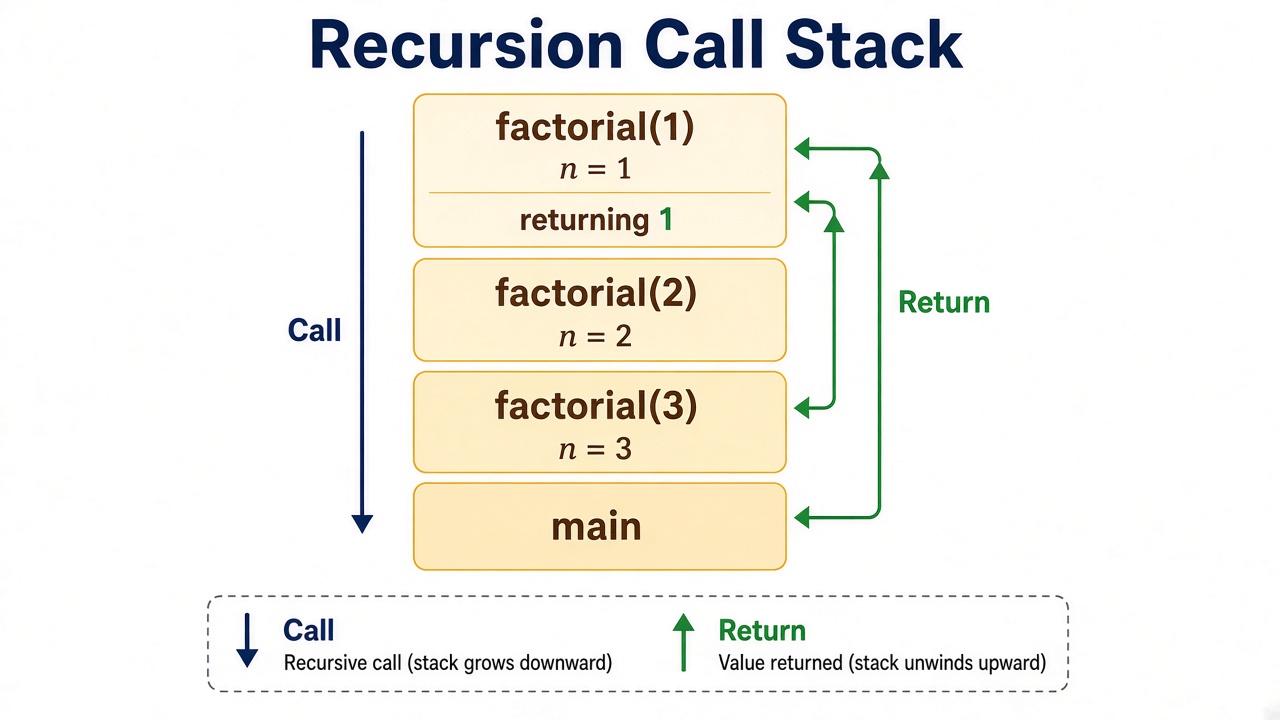
Space complexity is the memory an algorithm needs as a function of n. Auxiliary space is the extra memory beyond the input; total space = input + auxiliary. Each recursive call adds a stack frame, so recursion depth d contributes O(d) space.
In short: How much extra memory you use, including the hidden memory taken by recursion.
Think about it
Memory limits and stack overflow crashes are real failure modes; GATE asks stack depth of recursive functions directly.
Iterative sum: O(1).
Recursive sum(n) = n + sum(n-1): O(n) stack.
Binary search recursive: O(log n) stack, iterative O(1).
Merge sort: O(n) auxiliary for the merge buffer plus O(log n) stack.
Quick sort: O(log n) expected stack, O(n) worst case unless you recurse on the smaller half first (guarantees O(log n)).
DFS on a graph: O(V) stack worst case.
Memoized Fibonacci: O(n) table + O(n) stack.
In-place means O(1) auxiliary (reverse an array with two pointers).
Python default recursion limit is about 1000 frames, so deep recursion on n=10^5 raises RecursionError; convert to iteration or an explicit stack.
Key points
Read more
Example
CodeRecursion vs iteration space:
def sum_rec(n): # time O(n), stack O(n)
if n == 0:
return 0
return n + sum_rec(n - 1)
def sum_iter(n): # time O(n), space O(1)
total = 0
for i in range(1, n + 1):
total += i
return total
def fib_naive(n): # time O(2^n), stack depth O(n)
return n if n < 2 else fib_naive(n - 1) + fib_naive(n - 2)Solved examples
Find time complexity: for i in range(n): for j in range(i, n): work()
Big-O
Formula Applied:—Approach note: Triangular sums always give n^2 / 2.
Solve T(n) = 2T(n/2) + n log n using Master-like reasoning.
Closed form
Formula Applied:—Approach note: Recursion tree: each of log n levels costs n log n at the top and about n*log(n/2^i) below, summing to n log^2 n.
Stack space of: def f(n): return 0 if n <= 1 else f(n // 2) + f(n // 2)
Time and stack depth
Formula Applied:—Approach note: Stack space = depth, not total number of calls.
for (i=n; i>0; i/=2) for (j=1; j<=n; j++) stmt;. What is the time complexity?
Big-O
Formula Applied:—Approach note: Multiply independent nested loop costs.
Real-world applications
Using Asymptotic Analysis & Complexity in real projects
Choosing between O(n log n) and O(n^2) approaches, predicting whether n = 10^5 or 10^7 will pass a time limit (about 10^8 simple ops/sec), and sizing memory for recursion.
Common mistakes
❌ Myth: Big-O always means the worst case.
Why this is wrong: Big-O is a mathematical upper bound on any function; it can describe best, average or worst case.
✅ Verified Truth: Say "worst-case time is O(n^2)" or "best case is Omega(n)". Theta applies when upper and lower match.
⚠️ Exam Tip: In GATE, if a case is not specified, assume worst case for the algorithm.
❌ Myth: O(n) is always faster than O(n^2) for any input.
Why this is wrong: Asymptotic notation hides constants and holds only for n beyond n0; 1000n loses to n^2 for n<1000.
✅ Verified Truth: Growth rate wins for large n; for tiny n insertion sort beats merge sort, which is why hybrid sorts exist.
⚠️ Exam Tip: State the n0 caveat if asked to compare real performance.
❌ Myth: Recursive code uses O(1) space if it has no arrays.
Why this is wrong: Every pending call holds a stack frame.
✅ Verified Truth: Space = max recursion depth times frame size.
⚠️ Exam Tip: Always add stack depth to auxiliary space.
Revision notes
Asymptotic analysis measures how running time and memory grow with input size n, ignoring machine-specific constants. Big-O (upper bound), Omega (lower bound) and Theta (tight bound) are the language of every algorithm comparison; recursion adds call-stack space.
High-Yield Quick Revision Points
- Order: 1 < log n < sqrt n < n < n log n < n^2 < n^3 < 2^n < n! < n^n
- Theta = O and Omega; drop constants and lower terms
- Sequential: add (max); nested: multiply; halving/doubling: log
- Master: compare n^(log_b a) with f(n)
- Space = auxiliary + recursion depth; naive Fibonacci time 2^n, stack n
Practice questions
Complexity of: i = n; while i > 1: i = i // 2 ?
T(n) = T(n-1) + n has solution:
Which is true? 2^(n+1) = ? and 2^(2n) = ?
Master theorem: T(n) = 4T(n/2) + n gives:
Auxiliary space of recursive binary search on n elements: