Chapter 20 · Class 11-12 & JEE Main/Adv
Continuity & Differentiability
41 topics · 15 sections · beginner-friendly study notes · Updated
Continuity at a means lim f=f(a).
Differentiability means the derivative limit exists; it implies continuity but not conversely (corners, cusps).
Piecewise functions need one-sided derivative checks.
Intermediate Value and Extreme Value theorems for continuous functions on closed intervals underpin existence arguments.
Fluency in Continuity and Differentiability means recognising which identity applies, executing algebra with domain discipline, and interpreting results so multi-step JEE problems become short chains of steps.
Continuity and Differentiability is a high-frequency JEE strand: weak technique here blocks multi-concept questions that mix smoothness of functions with algebra, calculus or coordinate geometry.
Applied STEM models routinely reduce to smoothness of functions; the same identities tested in classroom proofs appear in timed numericals.
Continuity
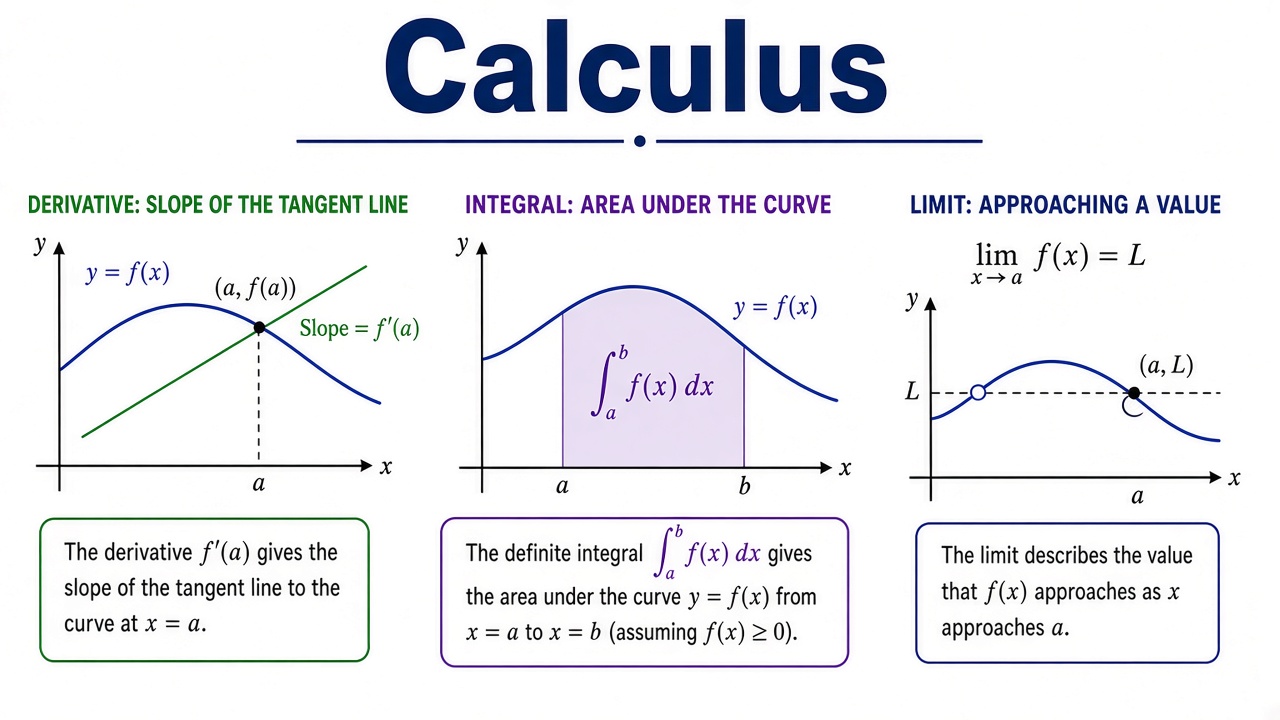
f continuous at a iff lim_{x→a} f(x)=f(a); continuous on an interval if continuous at each point; types of discontinuities: removable, jump, infinite.
In short: No holes, jumps or vertical blow-ups in the graph at that point.
Think about it
Definitional core. Continuity and Differentiability appears whenever smoothness of functions structures quantities or shapes.
For piecewise, match left/right limits and value; redefine to remove removable holes.
Standard manipulations for Continuity include clearing parameters carefully, checking equality cases, and rewriting expressions so the governing formula applies directly.
When several identities seem possible, prefer the one whose hypotheses are already verified by the given data in smoothness of functions.
A clean board layout names the identity, substitutes symbols, simplifies reversibly, and only then matches options — preventing the common error of using Continuity outside its domain in smoothness of functions.
In exam solutions involving Continuity, state hypotheses first, rewrite into canonical form, and verify endpoints or extraneous roots before selecting an option.
Domain restrictions and equality cases for Continuity and Differentiability often separate the correct choice from near-miss algebra.
Keep equivalent forms ready (factored vs expanded, parametric vs Cartesian, exponential vs logarithmic) so mid-solution switches do not introduce errors.
A reliable layout is: domain note, governing identity, one idea per line, boxed answer, rejection of illegal candidates.
Typical JEE mistakes around Continuity include dropping absolute values, ignoring restricted ranges, and applying a formula outside its hypothesis set — name the theorem you use and check every hypothesis explicitly before simplifying.
When a question mixes Continuity with neighbouring ideas from Continuity and Differentiability, isolate the local identity first, finish that block, then reconnect to the global unknown; this compartmentalisation keeps algebra short and makes substitution errors obvious at the join points.
Numeric sanity checks (signs, dimensions, special values such as 0 or 1) catch many wrong options before you invest in heavy simplification.
Key points
- Hypothesis: Conditions required before applying Continuity.
- Canonical form: Standard shape matching the theorem statement.
- Write domain/hypotheses before transforming.
- Reject extraneous roots after back-substitution.
- Simplify to match JEE option formats.
Continuity
- … — See definition (—)
Differentiability
f'(a)=lim_{h→0}(f(a+h)−f(a))/h; left and right derivatives must agree; differentiability ⇒ continuity.
In short: Local linear approximation exists.
Think about it
Strictly stronger than continuity. Continuity and Differentiability appears whenever smoothness of functions structures quantities or shapes.
Check corners (|x| at 0), cusps and vertical tangents separately.
Standard manipulations for Differentiability include clearing parameters carefully, checking equality cases, and rewriting expressions so the governing formula applies directly.
When several identities seem possible, prefer the one whose hypotheses are already verified by the given data in smoothness of functions.
A clean board layout names the identity, substitutes symbols, simplifies reversibly, and only then matches options — preventing the common error of using Differentiability outside its domain in smoothness of functions.
In exam solutions involving Differentiability, state hypotheses first, rewrite into canonical form, and verify endpoints or extraneous roots before selecting an option.
Domain restrictions and equality cases for Continuity and Differentiability often separate the correct choice from near-miss algebra.
Keep equivalent forms ready (factored vs expanded, parametric vs Cartesian, exponential vs logarithmic) so mid-solution switches do not introduce errors.
A reliable layout is: domain note, governing identity, one idea per line, boxed answer, rejection of illegal candidates.
Typical JEE mistakes around Differentiability include dropping absolute values, ignoring restricted ranges, and applying a formula outside its hypothesis set — name the theorem you use and check every hypothesis explicitly before simplifying.
When a question mixes Differentiability with neighbouring ideas from Continuity and Differentiability, isolate the local identity first, finish that block, then reconnect to the global unknown; this compartmentalisation keeps algebra short and makes substitution errors obvious at the join points.
Numeric sanity checks (signs, dimensions, special values such as 0 or 1) catch many wrong options before you invest in heavy simplification.
Key points
- Hypothesis: Conditions required before applying Differentiability.
- Canonical form: Standard shape matching the theorem statement.
- Write domain/hypotheses before transforming.
- Reject extraneous roots after back-substitution.
- Simplify to match JEE option formats.
Differentiability
- … — See definition (—)
Piecewise Checks
Match values for continuity; match one-sided derivatives for differentiability; parameters often fixed by these equations.
In short: Glue pieces smoothly by constraining constants.
Think about it
Classic JEE parameter problems. Continuity and Differentiability appears whenever smoothness of functions structures quantities or shapes.
Solve simultaneous conditions from lim and f'±.
Standard manipulations for Piecewise Checks include clearing parameters carefully, checking equality cases, and rewriting expressions so the governing formula applies directly.
When several identities seem possible, prefer the one whose hypotheses are already verified by the given data in smoothness of functions.
A clean board layout names the identity, substitutes symbols, simplifies reversibly, and only then matches options — preventing the common error of using Piecewise Checks outside its domain in smoothness of functions.
In exam solutions involving Piecewise Checks, state hypotheses first, rewrite into canonical form, and verify endpoints or extraneous roots before selecting an option.
Domain restrictions and equality cases for Continuity and Differentiability often separate the correct choice from near-miss algebra.
Keep equivalent forms ready (factored vs expanded, parametric vs Cartesian, exponential vs logarithmic) so mid-solution switches do not introduce errors.
A reliable layout is: domain note, governing identity, one idea per line, boxed answer, rejection of illegal candidates.
Typical JEE mistakes around Piecewise Checks include dropping absolute values, ignoring restricted ranges, and applying a formula outside its hypothesis set — name the theorem you use and check every hypothesis explicitly before simplifying.
When a question mixes Piecewise Checks with neighbouring ideas from Continuity and Differentiability, isolate the local identity first, finish that block, then reconnect to the global unknown; this compartmentalisation keeps algebra short and makes substitution errors obvious at the join points.
Numeric sanity checks (signs, dimensions, special values such as 0 or 1) catch many wrong options before you invest in heavy simplification.
Key points
- Hypothesis: Conditions required before applying Piecewise Checks.
- Canonical form: Standard shape matching the theorem statement.
- Write domain/hypotheses before transforming.
- Reject extraneous roots after back-substitution.
- Simplify to match JEE option formats.
Theorems on Continuous Functions
IVT: continuous on [a,b] hits every intermediate value; EVT: attains min/max; roots exist when f(a)f(b)<0.
In short: Continuous images of intervals are intervals.
Think about it
Theory marks. Continuity and Differentiability appears whenever smoothness of functions structures quantities or shapes.
Use IVT for existence proofs; combine with monotonicity for uniqueness.
Standard manipulations for Theorems on Continuous Functions include clearing parameters carefully, checking equality cases, and rewriting expressions so the governing formula applies directly.
When several identities seem possible, prefer the one whose hypotheses are already verified by the given data in smoothness of functions.
A clean board layout names the identity, substitutes symbols, simplifies reversibly, and only then matches options — preventing the common error of using Theorems on Continuous Functions outside its domain in smoothness of functions.
In exam solutions involving Theorems on Continuous Functions, state hypotheses first, rewrite into canonical form, and verify endpoints or extraneous roots before selecting an option.
Domain restrictions and equality cases for Continuity and Differentiability often separate the correct choice from near-miss algebra.
Keep equivalent forms ready (factored vs expanded, parametric vs Cartesian, exponential vs logarithmic) so mid-solution switches do not introduce errors.
A reliable layout is: domain note, governing identity, one idea per line, boxed answer, rejection of illegal candidates.
Typical JEE mistakes around Theorems on Continuous Functions include dropping absolute values, ignoring restricted ranges, and applying a formula outside its hypothesis set — name the theorem you use and check every hypothesis explicitly before simplifying.
When a question mixes Theorems on Continuous Functions with neighbouring ideas from Continuity and Differentiability, isolate the local identity first, finish that block, then reconnect to the global unknown; this compartmentalisation keeps algebra short and makes substitution errors obvious at the join points.
Numeric sanity checks (signs, dimensions, special values such as 0 or 1) catch many wrong options before you invest in heavy simplification.
Key points
- Hypothesis: Conditions required before applying Theorems on Continuous Functions.
- Canonical form: Standard shape matching the theorem statement.
- Write domain/hypotheses before transforming.
- Reject extraneous roots after back-substitution.
- Simplify to match JEE option formats.
Relation Summary
Diff ⇒ Cont ⇒ Limit exists; converse failures: step function continuous? no; |x| continuous not diff at 0; x sin(1/x) type examples.
In short: Hierarchy of regularity.
Think about it
Conceptual clarity. Continuity and Differentiability appears whenever smoothness of functions structures quantities or shapes.
Keep counterexamples ready for true/false.
Standard manipulations for Relation Summary include clearing parameters carefully, checking equality cases, and rewriting expressions so the governing formula applies directly.
When several identities seem possible, prefer the one whose hypotheses are already verified by the given data in smoothness of functions.
A clean board layout names the identity, substitutes symbols, simplifies reversibly, and only then matches options — preventing the common error of using Relation Summary outside its domain in smoothness of functions.
In exam solutions involving Relation Summary, state hypotheses first, rewrite into canonical form, and verify endpoints or extraneous roots before selecting an option.
Domain restrictions and equality cases for Continuity and Differentiability often separate the correct choice from near-miss algebra.
Keep equivalent forms ready (factored vs expanded, parametric vs Cartesian, exponential vs logarithmic) so mid-solution switches do not introduce errors.
A reliable layout is: domain note, governing identity, one idea per line, boxed answer, rejection of illegal candidates.
Typical JEE mistakes around Relation Summary include dropping absolute values, ignoring restricted ranges, and applying a formula outside its hypothesis set — name the theorem you use and check every hypothesis explicitly before simplifying.
When a question mixes Relation Summary with neighbouring ideas from Continuity and Differentiability, isolate the local identity first, finish that block, then reconnect to the global unknown; this compartmentalisation keeps algebra short and makes substitution errors obvious at the join points.
Numeric sanity checks (signs, dimensions, special values such as 0 or 1) catch many wrong options before you invest in heavy simplification.
Key points
- Hypothesis: Conditions required before applying Relation Summary.
- Canonical form: Standard shape matching the theorem statement.
- Write domain/hypotheses before transforming.
- Reject extraneous roots after back-substitution.
- Simplify to match JEE option formats.
Comparisons
Continuity vs differentiability
| Continuous | Differentiable | |
|---|---|---|
| Meaning | lim=f(a) | f' exists |
| Implies the other? | Not diff | Implies cont |
Educational Significance: Order the regularity hierarchy correctly.
Solved examples
Is f(x)=|x| continuous at 0?
Answer
Formula Applied:—Approach note: V-shape continuous.
Is |x| differentiable at 0?
Answer
Formula Applied:—Approach note: Corner.
f(x)=x² at 1: f'?
Answer
Formula Applied:—Approach note: Definition.
IVT: f(0)=−1,f(2)=3 continuous ⇒ root in?
Answer
Formula Applied:—Approach note: IVT.
Real-world applications
Continuity and Differentiability outside the classroom
Applied STEM models routinely reduce to smoothness of functions; the same identities tested in classroom proofs appear in timed numericals.
Common mistakes
❌ Myth: Continuous ⇒ differentiable
Why this is wrong: False; |x|
✅ Verified Truth: Diff is stronger
⚠️ Exam Tip: Check corners
❌ Myth: Jump discontinuity can be removable
Why this is wrong: Jump is not removable by redefining one point
✅ Verified Truth: Removable= hole
⚠️ Exam Tip: Classify carefully
❌ Myth: Derivative exists ⇒ left/right limits of f' exist
Why this is wrong: f' may be discontinuous
✅ Verified Truth: Diff ≠ cont of f'
⚠️ Exam Tip: Keep separate
Revision notes
Continuity at a means lim f=f(a). Differentiability means the derivative limit exists; it implies continuity but not conversely (corners, cusps). Piecewise functions need one-sided derivative checks. Intermediate Value and Extreme Value theorems for continuous functions on closed intervals underpin existence arguments. Fluency in Continuity and Differentiability means recognising which identity applies, executing algebra with domain discipline, and interpreting results so multi-step JEE problems become short chains of steps.
High-Yield Quick Revision Points
- Continuity definition
- Differentiability definition
- Piecewise parameter fitting
- IVT/EVT
- Counterexamples
Master Formula Cheat Sheet
Practice questions
Diff ⇒ continuous?
Number of points in R where |x| fails to be differentiable?
Removable disc. means lim exists but ≠ f(a) or f(a) missing; lim of (x²−1)/(x−1) at 1?
IVT needs continuity on?
Left derivative of |x| at 0?
Right derivative of |x| at 0?