Chapter 09 · Class 11-12 & JEE Main/Adv
Permutations & Combinations
56 topics · 16 sections · beginner-friendly study notes · Updated
Fundamental counting principles, nPr and nCr, with/without repetition, circular permutations, and derangements form the combinatorics core.
Distinguishing arrangements from selections and handling restrictions (together/apart, gaps, inclusion–exclusion) is the exam skill.
Fluency in Permutations and Combinations means recognising which identity applies, executing algebra with domain discipline, and interpreting results so multi-step JEE problems become short chains of steps.
Permutations and Combinations is a high-frequency JEE strand: weak technique here blocks multi-concept questions that mix counting arrangements and selections with algebra, calculus or coordinate geometry.
Applied STEM models routinely reduce to counting arrangements and selections; the same identities tested in classroom proofs appear in timed numericals.
Fundamental Counting
If one task has m ways and another n independent ways, together mn ways; addition for mutually exclusive cases.
In short: Multiply stages; add alternatives.
Think about it
Base of all counting. Permutations and Combinations appears whenever counting arrangements and selections structures quantities or shapes.
Draw a stage diagram; avoid double-counting overlapping cases.
Standard manipulations for Fundamental Counting include clearing parameters carefully, checking equality cases, and rewriting expressions so the governing formula applies directly.
When several identities seem possible, prefer the one whose hypotheses are already verified by the given data in counting arrangements and selections.
A clean board layout names the identity, substitutes symbols, simplifies reversibly, and only then matches options — preventing the common error of using Fundamental Counting outside its domain in counting arrangements and selections.
In exam solutions involving Fundamental Counting, state hypotheses first, rewrite into canonical form, and verify endpoints or extraneous roots before selecting an option.
Domain restrictions and equality cases for Permutations and Combinations often separate the correct choice from near-miss algebra.
Keep equivalent forms ready (factored vs expanded, parametric vs Cartesian, exponential vs logarithmic) so mid-solution switches do not introduce errors.
A reliable layout is: domain note, governing identity, one idea per line, boxed answer, rejection of illegal candidates.
Typical JEE mistakes around Fundamental Counting include dropping absolute values, ignoring restricted ranges, and applying a formula outside its hypothesis set — name the theorem you use and check every hypothesis explicitly before simplifying.
When a question mixes Fundamental Counting with neighbouring ideas from Permutations and Combinations, isolate the local identity first, finish that block, then reconnect to the global unknown; this compartmentalisation keeps algebra short and makes substitution errors obvious at the join points.
Numeric sanity checks (signs, dimensions, special values such as 0 or 1) catch many wrong options before you invest in heavy simplification.
Key points
- Hypothesis: Conditions required before applying Fundamental Counting.
- Canonical form: Standard shape matching the theorem statement.
- Write domain/hypotheses before transforming.
- Reject extraneous roots after back-substitution.
- Simplify to match JEE option formats.
Fundamental Counting
- … — See definition (—)
Permutations nPr
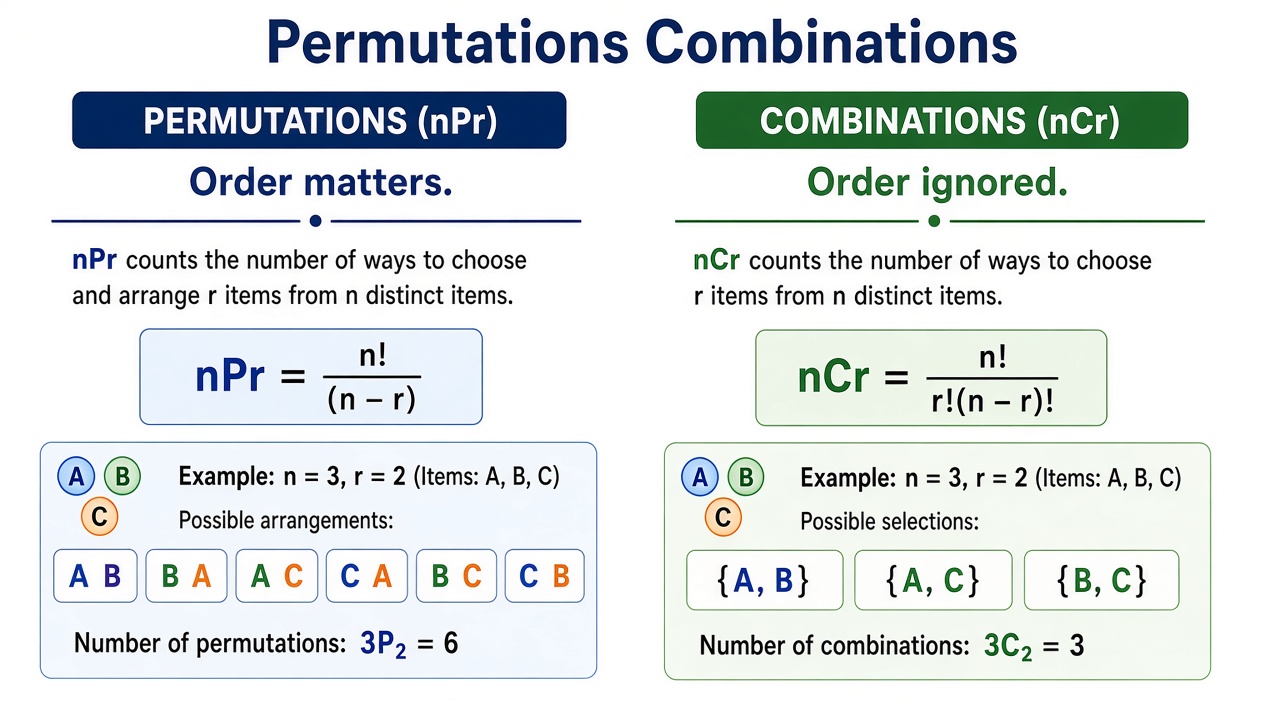
P(n,r)=n!/(n−r)! arrangements of r from n distinct; n! for all; with repetition n^r.
In short: Order matters in arrangements.
Think about it
Arrangements. Permutations and Combinations appears whenever counting arrangements and selections structures quantities or shapes.
Divide by symmetries for identical objects; circular: (n−1)!.
Standard manipulations for Permutations nPr include clearing parameters carefully, checking equality cases, and rewriting expressions so the governing formula applies directly.
When several identities seem possible, prefer the one whose hypotheses are already verified by the given data in counting arrangements and selections.
A clean board layout names the identity, substitutes symbols, simplifies reversibly, and only then matches options — preventing the common error of using Permutations nPr outside its domain in counting arrangements and selections.
In exam solutions involving Permutations nPr, state hypotheses first, rewrite into canonical form, and verify endpoints or extraneous roots before selecting an option.
Domain restrictions and equality cases for Permutations and Combinations often separate the correct choice from near-miss algebra.
Keep equivalent forms ready (factored vs expanded, parametric vs Cartesian, exponential vs logarithmic) so mid-solution switches do not introduce errors.
A reliable layout is: domain note, governing identity, one idea per line, boxed answer, rejection of illegal candidates.
Typical JEE mistakes around Permutations nPr include dropping absolute values, ignoring restricted ranges, and applying a formula outside its hypothesis set — name the theorem you use and check every hypothesis explicitly before simplifying.
When a question mixes Permutations nPr with neighbouring ideas from Permutations and Combinations, isolate the local identity first, finish that block, then reconnect to the global unknown; this compartmentalisation keeps algebra short and makes substitution errors obvious at the join points.
Numeric sanity checks (signs, dimensions, special values such as 0 or 1) catch many wrong options before you invest in heavy simplification.
Key points
- Hypothesis: Conditions required before applying Permutations nPr.
- Canonical form: Standard shape matching the theorem statement.
- Write domain/hypotheses before transforming.
- Reject extraneous roots after back-substitution.
- Simplify to match JEE option formats.
Permutations nPr
- … — See definition (—)
Combinations nCr
C(n,r)=n!/(r!(n−r)!) selections; order irrelevant; C(n,r)=P(n,r)/r!.
In short: Choose without arranging.
Think about it
Selections. Permutations and Combinations appears whenever counting arrangements and selections structures quantities or shapes.
Convert word problems: if order irrelevant use C; bridge via P/r!.
Standard manipulations for Combinations nCr include clearing parameters carefully, checking equality cases, and rewriting expressions so the governing formula applies directly.
When several identities seem possible, prefer the one whose hypotheses are already verified by the given data in counting arrangements and selections.
A clean board layout names the identity, substitutes symbols, simplifies reversibly, and only then matches options — preventing the common error of using Combinations nCr outside its domain in counting arrangements and selections.
In exam solutions involving Combinations nCr, state hypotheses first, rewrite into canonical form, and verify endpoints or extraneous roots before selecting an option.
Domain restrictions and equality cases for Permutations and Combinations often separate the correct choice from near-miss algebra.
Keep equivalent forms ready (factored vs expanded, parametric vs Cartesian, exponential vs logarithmic) so mid-solution switches do not introduce errors.
A reliable layout is: domain note, governing identity, one idea per line, boxed answer, rejection of illegal candidates.
Typical JEE mistakes around Combinations nCr include dropping absolute values, ignoring restricted ranges, and applying a formula outside its hypothesis set — name the theorem you use and check every hypothesis explicitly before simplifying.
When a question mixes Combinations nCr with neighbouring ideas from Permutations and Combinations, isolate the local identity first, finish that block, then reconnect to the global unknown; this compartmentalisation keeps algebra short and makes substitution errors obvious at the join points.
Numeric sanity checks (signs, dimensions, special values such as 0 or 1) catch many wrong options before you invest in heavy simplification.
Key points
- Hypothesis: Conditions required before applying Combinations nCr.
- Canonical form: Standard shape matching the theorem statement.
- Write domain/hypotheses before transforming.
- Reject extraneous roots after back-substitution.
- Simplify to match JEE option formats.
Combinations nCr
- … — See definition (—)
Restrictions and Inclusion–Exclusion
Together treat as block; apart = total−together; gaps method; inclusion–exclusion for overcounting unions.
In short: Encode restrictions before counting.
Think about it
Harder JEE PnC. Permutations and Combinations appears whenever counting arrangements and selections structures quantities or shapes.
Complement counting often shorter; watch identical vs distinct.
Standard manipulations for Restrictions and Inclusion–Exclusion include clearing parameters carefully, checking equality cases, and rewriting expressions so the governing formula applies directly.
When several identities seem possible, prefer the one whose hypotheses are already verified by the given data in counting arrangements and selections.
A clean board layout names the identity, substitutes symbols, simplifies reversibly, and only then matches options — preventing the common error of using Restrictions and Inclusion–Exclusion outside its domain in counting arrangements and selections.
In exam solutions involving Restrictions and Inclusion–Exclusion, state hypotheses first, rewrite into canonical form, and verify endpoints or extraneous roots before selecting an option.
Domain restrictions and equality cases for Permutations and Combinations often separate the correct choice from near-miss algebra.
Keep equivalent forms ready (factored vs expanded, parametric vs Cartesian, exponential vs logarithmic) so mid-solution switches do not introduce errors.
A reliable layout is: domain note, governing identity, one idea per line, boxed answer, rejection of illegal candidates.
Typical JEE mistakes around Restrictions and Inclusion–Exclusion include dropping absolute values, ignoring restricted ranges, and applying a formula outside its hypothesis set — name the theorem you use and check every hypothesis explicitly before simplifying.
When a question mixes Restrictions and Inclusion–Exclusion with neighbouring ideas from Permutations and Combinations, isolate the local identity first, finish that block, then reconnect to the global unknown; this compartmentalisation keeps algebra short and makes substitution errors obvious at the join points.
Numeric sanity checks (signs, dimensions, special values such as 0 or 1) catch many wrong options before you invest in heavy simplification.
Key points
- Hypothesis: Conditions required before applying Restrictions and Inclusion–Exclusion.
- Canonical form: Standard shape matching the theorem statement.
- Write domain/hypotheses before transforming.
- Reject extraneous roots after back-substitution.
- Simplify to match JEE option formats.
Distribution and Derangements
Stars and bars for identical objects into distinct bins; derangements !n ≈ n!/e of no fixed points.
In short: Distributing and deranging are specialised counts.
Think about it
Advanced counting. Permutations and Combinations appears whenever counting arrangements and selections structures quantities or shapes.
Clarify identical/distinct objects and boxes; use !
n=n!
Σ(−1)^k/k!.
Standard manipulations for Distribution and Derangements include clearing parameters carefully, checking equality cases, and rewriting expressions so the governing formula applies directly.
When several identities seem possible, prefer the one whose hypotheses are already verified by the given data in counting arrangements and selections.
A clean board layout names the identity, substitutes symbols, simplifies reversibly, and only then matches options — preventing the common error of using Distribution and Derangements outside its domain in counting arrangements and selections.
In exam solutions involving Distribution and Derangements, state hypotheses first, rewrite into canonical form, and verify endpoints or extraneous roots before selecting an option.
Domain restrictions and equality cases for Permutations and Combinations often separate the correct choice from near-miss algebra.
Keep equivalent forms ready (factored vs expanded, parametric vs Cartesian, exponential vs logarithmic) so mid-solution switches do not introduce errors.
A reliable layout is: domain note, governing identity, one idea per line, boxed answer, rejection of illegal candidates.
Typical JEE mistakes around Distribution and Derangements include dropping absolute values, ignoring restricted ranges, and applying a formula outside its hypothesis set — name the theorem you use and check every hypothesis explicitly before simplifying.
When a question mixes Distribution and Derangements with neighbouring ideas from Permutations and Combinations, isolate the local identity first, finish that block, then reconnect to the global unknown; this compartmentalisation keeps algebra short and makes substitution errors obvious at the join points.
Numeric sanity checks (signs, dimensions, special values such as 0 or 1) catch many wrong options before you invest in heavy simplification.
Key points
- Hypothesis: Conditions required before applying Distribution and Derangements.
- Canonical form: Standard shape matching the theorem statement.
- Write domain/hypotheses before transforming.
- Reject extraneous roots after back-substitution.
- Simplify to match JEE option formats.
Comparisons
Permutation vs combination
| Permutation | Combination | |
|---|---|---|
| Order | Matters | Irrelevant |
| Formula | P(n,r) | C(n,r)=P/r! |
Educational Significance: First decide whether order matters.
Solved examples
P(5,2)=?
Answer
Formula Applied:—Approach note: n!/(n−r)!.
C(6,2)=?
Answer
Formula Applied:—Approach note: 6·5/2.
Ways to arrange 4 distinct books?
Answer
Formula Applied:—Approach note: n!.
Circular arrangements of 5 people?
Answer
Formula Applied:—Approach note: Circular (n−1)!.
Real-world applications
Permutations and Combinations outside the classroom
Applied STEM models routinely reduce to counting arrangements and selections; the same identities tested in classroom proofs appear in timed numericals.
Common mistakes
❌ Myth: Always use n! for selections
Why this is wrong: Selections use C(n,r)
✅ Verified Truth: Order? → P or C
⚠️ Exam Tip: Ask if order matters
❌ Myth: Circular is n!
Why this is wrong: Usually (n−1)! for rotations same
✅ Verified Truth: Fix one position
⚠️ Exam Tip: Necklaces may need more
❌ Myth: Together always multiply by 2
Why this is wrong: Block can flip if ordered
✅ Verified Truth: Treat block then arrange inside
⚠️ Exam Tip: Depends on distinctness
Revision notes
Fundamental counting principles, nPr and nCr, with/without repetition, circular permutations, and derangements form the combinatorics core. Distinguishing arrangements from selections and handling restrictions (together/apart, gaps, inclusion–exclusion) is the exam skill. Fluency in Permutations and Combinations means recognising which identity applies, executing algebra with domain discipline, and interpreting results so multi-step JEE problems become short chains of steps.
High-Yield Quick Revision Points
- mn principle
- P(n,r) vs C(n,r)
- Circular (n−1)!
- Blocks and complements
- Inclusion–exclusion
Master Formula Cheat Sheet
Practice questions
C(5,0)?
P(4,4)?
C(n,r)=C(n,n−r)?
2-letter words from {A,B,C} no repeat?
C(10,2)?
(n−1)! circular for n=6?