Chapter 10
Python Functions
6 topics · 1 sections · beginner-friendly study notes · Updated
A function is a named, reusable block of code.
You will learn defining functions with def, lambda functions, important built-in functions, *args and **kwargs, and recursion.
Functions remove repetition and keep programs organised and testable.
Every library, API handler, data pipeline and script.
Python Functions
A function is a named block of statements that performs a task, runs only when called, can accept inputs (parameters) and can give back a result using return.
In short: A function is a recipe with a name. Write it once, then use it whenever you need it.
Think about it
Large programs are only manageable if split into small functions. A calculator app has add(), subtract() and so on, each reused many times.
Types: built-in (len), user-defined (def), anonymous (lambda) and methods (functions on objects).
Parameters are names in the definition; arguments are the actual values in the call.
Argument styles: positional, keyword (f(b=2, a=1)), default (def f(x=10)), variable (*args, **kwargs).
A function without return, or with a bare return, gives None.
Variables assigned inside a function are LOCAL; the LEGB rule (Local, Enclosing, Global, Built-in) decides name lookup, and global or nonlocal lets a function rebind outer names.
Functions are first-class objects: they can be stored in variables, passed as arguments and returned.
Benefits
reuse, readability, easier testing and less duplication.
Key points
- Parameter: Name listed in the function definition.
- Argument: Actual value passed in the call.
- Return value: The result sent back to the caller.
- Local scope: Names that exist only inside the function.
Read more
Example
CodeDefining and calling functions:
def greet(name):
print("Hello,", name)
greet("Ann") # Hello, Ann
def add(a, b):
return a + b
total = add(3, 4)
print(total) # 7
def power(base, exp=2): # default parameter
return base ** exp
print(power(5), power(2, 3), power(exp=3, base=2)) # 25 8 8
def stats(nums):
return min(nums), max(nums), sum(nums) / len(nums)
lo, hi, avg = stats([2, 4, 6])
print(lo, hi, avg) # 2 6 4.0
def no_return():
x = 5
print(no_return()) # None
count = 0
def inc():
global count # modify the global variable
count += 1
inc(); inc()
print(count) # 2
def apply(f, v): # functions are objects
return f(v)
print(apply(abs, -9)) # 9def Function in Python
The def keyword defines a user-defined function: def name(parameters): followed by an indented body. Optional parts are a docstring, return statements and type hints.
In short: def tells Python "here comes a new function with this name and these inputs".
Think about it
The mutable default and pass-by-reference behaviour are classic interview traps. def calculate_tax(amount, rate=0.18) is called from many parts of a billing system.
Syntax
`def function_name(p1, p2=default):` + indented block.
def is an executable statement: the function object is created when the line runs, so a function must be defined before it is called.
The first string in the body is a docstring, readable via help(f) or `f.
__doc__`.
Use pass for an empty body.
DEFAULT values are evaluated ONCE when the function is defined, so a mutable default like def f(x, items=[]) is shared between calls; use None and create the list inside.
Rules for order: non-default parameters first, then defaults; keyword arguments come after positional ones in a call.
A function can return several values (a tuple) and can contain other functions (nested/closure).
Type hints (def f(x: int) -> int) document intent but are not enforced.
Arguments are passed by object reference: mutating a passed list changes the caller list, but rebinding the parameter does not.
Key points
Read more
Example
Codedef syntax, docstring, defaults and traps:
def area(length, width=1):
"""Return the area of a rectangle."""
return length * width
print(area(4, 5), area(4)) # 20 4
print(area.__doc__) # Return the area of a rectangle.
# mutable default trap
def bad(x, items=[]):
items.append(x)
return items
print(bad(1), bad(2)) # [1, 2] [1, 2] (shared list!)
def good(x, items=None):
if items is None:
items = []
items.append(x)
return items
print(good(1), good(2)) # [1] [2]
def change(lst):
lst.append(99) # mutates caller list
lst = [0] # rebinding has no effect outside
nums = [1]
change(nums)
print(nums) # [1, 99]
def make_multiplier(n): # closure
def multiply(x):
return x * n
return multiply
triple = make_multiplier(3)
print(triple(5)) # 15
def typed(a: int, b: int = 2) -> int:
return a + b
print(typed(3)) # 5
def todo():
pass # empty body placeholderPython Lambda Functions
A lambda is a small anonymous function written as a single expression: `lambda arguments: expression`. It returns the value of the expression automatically.
In short: A lambda is a one-line throwaway function without a name.
Think about it
Sorting by a custom key and using map/filter appear in many exam and interview questions. Sorting a list of students by marks: sorted(students, key=lambda s: s["marks"]).
A lambda can take any number of arguments but only ONE expression, no statements such as assignment or return.
square = lambda x: x * x is the same as a def but is not recommended for named functions (use def).
The main use is as a short argument to higher-order functions: sorted(data, key=lambda p: p[1]), `max(...
, key=...
), map(lambda x: x * 2, nums) and filter(lambda x: x > 0, nums)`.
map and filter return lazy iterators, so wrap with list().
A conditional expression can be used inside: lambda x: "even" if x % 2 == 0 else "odd".
Lambdas capture variables by reference, so lambdas created in a loop all see the final value unless you bind it with a default lambda i=i: i.
For reducing a list use `functools.
reduce`.
Key points
- Anonymous function: Function with no name.
- Higher-order function: Function that takes or returns another function.
- map / filter: Apply a function to every item, or keep items where it is
True.
Read more
Example
CodeLambda with map, filter, sorted and reduce:
square = lambda x: x * x
add = lambda a, b: a + b
print(square(5), add(2, 3)) # 25 5
nums = [1, 2, 3, 4, 5, 6]
print(list(map(lambda x: x * 2, nums))) # [2, 4, 6, 8, 10, 12]
print(list(filter(lambda x: x % 2 == 0, nums)))# [2, 4, 6]
people = [("Ann", 25), ("Raj", 20), ("Li", 30)]
print(sorted(people, key=lambda p: p[1]))
# [('Raj', 20), ('Ann', 25), ('Li', 30)]
print(max(people, key=lambda p: p[1])) # ('Li', 30)
parity = lambda n: "even" if n % 2 == 0 else "odd"
print(parity(7)) # odd
from functools import reduce
print(reduce(lambda a, b: a * b, [1, 2, 3, 4])) # 24
funcs = [lambda i=i: i for i in range(3)] # bind i with a default
print([f() for f in funcs]) # [0, 1, 2]Python Built-in Functions
Built-in functions are functions always available in Python without importing anything, such as print, len, type, range, sum, min, max, sorted, enumerate, zip and input.
In short: These are Python tools already in your toolbox. Just call them.
Think about it
Using built-ins gives shorter, faster and more readable programs. sum(prices) / len(prices) gives an average in one line.
Input/output: print, input (always returns a string).
Type and conversion: int, float, str, bool, list, tuple, set, dict, type, `isinstance`.
Numbers: abs, round (round(2.5) is 2 because ties go to the even number), pow, divmod, sum, min, max.
Sequences: len, sorted, reversed, `enumerate, zip, range`.
Functional: map, filter, any (True if at least one item is truthy), all (True if every item is truthy; True for empty).
Objects: dir, help, id, hasattr, getattr.
ord and chr convert between characters and codes.
reversed, map, filter, zip and `enumerate` return iterators.
List all built-ins with dir(__builtins__).
Do not name your variables list, sum or max, because that hides the built-in.
Key points
- Built-in: Available without import.
- Iterator: Object that gives items one at a time.
- Shadowing: Reusing a built-in name for a variable, which hides the built-in.
Read more
Example
CodeFrequently used built-in functions:
nums = [4, 9, 1, 7]
print(len(nums), sum(nums), min(nums), max(nums)) # 4 21 1 9
print(sorted(nums), sorted(nums, reverse=True)) # [1, 4, 7, 9] [9, 7, 4, 1]
print(list(reversed(nums))) # [7, 1, 9, 4]
print(abs(-7), round(3.14159, 2), pow(2, 5)) # 7 3.14 32
print(round(2.5), round(3.5)) # 2 4 (ties to even)
print(divmod(17, 5)) # (3, 2)
for i, v in enumerate(["a", "b"], start=1):
print(i, v) # 1 a / 2 b
print(list(zip([1, 2, 3], "xy"))) # [(1, 'x'), (2, 'y')]
print(any([0, "", 3]), all([1, 2, 0]), all([])) # True False True
print(type(5), isinstance(5, int), isinstance("a", (int, str)))
print(int("42") + 1, float("2.5"), str(10) + "0", bool([])) # 43 2.5 100 False
print(ord("A"), chr(98)) # 65 b
name = input("Name: ") # always a string
age = int(input("Age: ")) # convert when you need a number
# avoid shadowing:
# sum = 5 -> sum([1, 2]) would now fail*args and **kwargs in Python
*args collects any number of extra positional arguments into a tuple, and **kwargs collects any number of extra keyword arguments into a dictionary. The names args and kwargs are only conventions; the stars are what matter.
In short: *args = "give me any number of plain values". **kwargs = "give me any number of name=value pairs".
Think about it
They appear in decorators, frameworks and every interview on Python functions. A logging helper that accepts any number of values and options: log("x", "y", level="INFO").
Parameter order must be: normal parameters, *args, keyword-only parameters, **kwargs: def f(a, b=1, *args, c, **kwargs).
Inside the function args is a tuple and kwargs is a dict.
At the CALL site the stars UNPACK: f(*[1, 2, 3]) spreads a list as positional arguments, f(**{"a": 1}) spreads a dict as keyword arguments.
Use them to write flexible functions (like print, which accepts any number of values), to forward arguments to another function (wrappers and decorators), and to extend base-class constructors.
A bare * in the parameter list makes later parameters keyword-only.
Passing the same argument both positionally and by keyword raises TypeError.
Key points
Example
Code*args and **kwargs:
def total(*args):
print(args) # (1, 2, 3)
return sum(args)
print(total(1, 2, 3)) # 6
print(total()) # 0
def profile(**kwargs):
print(kwargs) # {'name': 'Ann', 'age': 20}
for k, v in kwargs.items():
print(k, "=", v)
profile(name="Ann", age=20)
def mix(a, b=10, *args, flag=False, **kwargs):
print(a, b, args, flag, kwargs)
mix(1, 2, 3, 4, flag=True, x=9) # 1 2 (3, 4) True {'x': 9}
def add3(x, y, z):
return x + y + z
nums = [1, 2, 3]
print(add3(*nums)) # 6 (unpack list)
info = {"x": 1, "y": 2, "z": 3}
print(add3(**info)) # 6 (unpack dict)
def logger(func):
def wrapper(*args, **kwargs): # forward everything
print("calling", func.__name__)
return func(*args, **kwargs)
return wrapper
@logger
def hello(name, punct="!"):
return "Hi " + name + punct
print(hello("Li", punct="?")) # prints calling hello, then Hi Li?
def only_kw(*, a, b): # keyword-only
return a + b
print(only_kw(a=1, b=2)) # 3Recursion in Python
Recursion is a technique where a function calls itself to solve a smaller version of the same problem. Every recursive function needs a BASE CASE that stops the calls and a RECURSIVE CASE that moves toward it.
In short: Solve a big problem by solving a slightly smaller copy of it, until it is so small the answer is obvious.
Think about it
Recursion is a core exam and interview topic and the basis of tree and graph algorithms. Walking through folders inside folders, where each folder is processed the same way.
Example
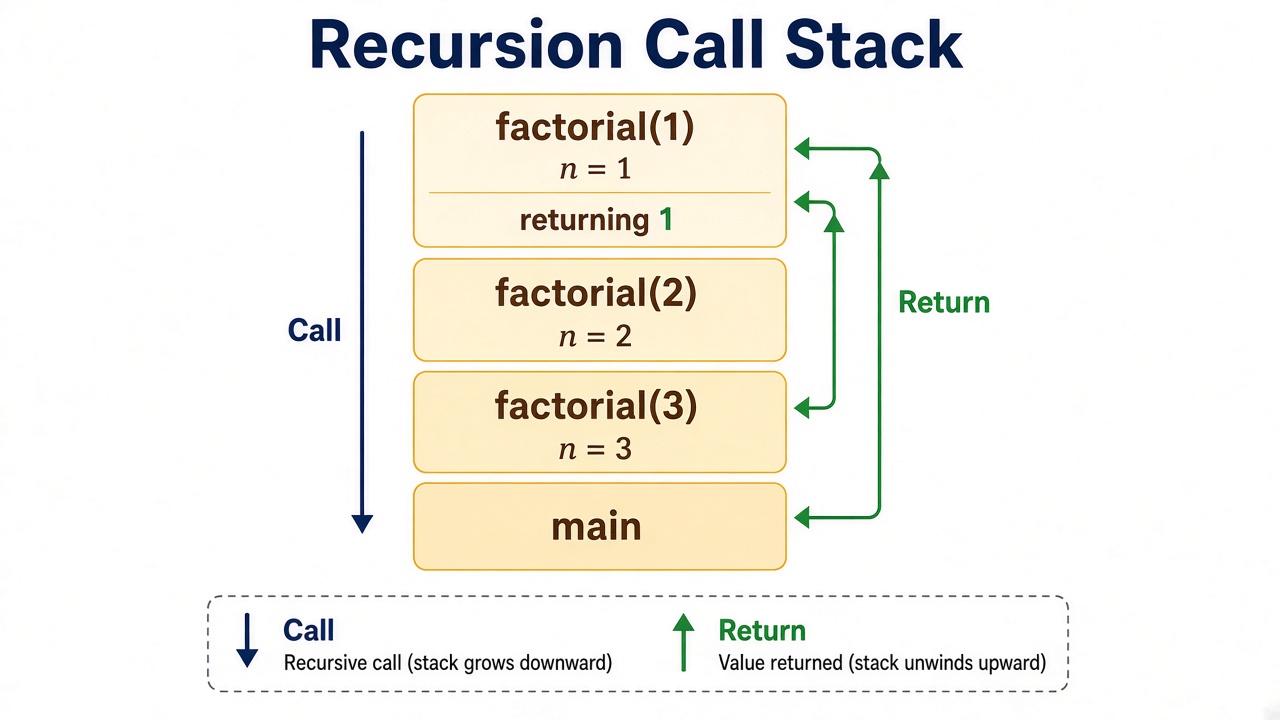
factorial(n) = n * factorial(n-1) with base case factorial(0) = 1.
Each call is placed on the call stack and removed as it returns.
Without a base case, or without progress toward it, Python raises RecursionError when the depth passes the limit (default about 1000; see `sys.
getrecursionlimit()`).
Naive Fibonacci repeats work exponentially; memoization with `functools.
lru_cache` stores results and makes it linear.
Recursion suits trees, nested data, divide-and-conquer (binary search, merge sort) and backtracking.
An iterative loop is usually faster and uses less memory in Python because there is no tail-call optimisation.
Steps for writing: (1) write the base case, (2) trust the function for n-1, (3) combine.
Key points
- Base case: Condition that ends the recursion.
- Recursive case: Call to itself with a smaller input.
- Call stack: Memory structure holding active function calls.
- Memoization: Caching results to avoid repeated work.
Read more
Example
CodeRecursion: base case, recursive case, memoization:
def factorial(n):
if n == 0: # base case
return 1
return n * factorial(n - 1) # recursive case
print(factorial(5)) # 120
def fib(n):
if n < 2:
return n
return fib(n - 1) + fib(n - 2)
print([fib(i) for i in range(8)]) # [0, 1, 1, 2, 3, 5, 8, 13]
def sum_digits(n):
if n < 10:
return n
return n % 10 + sum_digits(n // 10)
print(sum_digits(1234)) # 10
def reverse(s):
if len(s) <= 1:
return s
return reverse(s[1:]) + s[0]
print(reverse("python")) # nohtyp
def countdown(n):
if n == 0:
print("Go!")
return
print(n)
countdown(n - 1)
countdown(3) # 3 2 1 Go!
import sys
print(sys.getrecursionlimit()) # 1000 by default
def forever(n): # no base case
return forever(n + 1)
try:
forever(0)
except RecursionError:
print("too deep")
from functools import lru_cache
@lru_cache(maxsize=None)
def fast_fib(n):
return n if n < 2 else fast_fib(n - 1) + fast_fib(n - 2)
print(fast_fib(60)) # 1548008755920Solved examples
Write a function that returns the largest of three numbers without using max().
Function
Formula Applied:—Approach note: Test with equal values as well.
Write a function using *args that returns the average of any number of values.
Function
Formula Applied:—Approach note: args is a tuple, so len() and sum() work directly.
Write a recursive function for the power x ** n (n >= 0).
Recursive function
Formula Applied:—Approach note: Use n // 2 splitting for O(log n) speed.
Sort words = ["pear", "fig", "banana"] by length using a lambda.
Sorted list
Formula Applied:—Approach note: key=len gives the same result.
Real-world applications
Using Python Functions in real projects
Every library, API handler, data pipeline and script.
Common mistakes
❌ Myth: A function without return gives nothing.
Why this is wrong: It returns None.
✅ Verified Truth: print(f()) shows None.
⚠️ Exam Tip: Common output question.
❌ Myth: Default list arguments are fresh on every call.
Why this is wrong: Defaults are evaluated once at definition time.
✅ Verified Truth: Use None as the default and create the list inside.
⚠️ Exam Tip: Classic interview trap.
❌ Myth: Recursion has no limit.
Why this is wrong: The call stack is finite.
✅ Verified Truth: Python stops with RecursionError near depth 1000.
⚠️ Exam Tip: Mention base case and memoization.
Revision notes
A function is a named, reusable block of code. You will learn defining functions with def, lambda functions, important built-in functions, *args and **kwargs, and recursion.
High-Yield Quick Revision Points
- def name(params): body; return gives the result, default None
- Default values are evaluated once; avoid mutable defaults
- lambda args: expression (single expression only)
- any/all, enumerate, zip, sorted, map, filter are built-in
- *args = tuple, **kwargs = dict; star at call site unpacks
- Recursion needs a base case; limit about 1000; use lru_cache
Practice questions
What does a function without a return statement return?
Inside a function, *args is a:
Inside a function, **kwargs is a:
Value of (lambda x, y: x + y)(2, 3)?
What error is raised when recursion has no base case?
What does round(2.5) return in Python 3?