Chapter 19 · Class 11-12 & JEE/NEET
Magnetic Effects of Current & Magnetism
68 topics · 16 sections · beginner-friendly study notes · Updated
Detailed notes with diagrams
2 full topic lessons from this chapter — diagram, table, examples and a quick check.
Steady currents produce magnetic fields described by the Biot–Savart law and Ampère’s law.
Moving charges and current-carrying wires feel the Lorentz force.
Bar magnets are dipole assemblies of atomic currents; magnetic materials are classified by susceptibility.
Together these ideas cover moving-coil instruments, solenoids and Earth’s magnetism for JEE and NEET.
Magnetic-effects and magnetism form a large chunk of Class 12 electrodynamics papers, often mixed with EMI in Advanced.
Electric motors, MRI magnets, relay switches, compass navigation and particle spectrometers all rely on B fields and Lorentz forces.
Biot–Savart Law
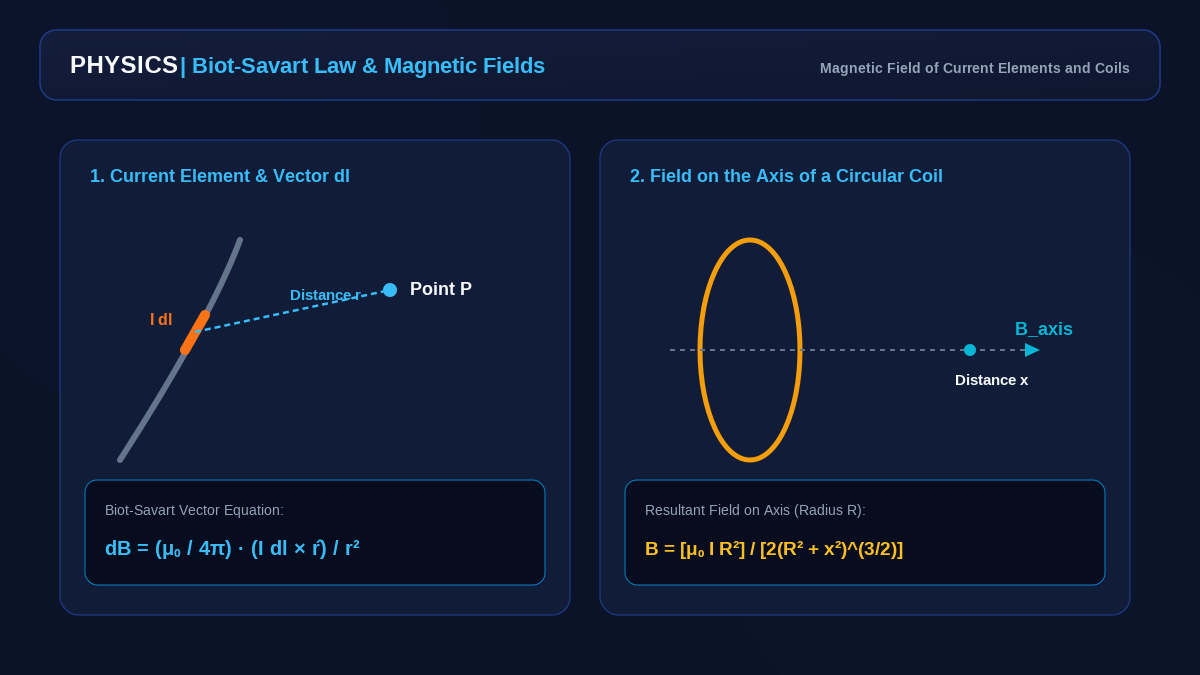
An infinitesimal current element Idl at a point produces dB = (μ₀/4π)(I dl × r̂)/r² at a displacement r from the element. The total field is the integral of dB over the wire. μ₀ = 4π × 10⁻⁷ T·m/A.
In short: Every tiny piece of current makes a little circling magnetic field; add them all with the right-hand rule to get the net B.
Think about it
It is the magnetic counterpart of Coulomb’s law for current sources. The field near a DC power cable falls as 1/r — relevant for magnetic interference with compasses and sensors.
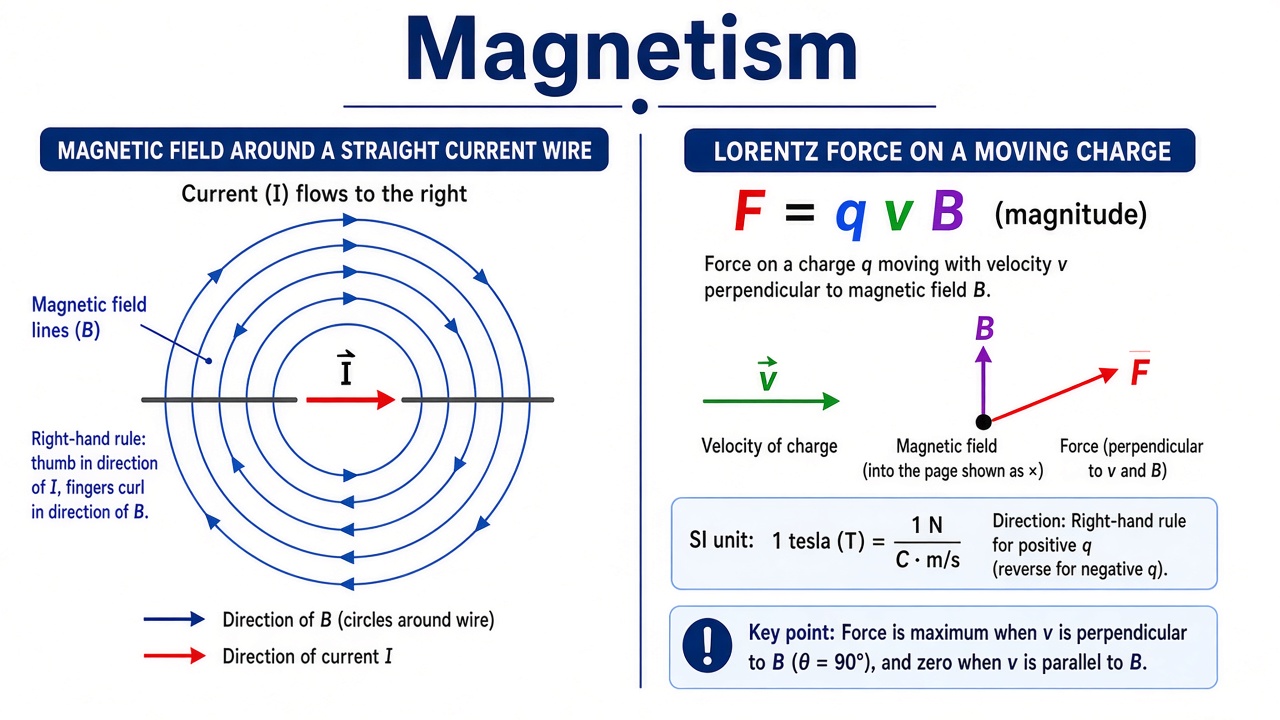
For an infinite straight wire, B = μ₀I/(2πr) with circular field lines.
At the centre of a circular loop of radius R, B = μ₀I/(2R); for N turns, multiply by N. On the axis of a loop, B = (μ₀/2)IR²/(R²+x²)^{3/2}.
A finite straight wire subtending angles α, β at the point gives B = (μ₀I/4πd)(sinα+sinβ).
Direction: thumb along I, fingers curl along B for a straight wire.
Key points
- Tesla: SI unit of B; 1 T = 1 N/(A·m).
- Current element: Idl vector along the local current.
- Biot–Savart always works; Ampère’s law is faster when symmetry is high.
- At the centre of an arc of angle φ (radians), B = (φ/2π)×(μ₀I/R) relative to full loop.
Biot–Savart
- I — Current (A)
Ampère’s Law & Solenoid
Ampère’s circuital law states ∮ B·dl = μ₀ I_enclosed for steady currents. A long solenoid of n turns per metre carries B ≈ μ₀ n I along its axis (ideal infinite solenoid), zero outside. A toroid has B = μ₀ N I/(2πr) inside the core and ≈ 0 outside.
In short: Walk around a closed path; the “circulation” of B equals μ₀ times the total current piercing the loop you walked.
Think about it
Solenoid/toroid fields are stock numericals and the basis of electromagnets. MRI main coils and particle-detector solenoids aim for highly uniform interior B.
Use Ampère only when |B| is constant on the path and B is tangent (or zero).
Infinite wire: circle of radius r recovers μ₀I/(2πr).
Solenoid: rectangular Amperian loop with one side inside gives Bℓ = μ₀(nℓ)I. Real solenoids have fringing; end field is roughly half the central field.
Inside a tightly wound toroid B varies as 1/r; often take mean radius.
Displacement current is not needed for magnetostatics of steady currents.
Key points
- Amperian loop: Closed path chosen to exploit symmetry of B.
- n: Turn density (turns per metre) of a solenoid.
- Outside ideal infinite solenoid B = 0; outside toroid B ≈ 0.
- I_enclosed is algebraic: opposite currents subtract.
Read more
Solenoid field
- n — Turns per metre (m^{-1})
Lorentz Force
A charge q moving with velocity v in fields E and B feels F = q(E + v × B). The magnetic part is always perpendicular to v, does no work, and can only change direction of velocity. For a wire, F = I ∫ dl × B.
In short: Magnetic fields shove moving charges sideways — never speeding them up or slowing them down by themselves.
Think about it
Motors, mass spectrometers and Hall-effect sensors are Lorentz-force machines. Auroras appear when solar-wind charges spiral along Earth’s magnetic field lines into the atmosphere.
Uniform B perpendicular to v gives circular motion with r = mv/(qB) and T = 2πm/(qB).
Pitch of a helix when v has a parallel component: p = v∥T. Parallel wires: currents in the same direction attract with F/ℓ = μ₀ I₁ I₂/(2πd).
Cyclotron frequency ω = qB/m is independent of speed (non-relativistic).
Velocity selector: E/B = v for undeflected charges.
Magnetic force on a closed loop in uniform B is zero; net torque may remain.
Key points
- Cyclotron radius: r = mv_⊥/(qB).
- Hall effect: Transverse voltage from v × B on charge carriers in a current-carrying strip.
- Magnetic force does no work ⇒ KE changed only by electric fields or other forces.
- F = 0 if v ∥ B or I ∥ B.
Read more
Lorentz force
- q — Charge (C)
Current Loop as Magnetic Dipole
A planar loop carrying current I with area vector A has magnetic moment μ = I A (direction by right-hand rule). In a uniform field, τ = μ × B and U = −μ·B. A bar magnet behaves as a dipole with μ along south→north inside the magnet.
In short: A current loop is a tiny magnet. Uniform B twists it into alignment the way a compass needle lines up.
Think about it
Links circuits to magnetism and explains meters and compass needles. Hard-disk write heads flip tiny magnetic domains using local current-loop fields.
For N turns, μ = NIA.
Potential energy minimum when μ ∥ B (stable).
Moving-coil galvanometer: τ = NIAB sinθ balanced by kθ in radial field so θ ∝ I. Ammeter: small shunt R_s = I_g R_g/(I − I_g) across galvanometer.
Voltmeter: series resistance R = V/I_g − R_g.
Axial B of a magnetic dipole: (μ₀/4π)(2μ/r³); equatorial half and opposite — same structure as electric dipole with μ₀/4π playing the role of 1/(4πε₀).
Key points
- Magnetic moment: μ = IA, unit A·m².
- Figure of merit: Current sensitivity of a galvanometer.
- Net F on a loop in uniform B is zero; in non-uniform B there is a force toward stronger field if μ aligned.
- Earth’s field ≈ 25–65 μT; declination and inclination describe its direction.
Read more
Dipole torque
- \mu — Magnetic moment (A·m²)
Magnetic Materials
In linear media B = μ₀(H + M) = μ₀μᵣ H with susceptibility χ = μᵣ − 1. Diamagnets have χ slightly negative; paramagnets small positive χ; ferromagnets large χ with hysteresis and Curie temperature above which they become para.
In short: Some materials make a weak opposing magnet when placed in a field (dia), some a weak aiding magnet (para), and some become strong permanent magnets (ferro).
Think about it
NEET especially asks classification tables; JEE links μᵣ to solenoid B = μ n I inside cores. Fridge magnets, transformer cores and MRI contrast agents exploit ferro/paramagnetism.
Diamagnetism arises from induced atomic currents (Lenz) and exists in all materials but is often masked.
Paramagnetism needs permanent atomic moments that partially align with B (Curie’s law χ ∝ 1/T).
Ferromagnets have domains; magnetisation curves show remanence and coercivity — soft iron for cores, steel for permanent magnets.
Relative permeability μᵣ ≫ 1 concentrates flux in transformer cores.
Superconductors are perfect diamagnets (Meissner effect) with χ = −1.
Key points
- Susceptibility χ: M = χH; measures magnetisation response.
- Curie temperature: Temperature where ferromagnetism vanishes.
- Dia: Bi, Cu, Au; Para: Al, O₂, Pt; Ferro: Fe, Co, Ni, Gd.
- In vacuum μᵣ = 1, χ = 0.
Earth’s Magnetism
Earth behaves approximately as a magnetic dipole tilted relative to the rotation axis. At a place, the field has horizontal component B_H, vertical component B_V, total B_T, dip angle δ (tanδ = B_V/B_H) and declination (angle between geographic and magnetic meridian).
In short: A compass reads the horizontal part of Earth’s field; the needle also wants to tilt up or down by the dip angle.
Think about it
Short theory + numerical items on tanδ still appear in NEET and boards. Airport runways and maps quote magnetic variation (declination) for navigation.
Magnetic elements: declination θ, inclination/dip δ, and B_H are the three quantities that fix the local field.
B_V = B_H tanδ, B_T = B_H/cosδ.
Apparent dip in a plane tilted from the magnetic meridian is less than true dip.
Neutral points appear where a bar magnet’s field cancels B_H.
Time variations include diurnal changes and magnetic storms from solar activity.
Key points
- Declination: Angle of magnetic meridian from geographic meridian.
- Inclination (dip): Angle of total field from horizontal.
- At magnetic equator δ = 0; at magnetic poles δ = 90°.
- B_H is what acts on a compass in the horizontal plane.
Comparisons
Dia vs para vs ferro
| Diamagnetic | Paramagnetic | Ferromagnetic | |
|---|---|---|---|
| χ | small negative | small positive | large positive |
| μᵣ | < 1 | > 1 (slightly) | ≫ 1 |
| Temp dependence | weak | Curie χ∝1/T | Curie–Weiss; domains |
| Examples | Cu, Bi, water | Al, O₂ | Fe, Co, Ni |
Educational Significance: Classification + χ sign is a frequent one-mark NEET pattern.
Solved examples
Find B at 5 cm from a long straight wire carrying 10 A.
- I = 10 A
- r = 0.05 m
B
Formula Applied:B=μ₀I/(2πr)Approach note: μ₀/2π = 2×10⁻⁷ simplifies arithmetic.
A circular coil of radius 10 cm and 100 turns carries 2 A. Find B at the centre.
- R=0.1 m
- N=100
- I=2 A
B_centre
Formula Applied:B=μ₀NI/(2R)Approach note: N multiplies the single-loop formula.
An electron with speed 10⁶ m/s enters B = 0.1 T perpendicularly. Find orbit radius. (m = 9.1×10⁻³¹ kg, e = 1.6×10⁻¹⁹ C)
- v=10⁶
- B=0.1 T
r
Formula Applied:r=mv/(qB)Approach note: Use v_⊥ only; parallel speed does not bend.
A solenoid has n = 1000 turns/m and I = 2 A. Find B on the axis (ideal).
- n=1000 m⁻¹
- I=2 A
B
Formula Applied:B=μ₀nIApproach note: Outside ideal solenoid B ≈ 0 — a common trap option.
Real-world applications
Magnetic Effects of Current & Magnetism outside the classroom
Electric motors, MRI magnets, relay switches, compass navigation and particle spectrometers all rely on B fields and Lorentz forces.
Common mistakes
❌ Myth: Magnetic force can change the speed of a charged particle.
Why this is wrong: Students confuse sideways push with acceleration magnitude change.
✅ Verified Truth: F_m ⊥ v so power F·v = 0; only direction changes.
⚠️ Exam Tip: KE formulas in pure B regions stay constant.
❌ Myth: Ampère’s law gives B for any shaped wire easily.
Why this is wrong: The integral equals μ₀I always, but pulling |B| out needs symmetry.
✅ Verified Truth: Use Biot–Savart for arbitrary shapes; Ampère for high symmetry.
⚠️ Exam Tip: If |B| varies on your path, do not write B×(2πr)=μ₀I blindly.
❌ Myth: Diamagnets are “non-magnetic” and never respond.
Why this is wrong: Everyday language hides the weak negative χ.
✅ Verified Truth: All materials have diamagnetism; it is just often tiny.
⚠️ Exam Tip: Remember χ < 0 and μᵣ < 1 for dia in tables.
Revision notes
Steady currents produce magnetic fields described by the Biot–Savart law and Ampère’s law. Moving charges and current-carrying wires feel the Lorentz force. Bar magnets are dipole assemblies of atomic currents; magnetic materials are classified by susceptibility. Together these ideas cover moving-coil instruments, solenoids and Earth’s magnetism for JEE and NEET.
High-Yield Quick Revision Points
- Wire: B=μ₀I/(2πr); loop centre μ₀I/(2R); solenoid μ₀nI.
- F=q(E+v×B); r=mv/(qB) for ⊥ motion.
- μ=IA; τ=μB sinθ.
- Dia χ<0; para χ>0 small; ferro domains.
Master Formula Cheat Sheet
Practice questions
B at the centre of a current-carrying circular arc of angle 60° and radius R is
Two parallel wires with currents in opposite directions
A wire of length 0.5 m carries 4 A perpendicular to B = 0.2 T. Force (N)?
Soft iron is preferred in transformer cores because
If dip angle is 30° and B_H = 2×10⁻⁵ T, B_V equals
Solved questions from this chapter
Real doubts students asked — full working and final answer, some with a video.