Chapter 11 · Class 11-12 & JEE/NEET
Thermal Properties of Matter
49 topics · 6 sections · beginner-friendly study notes · Updated
Temperature measures hotness and is defined operationally by the zeroth law of thermodynamics.
Matter expands when heated: solids have linear, area and volume coefficients related by β ≈ 2α, γ ≈ 3α.
Heat capacity and specific heat quantify energy needed to raise temperature; latent heats govern phase changes at constant temperature.
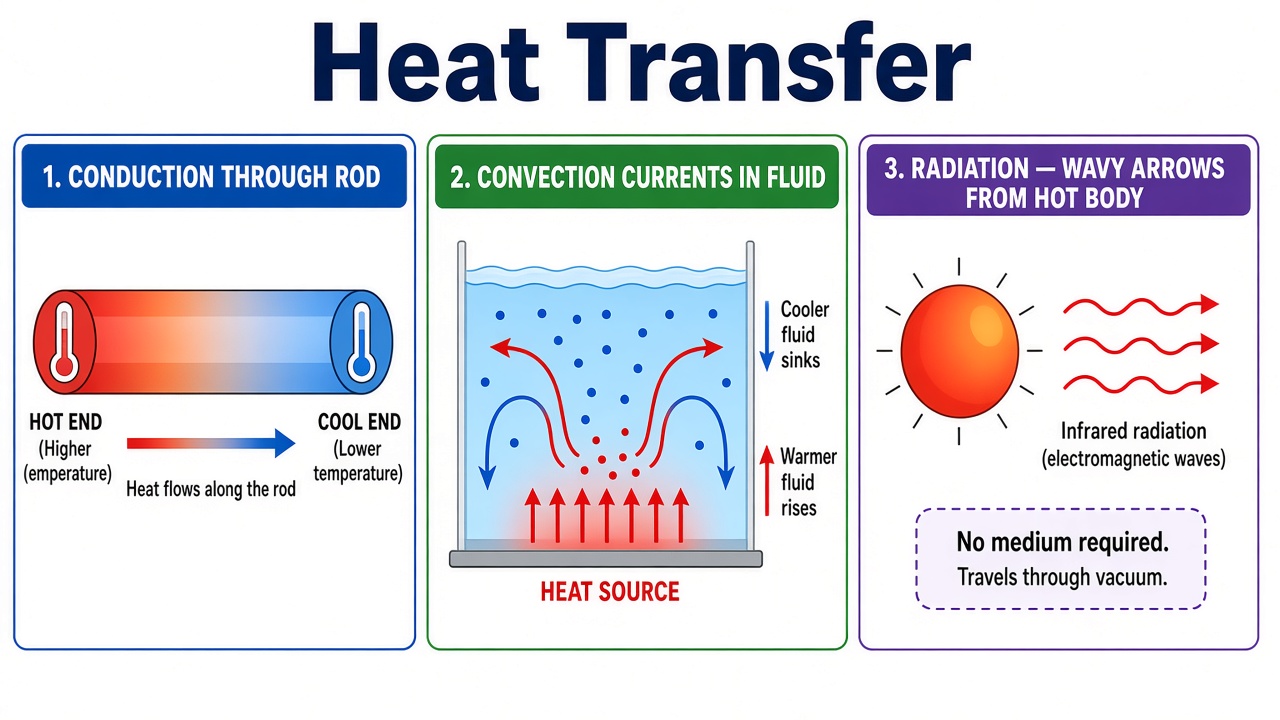
Conduction, convection and radiation transfer heat; Newton’s law of cooling and the Stefan–Boltzmann law quantify cooling rates.
Calorimetry, expansion and heat-transfer numericals are reliable marks in NEET and JEE Main.
Railway expansion gaps, bimetallic thermostats, building insulation and black-body pyrometry are everyday applications.
Temperature and the Zeroth Law
If two systems are each in thermal equilibrium with a third, they are in equilibrium with each other (zeroth law). This allows temperature as a common label. Celsius, Fahrenheit and Kelvin scales are related by linear mappings; absolute zero is 0 K = −273.15 °C.
In short: Temperature is what thermometers measure. If A matches C and B matches C, then A matches B — that is the zeroth law.
Think about it
Underpins every thermal measurement and the meaning of “same temperature”.
Ideal-gas temperature comes from PV ∝ T at constant volume/pressure extrapolations.
Triple point of water fixes the Kelvin scale (273.16 K).
Thermal equilibrium means no net heat flow.
A thermometer must be small enough not to disturb the system.
Rankine and Réaumur appear rarely in exams; focus on C ↔ F ↔ K conversions: T_K = T_C + 273.15, T_F = 1.8 T_C + 32.
Key points
- Thermal equilibrium: No net heat flow between systems in contact.
- Absolute temperature: Kelvin scale starting at absolute zero.
- ΔT is the same in °C and K.
- Ideal-gas thermometer is a primary standard conceptually.
- Zeroth law comes before first and second historically in logic, not discovery.
Thermal Expansion
Linear expansion: ΔL = L α ΔT. Area: ΔA = A β ΔT with β ≈ 2α. Volume: ΔV = V γ ΔT with γ ≈ 3α for isotropic solids. Liquids have only γ; apparent expansion in a vessel is γ_liquid − γ_vessel.
In short: Heat a metal rod and it gets slightly longer. Heat a hole in a plate and the hole gets larger too — every linear dimension scales.
Think about it
Expansion numericals and “hole expands” reasoning are frequent traps.
Bimetallic strips bend because two metals expand differently — used in thermostats.
Anomalous expansion of water: density maximum at 4 °C, so lakes freeze from the top and aquatic life survives.
A pendulum clock runs fast if α-effective makes L increase?
Actually longer L increases T = 2π√(L/g) so it runs slow when warmed.
Steel tape measures long on hot days if calibrated cold.
Exact formula L = L₀(1+αΔT) for finite ΔT still linear in the small-αΔT approximation.
Key points
- Coefficient α: Fractional length change per kelvin.
- Apparent expansion: Liquid expansion relative to the container.
- Isotropic solid: β = 2α, γ = 3α.
- Water between 0 and 4 °C contracts on heating.
- Thermal stress (fixed ends) = YαΔT.
Read more
Linear and volume expansion
- \alpha — Linear expansivity (K⁻¹)
Specific Heat and Calorimetry
Heat required to raise temperature: Q = m c ΔT = n C ΔT where c is specific heat and C molar heat capacity. Calorimetry assumes heat lost = heat gained for an isolated mixture (no phase change). Water’s c ≈ 4200 J/(kg·K) is high, moderating climates.
In short: Specific heat tells how much energy you must pour in to warm one kilogram by one degree. Water needs a lot; metals need less.
Think about it
Mixture problems are among the most common NEET thermal numericals.
Principle of mixtures: Σ m c ΔT = 0 with signed ΔT, or equate magnitudes carefully.
Water equivalent of a calorimeter is m_c c_c / c_water.
Specific heat of gases needs care (C_p vs C_v) — deferred to thermodynamics/kinetic theory.
Heating curve of ice→water→steam shows slopes inversely related to c and flat latent-heat segments.
Avoid assuming final state; check if all ice melts.
Key points
- Water equivalent: Mass of water with same heat capacity as the calorimeter.
- Molar heat capacity: Heat to raise 1 mol by 1 K.
- 1 cal/(g·°C) = 4200 J/(kg·K) approx for water.
- Metals: c roughly decreases as atomic mass increases (Dulong–Petit for molar).
- Always track units: grams vs kilograms.
Sensible heat
- c — Specific heat (J/(kg·K))
Latent Heat and Phase Change
Latent heat L is heat per unit mass to change phase at constant temperature: Q = mL. L_f (fusion) for ice≈3.35×10⁵ J/kg; L_v (vaporisation) for water≈2.26×10⁶ J/kg. During phase change, temperature stays constant while potential energy of molecular arrangement changes.
In short: Melting ice or boiling water eats heat without a temperature rise — that “hidden” heat is latent heat.
Think about it
Phase-change bookkeeping decides the final state in mixture problems.
Regelation: pressure melting under ice skates (qualitative).
Sublimation: solid to vapour (camphor, dry ice).
In calorimetry with ice, compute heat to bring ice to 0 °C, then melt, then warm water — stop when heat budget is exhausted.
Boiling point rises with pressure; melting point of ice falls with pressure (anomalous).
Steam burns are severe because of large L_v released on condensation.
Key points
- Fusion: Solid ↔ liquid transition.
- Vaporisation: Liquid ↔ gas transition.
- Q = mL only at the phase-change temperature for that pressure.
- Condensation releases +mL_v to the surroundings.
- Partial melting: leftover ice + water at 0 °C.
Heat Transfer: Conduction and Convection
Conduction: heat current H = dQ/dt = KA (T₁−T₂)/x for a slab in steady state. Thermal resistance R = x/(KA); series slabs add R. Convection is heat carried by bulk fluid motion (natural or forced).
In short: A metal spoon in hot tea warms by conduction through the metal; boiling soup mixes heat by moving liquid — convection.
Think about it
Slab and series-slab conduction numericals are standard.
Steady state means temperatures at each point constant in time while heat still flows.
Analogous to electrical Ohm’s law: H ↔ I, ΔT ↔ V, R_thermal ↔ R. Compound walls and lagged pipes use series/parallel resistances.
Good conductors (metals) have large K; wood, air, styrofoam small K. Critical radius of insulation for cylinders is a niche JEE topic.
Convection currents drive land–sea breezes and room heaters.
Key points
- Thermal conductivity K: Material constant in H = KAΔT/x.
- Steady state: ∂T/∂t = 0 at each point; H same through each cross-section in 1D.
- Series: H same, ΔT adds; parallel: ΔT same, H adds.
- Temperature gradient is steeper in the poorer conductor in series.
- Vacuum flask: minimise conduction and convection with vacuum jacket.
Read more
Conduction
- K — Thermal conductivity (W/(m·K))
Radiation and Newton’s Law of Cooling
All bodies emit thermal radiation. Stefan–Boltzmann law: power radiated = eσA T⁴ where T is absolute temperature, σ = 5.67×10⁻⁸ W/(m²·K⁴), e = emissivity (0 to 1). Net power ≈ eσA(T⁴ − T₀⁴). Newton’s law of cooling: dT/dt ∝ (T − T₀) for small excess temperature (also for forced convection).
In short: Hot objects glow and cool by sending out invisible infrared. The hotter they are (in kelvin), the more fiercely they radiate — T⁴ is strong.
Think about it
Stefan and Newton cooling questions appear in both conceptual and numerical form.
Good absorbers are good emitters (Kirchhoff).
Black body e = 1.
Wien’s displacement law λ_max T = constant explains why hotter stars look bluer.
Greenhouse effect: glass passes visible, blocks IR.
Newton’s cooling follows from linearising T⁴ − T₀⁴ ≈ 4T₀³ (T−T₀) or from convection correlations.
Plot of ln(T−T₀) vs t is linear under Newton’s law.
Key points
- Emissivity e: Fraction of black-body emission; also absorptivity in equilibrium.
- Black body: Ideal absorber/emitter with e = 1.
- Net rate uses T⁴ − T_surr⁴.
- Polished silver: low e; lampblack: high e.
- Newton: valid when ΔT not too large compared with T₀.
Stefan and Newton cooling
- \sigma — Stefan constant (W/(m²·K⁴))
Comparisons
Conduction vs convection vs radiation
| Conduction | Convection | Radiation | |
|---|---|---|---|
| Medium needed | Yes (material) | Yes (fluid) | No (works in vacuum) |
| Mechanism | Molecular collisions / free electrons | Bulk flow of fluid | EM waves |
| Key law | H = KAΔT/x | Newton cooling (approx) | P = eσAT⁴ |
| Example | Metal rod | Boiling water | Sunlight, IR from heater |
Educational Significance: Identify the dominant mode before choosing a formula.
Solved examples
A steel rod of length 1 m, α = 1.2×10⁻⁵ /K, heats by 100 °C. Find expansion.
- L = 1 m
- α = 1.2×10⁻⁵
- ΔT = 100
ΔL
Formula Applied:ΔL = LαΔTApproach note: ΔT in °C equals ΔT in K.
100 g water at 30 °C mixed with 50 g water at 90 °C. Find final temperature (ignore losses).
- m₁=100 g at 30 °C
- m₂=50 g at 90 °C
- same c
T_f
Formula Applied:m₁c(T_f−30)=m₂c(90−T_f)Approach note: Heat gained = heat lost when no phase change and isolated.
A slab K = 200 W/(m·K), A = 0.1 m², thickness 2 cm, faces at 100 °C and 0 °C. Find heat current.
- K=200
- A=0.1
- x=0.02
- ΔT=100
H
Formula Applied:H=KAΔT/xApproach note: Convert cm to m for x.
A black body is heated from 27 °C to 327 °C. By what factor does the total power it radiates increase?
- T₁ = 300 K
- T₂ = 600 K
- e = 1
P₂/P₁
Formula Applied:P ∝ T⁴Approach note: Always convert to kelvin before using T⁴.
Real-world applications
Thermal Properties of Matter outside the classroom
Railway expansion gaps, bimetallic thermostats, building insulation and black-body pyrometry are everyday applications.
Common mistakes
❌ Myth: A hole in a metal plate shrinks when the plate is heated.
Why this is wrong: Every linear dimension expands, including the hole diameter.
✅ Verified Truth: Treat the hole as filled with the same metal; that plug expands.
⚠️ Exam Tip: Hole expands with the plate’s α.
❌ Myth: Heat and temperature are the same quantity.
Why this is wrong: Temperature is intensive; heat is energy in transit due to temperature difference.
✅ Verified Truth: Q is in joules; T is in kelvin.
⚠️ Exam Tip: Never say “heat of a body” when you mean internal energy.
❌ Myth: Newton’s law of cooling always uses T⁴.
Why this is wrong: Newton is the linear law dΘ/dt ∝ Θ; Stefan is T⁴.
✅ Verified Truth: Use Newton for small excess temperature or when stated.
⚠️ Exam Tip: Match the law named in the question.
Revision notes
Temperature measures hotness and is defined operationally by the zeroth law of thermodynamics. Matter expands when heated: solids have linear, area and volume coefficients related by β ≈ 2α, γ ≈ 3α. Heat capacity and specific heat quantify energy needed to raise temperature; latent heats govern phase changes at constant temperature. Conduction, convection and radiation transfer heat; Newton’s law of cooling and the Stefan–Boltzmann law quantify cooling rates.
High-Yield Quick Revision Points
- Zeroth law ⇒ temperature; T_K = T_C + 273.
- ΔL = LαΔT; γ ≈ 3α; apparent γ_ℓ − γ_s.
- Q = mcΔT; Q = mL for phase change.
- H = KAΔT/x; series thermal resistances add.
- P = eσAT⁴; Newton: dT/dt ∝ (T−T₀).
- Water density max at 4 °C.
Master Formula Cheat Sheet
Practice questions
For an isotropic solid, volume expansivity γ is approximately:
How much heat (J) to raise 0.5 kg water by 20 °C? (c=4200)
In steady-state conduction through a wall, the heat current H is:
Ice at 0 °C needs how many joules to melt 0.1 kg? (L_f=3.35×10⁵)
Good absorbers of radiation are also:
Solved questions from this chapter
Real doubts students asked — full working and final answer.