Chapter 09 · Class 11-12 & JEE/NEET
Mechanical Properties of Solids
44 topics · 12 sections · beginner-friendly study notes · Updated
Solids resist changes in shape and size because interatomic forces act like tiny springs.
Stress is internal restoring force per unit area; strain is the fractional deformation.
Within the elastic limit Hooke’s law says stress ∝ strain, and the constants of proportionality are Young’s modulus Y, shear modulus G and bulk modulus B. Beyond the elastic limit materials yield, then may break at the ultimate or fracture stress.
Energy stored in a stretched wire is ½ × stress × strain × volume.
Elasticity numericals (Young’s modulus wires, bulk modulus of liquids/solids, energy stored) are staples of JEE Main and NEET.
Bridge cables, elevator ropes, building columns and pressure vessels are sized using stress, strain and safety factors from this chapter.
Elasticity and Interatomic Forces
Elasticity is the property of a body to regain its original shape and size when deforming forces are removed. Near equilibrium spacing, the interatomic force is approximately linear in displacement (Hookean), arising from the curvature of the interatomic potential-energy well.
In short: Atoms in a solid sit in balanced attraction and repulsion. Pull them slightly apart and they pull back; squeeze them and they push back — like microscopic springs.
Think about it
Connects the spring model used in problems to the atomic reason Hooke’s law works at small strain.
The potential energy vs separation curve has a minimum at r₀.
For small (r − r₀), U ≈ U₀ + ½ k (r − r₀)², so F = −k(r − r₀).
That microscopic k aggregates into macroscopic moduli.
Plastic deformation occurs when atomic planes permanently slip (dislocations).
Heating usually softens metals by helping dislocations move.
Perfect crystals are rare; real strength is limited by defects.
Key points
- Elastic limit: Maximum stress with full recovery on unloading.
- Plasticity: Permanent deformation beyond the elastic limit.
- Rubber can have large recoverable strain but is not linear Hookean over that whole range.
- Ductile materials show large plastic region; brittle ones fracture near the elastic limit.
- Annealing and work-hardening change dislocation structure and thus strength.
Stress and Strain
Stress is restoring force per unit area developed inside a body: σ = F/A (unit pascal). Longitudinal or tensile/compressive stress is normal to the area; shear (tangential) stress is parallel to the area; hydraulic stress is the uniform pressure in volume compression. Strain is dimensionless fractional change: longitudinal ΔL/L, shear x/L, volumetric ΔV/V.
In short: Stress is how hard the material is being pulled or pushed per square metre; strain is how much it stretches or squashes compared with its original size.
Think about it
Normalising force by area and change by original size lets different samples be compared fairly.
Engineering stress uses original area A₀; true stress uses instantaneous area.
For exam problems use A₀ unless stated otherwise.
Breaking stress (tensile strength) is the stress at fracture.
A wire with half the diameter has four times the stress for the same load.
Strain is not the same as displacement: a long wire stretches more than a short one under the same stress if Y is fixed (ΔL = FL/(AY)).
Oblique loading resolves into normal and shear components on a plane.
Key points
- Tensile stress: Pulling stress normal to the cross-section.
- Shear strain: Angular deformation; tan θ ≈ θ = x/L for small angles.
- 1 MPa = 10⁶ Pa; steel yield is typically hundreds of MPa.
- Hydraulic stress = ΔP applied to the fluid/solid surface.
- Same force, smaller A ⇒ larger stress ⇒ fails sooner.
Stress and strain
- \sigma — Stress (Pa)
- \varepsilon — Longitudinal strain (—)
Young's Modulus and Hooke's Law
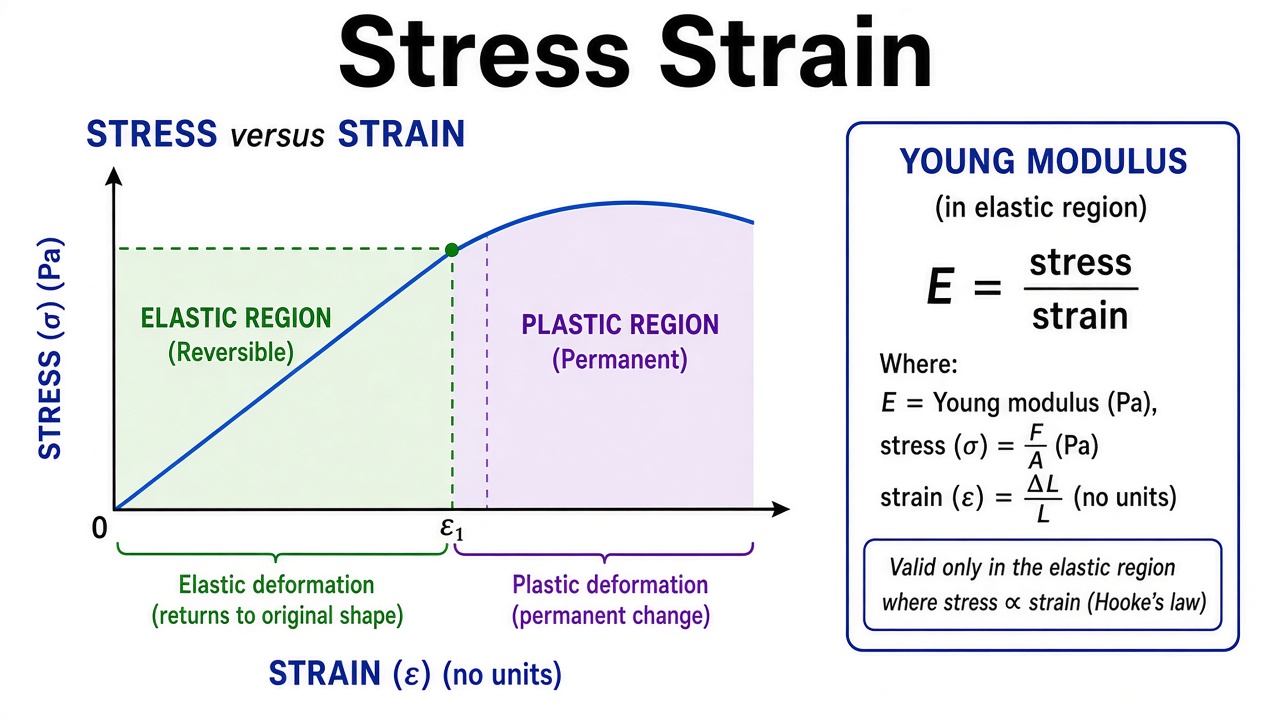
Within the proportional limit, longitudinal stress / longitudinal strain = Young’s modulus Y = (F/A)/(ΔL/L) = FL/(A ΔL). Hooke’s law also appears as F = kx with k = YA/L for a wire. Y is large for stiff materials (steel ~ 2×10¹¹ Pa) and smaller for soft ones.
In short: Y tells you how stubborn a material is against being stretched or compressed along its length. Bigger Y means less stretch for the same pull.
Think about it
Most board and JEE wire problems are direct applications of Y = FL/(AΔL).
Elongation ΔL = MgL/(πr²Y) for a hanging wire.
Two wires in series share the same tension; extensions add.
In parallel (same load distribution by stiffness) extensions match if ends are connected by a rigid bar.
Thermal stress in a constrained rod is Y α ΔT. Poisson’s ratio σ_p = −(lateral strain)/(longitudinal strain), typically 0.2–0.4 for metals; for incompressible rubber approaches 0.5.
Key points
- Proportional limit: End of linear stress–strain region.
- Poisson ratio: Negative ratio of lateral to longitudinal strain.
- k_eff for a wire = YA/L, like a spring constant.
- Thicker and shorter wires stretch less.
- Y is a material property — independent of sample shape in the linear isotropic model.
Read more
Young's modulus
- Y — Young's modulus (Pa)
Shear and Bulk Moduli
Shear modulus (modulus of rigidity) G = (shear stress)/(shear strain) = (F/A)/(x/L). Bulk modulus B = −ΔP / (ΔV/V); the compressibility is 1/B. Liquids have finite B but G ≈ 0; ideal fluids cannot sustain static shear.
In short: G measures resistance to sideways sliding of layers; B measures resistance to being squeezed from all sides.
Think about it
Completes the trio of moduli needed when loading is not pure tension.
Twisting a wire or shaft involves G (torsion formula τ = πηr⁴θ/(2L) in many textbooks with η ≡ G).
Volume strain under pressure is small for solids and larger for gases (for an ideal gas B = P for isothermal, γP for adiabatic — link to kinetic theory/thermodynamics).
Relations among elastic constants exist for isotropic solids: Y = 2G(1+σ_p) = 3B(1−2σ_p).
Rubber has small Y but is nearly incompressible (large B).
Key points
- Compressibility: κ = 1/B.
- Torsion: Twisting deformation of a shaft or wire.
- Negative sign in B keeps B positive when pressure increase shrinks volume.
- Steel: Y ≈ 2×10¹¹, G ≈ 0.8×10¹¹, B ≈ 1.4×10¹¹ Pa (order of magnitude).
- Fluids: quote B, not Y or G, for pressure problems.
Shear and bulk moduli
- G — Shear modulus (Pa)
- B — Bulk modulus (Pa)
Stress–Strain Curve and Elastic Energy
A stress–strain graph typically shows a linear Hookean region, then yield, a plastic region, ultimate tensile stress (maximum), and fracture. The area under the stress–strain curve up to a strain is the energy density (J/m³). For linear elasticity, energy density = ½ × stress × strain = ½ Y strain² = stress²/(2Y). Total energy U = ½ F ΔL for a wire.
In short: The graph is the material’s biography under pull. The area under it is the energy absorbed per unit volume — toughness if taken to fracture.
Think about it
Energy and curve-reading questions test conceptual depth beyond plugging into Y = FL/AΔL.
Loading and unloading in the plastic region leaves a permanent set; hysteresis loops represent energy dissipated as heat.
Proof stress is used when yield is not sharp.
Factor of safety = breaking stress / working (allowed) stress.
Sudden loading (matching velocities) can store twice the energy of gradual loading for the same max extension in idealised models — a classic comparison question.
Springs in series/parallel map to wires via k = YA/L.
Key points
- Ultimate stress: Maximum stress on the curve before necking/fracture.
- Energy density: Elastic energy per unit volume.
- Work by the external force equals stored energy if loading is quasi-static and elastic.
- Ductile materials absorb more energy before fracture (larger area).
- Brittle fracture: little plastic area; sudden failure.
Read more
Elastic energy
- U — Stored elastic energy (J)
Applications: Beams, Columns and Thermal Stress
A cantilever or simply supported beam bends under load; depression formulas involve Y and the geometry (e.g. δ = MgL³/(3YI) for an end-loaded cantilever). A rod fixed between rigid walls develops thermal stress YαΔT when temperature changes. Buckling of slender columns depends on Y and slenderness (Euler load).
In short: Bridges sag a little under traffic; railway rails need gaps or else summer heat would crush them with huge thermal stresses.
Think about it
Brings moduli into design-style problems that JEE sometimes frames as short numericals.
I here is the second moment of area of the cross-section, not mass moment of inertia — notation clash to watch.
For a rod free to expand, ΔL = LαΔT and stress is zero; if fully constrained, strain is forced to zero so stress = YαΔT. Partially constrained cases interpolate.
Elevator cables are oversized so working stress ≪ breaking stress (safety factor 5–10 often).
Key points
- Thermal stress: Stress from temperature change under constraint.
- Safety factor: Ratio of failure stress to allowed working stress.
- Free expansion: stress 0, strain αΔT.
- Fixed ends: strain 0, stress YαΔT.
- Beam stiffness rises with Y and with deeper cross-sections (larger I).
Comparisons
Y vs G vs B
| Young's Y | Shear G | Bulk B | |
|---|---|---|---|
| Deformation | Length change | Shape twist/slide | Volume change |
| Stress type | Longitudinal | Tangential | Hydraulic (pressure) |
| Strain | ΔL/L | x/L | ΔV/V |
| Fluids | Not defined (no fixed shape) | ≈ 0 static | Finite |
Educational Significance: Pick the modulus that matches how the load tries to deform the sample.
Solved examples
A steel wire of length 2 m and area 1 mm² stretches 1 mm under 200 N. Find Y.
- L = 2 m
- A = 10⁻⁶ m²
- ΔL = 10⁻³ m
- F = 200 N
Y
Formula Applied:Y = FL/(AΔL)Approach note: Convert mm² and mm carefully to metres.
Find the elastic energy stored in the wire of the previous example.
- F = 200 N
- ΔL = 1 mm
U
Formula Applied:U = ½ F ΔLApproach note: Same as area under F–ΔL graph for linear case.
A cube of side 0.1 m is subjected to a shearing force of 2000 N on its top face. Displacement of the top face is 0.1 mm. Find G.
- L = 0.1 m
- F = 2000 N
- x = 10⁻⁴ m
- A = 0.01 m²
G
Formula Applied:G = (F/A)/(x/L)Approach note: Strain = x/L, not x alone.
A rod of length L, area A, Young modulus Y is fixed between two rigid walls. Temperature rises by ΔT with linear expansion coefficient α. Find thermal stress.
- constrained rod
- α
- ΔT
- Y
stress
Formula Applied:stress = Y α ΔTApproach note: Fixed ends ⇒ total strain zero = thermal + mechanical.
Real-world applications
Mechanical Properties of Solids outside the classroom
Bridge cables, elevator ropes, building columns and pressure vessels are sized using stress, strain and safety factors from this chapter.
Common mistakes
❌ Myth: Strain is always less than 1 and stress is always less than Y.
Why this is wrong: Strain can exceed 1 for rubbers; stress vs Y comparison is meaningless as a universal rule.
✅ Verified Truth: Hooke’s law needs small strain in metals; check the elastic limit experimentally.
⚠️ Exam Tip: Use the linear formula only inside the proportional region.
❌ Myth: Breaking load depends only on the material, not on thickness.
Why this is wrong: Breaking stress is a material property; breaking load = stress × area.
✅ Verified Truth: Thicker wires carry larger loads before breaking.
⚠️ Exam Tip: Convert between load and stress with the actual cross-section.
❌ Myth: Bulk modulus is only for liquids.
Why this is wrong: Solids also have B; liquids simply cannot be described by Y or G in static shear.
✅ Verified Truth: B = −ΔP/(ΔV/V) for solids, liquids and gases.
⚠️ Exam Tip: Choose B whenever the loading is hydrostatic pressure.
Revision notes
Solids resist changes in shape and size because interatomic forces act like tiny springs. Stress is internal restoring force per unit area; strain is the fractional deformation. Within the elastic limit Hooke’s law says stress ∝ strain, and the constants of proportionality are Young’s modulus Y, shear modulus G and bulk modulus B. Beyond the elastic limit materials yield, then may break at the ultimate or fracture stress. Energy stored in a stretched wire is ½ × stress × strain × volume.
High-Yield Quick Revision Points
- Stress = F/A; strain = ΔL/L or x/L or ΔV/V.
- Y = (F/A)/(ΔL/L); G for shear; B = −ΔP/(ΔV/V).
- ΔL = FL/(AY); k = YA/L.
- U = ½ F ΔL = (stress²/(2Y)) × volume.
- Thermal stress (fixed) = YαΔT.
- Read yield, ultimate and fracture points on stress–strain curves.
Master Formula Cheat Sheet
Practice questions
SI unit of Young’s modulus is the same as that of:
A wire of Y = 2×10¹¹ Pa, L = 1 m, A = 2 mm² stretches under 100 N. Find ΔL in mm.
Energy density in a stretched wire equals:
Pressure increase 2×10⁶ Pa reduces volume by 0.1%. Find B in Pa.
Poisson’s ratio is the ratio of:
Solved questions from this chapter
Real doubts students asked — full working and final answer.