Chapter 07 · Class 11-12 & JEE/NEET
Rotational Motion
61 topics · 13 sections · beginner-friendly study notes · Updated
Rotational motion of a rigid body is described by the same angular variables as circular motion, but now every mass element shares one ω about an axis.
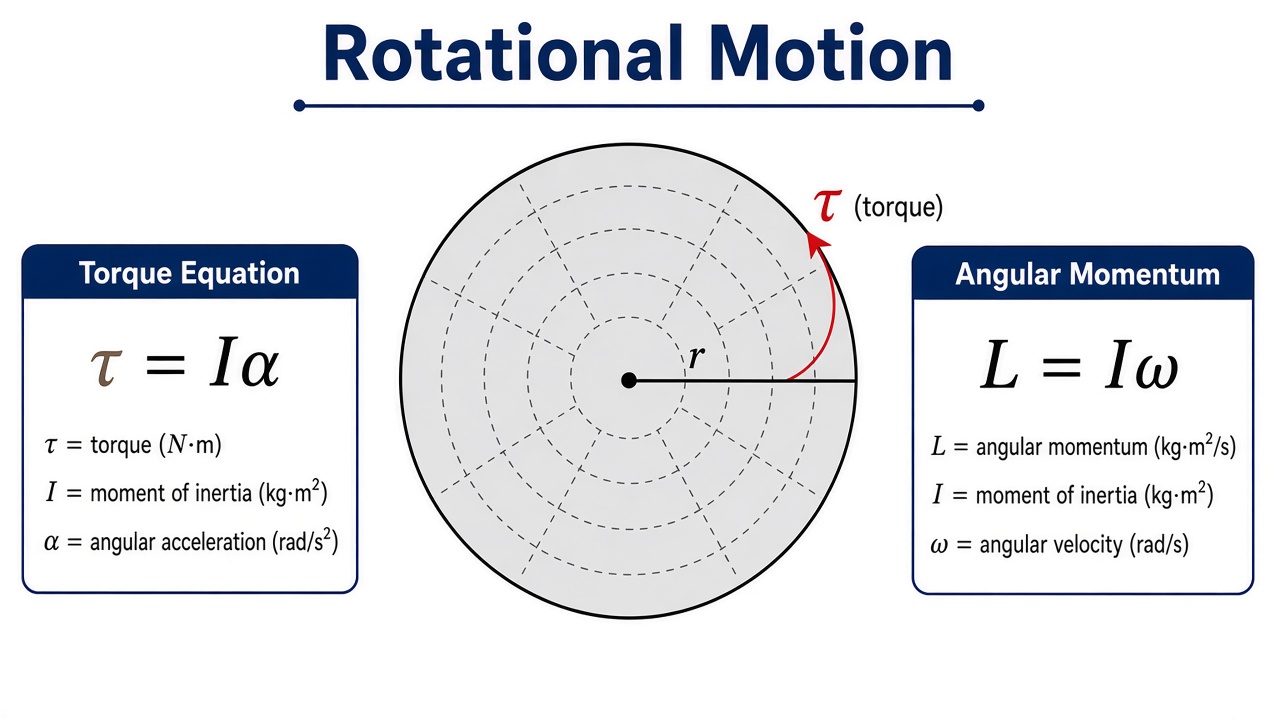
Torque τ = r × F plays the role of force; moment of inertia I plays the role of mass; and τ_net = Iα is the rotational form of Newton’s second law.
Angular momentum L = Iω is conserved when net external torque is zero.
Rolling without slipping links translation of the CM with rotation about the CM through v_cm = ωR. Rotation is among the highest-weightage Class 11 mechanics chapters in JEE Advanced and appears regularly in NEET as rolling and angular-momentum problems.
Flywheels store energy, gyroscopes maintain orientation, and vehicle stability depends on rolling dynamics and moment of inertia.
Moment of Inertia
The moment of inertia of a system about an axis is I = Σ m_i r_i² = ∫ r² dm, where r is the perpendicular distance from the axis. It measures resistance to angular acceleration about that axis. SI unit kg·m².
In short: Mass tells you how hard it is to push something straight; moment of inertia tells you how hard it is to spin it. Mass far from the axis counts much more.
Think about it
I is the rotational analogue of mass in τ = Iα and in KE = ½Iω².
Standard results (about CM, symmetry axis): thin ring/hoop MR²; solid cylinder/disc ½MR²; hollow thin sphere ⅔MR²; solid sphere ⅖MR²; thin rod about centre perpendicular to length ML²/12; about end ML²/3.
Parallel-axis theorem: I = I_cm + Md² for an axis parallel to one through the CM.
Perpendicular-axis theorem (planar lamina): I_z = I_x + I_y.
I is always positive and depends on the axis — quoting I without the axis is incomplete.
Key points
- Radius of gyration: k where I = Mk²; k is an equivalent distance.
- Parallel-axis theorem: I = I_cm + Md² for parallel axes.
- Disc about diameter: (1/4)MR² by perpendicular-axis theorem.
- Removing mass decreases I; shifting mass outward increases I sharply.
- For composite bodies add I of parts about the same axis.
Read more
Moment of inertia
- d — Distance between parallel axes (m)
Torque and Rotational Dynamics
Torque of a force F about a point is τ = r × F, magnitude rF sin θ = F × perpendicular lever arm. For a rigid body about a fixed axis, Σ τ_ext = Iα. For a free body one may write Σ τ_cm = I_cm α about the CM.
In short: Push far from a hinge and the door turns easily; push toward the hinge and it hardly moves — that is torque.
Think about it
Turns force problems into spin problems with a single scalar equation about a smart axis.
Equilibrium of a rigid body needs Σ F = 0 and Σ τ = 0 about any point.
Choosing the point where unknown forces act eliminates them from the torque equation.
Sign of torque: sense of intended rotation.
Variable torque: integrate α = τ(θ)/I. Rotational impulse ∫ τ dt = ΔL. A couple (two equal opposite forces) has torque independent of the reference point and equal to force × separation.
Key points
- Lever arm: Perpendicular distance from axis to the line of force.
- Couple: Pure moment with zero net force.
- Gravity acts at the CM for torque purposes (Mg through CM).
- Friction can provide torque that speeds or slows rolling.
- Hinge forces do no torque about the hinge — useful pivot choice.
Rotational Newton law
- I — Moment of inertia about the axis (kg·m²)
Angular Momentum
For a particle, L = r × p. For a rigid body about a fixed axis, L = Iω along the axis (for principal axes). Newton’s law in angular form: τ_ext = dL/dt. If τ_ext = 0, L is conserved.
In short: Angular momentum is the “quantity of rotation”. Ice skaters pull in their arms to spin faster because L = Iω stays the same while I drops.
Think about it
L conservation solves problems where impulsive hinge forces or internal rearrangements make energy or linear momentum awkward.
About the CM, L_total = R_cm × M v_cm + I_cm ω for planar motion.
Conservation applies to systems with zero external torque — collisions on a smooth table, a person on a rotating platform, planetary motion about the sun (Kepler’s second law).
A bullet embedding in a free rod: linear momentum is not conserved if the rod is hinged, but angular momentum about the hinge is conserved if the hinge impulse has no moment.
Kinetic energy is usually not conserved in such inelastic captures.
Key points
- Spin angular momentum: I_cm ω about the CM.
- Orbital angular momentum: R_cm × M v_cm of the CM motion.
- Skater: I₁ω₁ = I₂ω₂; KE increases when I decreases (muscles do work).
- Direction by right-hand rule.
- For non-principal axes L may not be parallel to ω (advanced).
Read more
Angular momentum
- L — Angular momentum (kg·m²/s)
Rotational Kinetic Energy and Work
A rigid body rotating about a fixed axis has KE = ½ I ω². If the body also translates, total KE = ½ M v_cm² + ½ I_cm ω². Work by torque W = ∫ τ dθ equals the change in rotational KE about that axis.
In short: A spinning wheel stores energy in its rotation just as a moving block stores energy in its speed.
Think about it
Energy methods avoid finding friction when it does no work in pure rolling on a static surface.
For pure rolling on a fixed surface, KE = ½ M v_cm² (1 + I_cm/(MR²)) = ½ M v_cm² (1 + k²/R²).
A solid sphere (k²/R² = 2/5) needs less PE height to reach a given v than a hoop (k²/R² = 1) on an incline — spheres win races.
Power P = τω.
Potential energy is unchanged by pure rotation about a fixed CM height; rolling down a hill converts PE into both translational and rotational KE.
Key points
- Pure rolling KE factor: 1 + I/(MR²) multiplies ½Mv².
- Instantaneous axis: Point of contact at rest; KE = ½ I_p ω².
- Static friction does no work in pure rolling on a stationary road (contact point at rest).
- Sliding friction dissipates energy until pure rolling starts.
- Flywheel energy ½Iω² smooths engine power delivery.
Read more
Kinetic energy of a rigid body
- \omega — Angular speed about CM (rad/s)
Rolling Motion
Pure rolling without slipping on a fixed surface means v_cm = ωR and a_cm = αR (signs by sense of rotation). The point of contact is instantaneously at rest. Friction may be static and need not equal μN; it only has to satisfy |f| ≤ μN and provide the required a and α.
In short: A wheel that rolls without skidding moves forward exactly one circumference per revolution.
Think about it
Connects translation and rotation with one constraint, reducing degrees of freedom.
On an incline of angle θ, for pure rolling: Mg sin θ − f = Ma, fR = Iα = I a/R, so a = g sin θ / (1 + I/(MR²)).
Friction acts up the plane for rolling down.
If the surface is too smooth, the body slides with kinetic friction and ω builds until v = ωR. Toppling before sliding occurs when the line of weight falls outside the base before friction is overcome — compare μ with horizontal acceleration conditions for blocks and cubes.
Key points
- No-slip condition: v_cm = ωR for rolling without slipping.
- Toppling: Rotation over an edge when torque of weight overcomes stability.
- Acceleration down incline: sphere > disc > hoop for same M, R, θ.
- Velocity of top point in pure rolling is 2v_cm.
- Backward friction can accelerate rotation for a sliding body pushed forward.
Read more
Rolling down an incline
- I — I about CM (kg·m²)
Combined Translation and Rotation
General plane rigid-body motion is the translation of the CM plus rotation about the CM. Velocity of a point is v_cm + ω × r_rel. Equivalently one may use rotation about the instantaneous axis of rotation (IAOR) when a point of the body is at rest.
In short: A flipping phone in the air: the CM follows a parabola while the phone spins about the CM.
Think about it
Gives a systematic way to analyse any planar rigid-body problem in the syllabus.
Angular momentum and torque theorems about the CM hold even if the CM accelerates, provided you use I_cm.
About a fixed point O they hold if O is fixed in an inertial frame.
For rolling without slipping the contact point is the IAOR; speeds scale with distance from that point.
A rod hinged at one end uses the hinge as axis with I_hinge = I_cm + Md².
Key points
- IAOR: Instantaneous axis of rotation through the rest point.
- Relative position r_rel: Vector from CM to the point of interest.
- v_A = v_cm + ω × r_{A/cm}.
- KE computed about IAOR equals ½ I_IAOR ω².
- Choose CM or hinge strategically to simplify unknowns.
Comparisons
Translation vs rotation analogues
| Quantity | Translation | Rotation |
|---|---|---|
| Inertia | Mass M | Moment of inertia I |
| Newton II | F = Ma | τ = Iα |
| Momentum | p = Mv | L = Iω |
| Kinetic energy | ½Mv² | ½Iω² |
| Work | ∫ F dx | ∫ τ dθ |
Educational Significance: Map every linear formula to its angular twin when switching chapters.
Solved examples
A solid disc of mass 2 kg and radius 0.1 m spins at 10 rad/s about its central axis. Find its rotational KE and I.
- M = 2 kg
- R = 0.1 m
- ω = 10 rad/s
I and KE
Formula Applied:I = ½MR², KE = ½Iω²Approach note: Use the standard disc formula about the symmetry axis.
A solid sphere rolls without slipping down a 30° incline of height 7 m. Find speed at the bottom. (g = 10)
- h = 7 m
- sphere I = ⅖MR²
- θ = 30°
v_cm
Formula Applied:Mgh = ½Mv²(1 + I/MR²)Approach note: Height matters for energy; angle cancels if only speed is asked.
Torque 2 N·m acts on a wheel with I = 0.5 kg·m² starting from rest. Find α and ω after 4 s.
- τ = 2 N·m
- I = 0.5 kg·m²
- t = 4 s
α, ω
Formula Applied:α = τ/I, ω = αtApproach note: Same structure as F = ma problems.
A bullet of mass 10 g at 100 m/s hits perpendicularly and sticks at the end of a uniform rod of mass 1 kg and length 1 m hinged at the other end. Find angular speed just after impact.
- m = 0.01 kg
- u = 100 m/s
- M = 1 kg
- L = 1 m
ω
Formula Applied:m u L = (I_rod + m L²) ωApproach note: Hinge impulse has zero moment about the hinge, so L about hinge is conserved.
Real-world applications
Rotational Motion outside the classroom
Flywheels store energy, gyroscopes maintain orientation, and vehicle stability depends on rolling dynamics and moment of inertia.
Common mistakes
❌ Myth: Moment of inertia is the same for every axis through a body.
Why this is wrong: I depends strongly on the axis direction and position.
✅ Verified Truth: Always state the axis; use parallel-axis theorem when shifting.
⚠️ Exam Tip: Look up or derive I for the exact axis in the problem.
❌ Myth: Friction must be μN whenever a body rolls.
Why this is wrong: In pure rolling friction is static and only as large as needed (≤ μN).
✅ Verified Truth: Set f from dynamics; then verify |f| ≤ μ_s N.
⚠️ Exam Tip: Do not replace f by μN unless slipping is stated or impending.
❌ Myth: Conservation of angular momentum requires conservation of kinetic energy.
Why this is wrong: They are independent; inelastic catches conserve L but lose KE.
✅ Verified Truth: Write L conservation when τ_ext = 0; check energy separately.
⚠️ Exam Tip: Hinged-rod bullet problems are classic inelastic + L conserved cases.
Revision notes
Rotational motion of a rigid body is described by the same angular variables as circular motion, but now every mass element shares one ω about an axis. Torque τ = r × F plays the role of force; moment of inertia I plays the role of mass; and τ_net = Iα is the rotational form of Newton’s second law. Angular momentum L = Iω is conserved when net external torque is zero. Rolling without slipping links translation of the CM with rotation about the CM through v_cm = ωR.
High-Yield Quick Revision Points
- I = ∫r² dm; parallel: I_cm + Md²; planar: I_z = I_x + I_y.
- Standards: hoop MR², disc ½MR², solid sphere ⅖MR², rod CM ML²/12.
- Στ = Iα; L = Iω; τ = dL/dt.
- KE = ½Mv_cm² + ½I_cm ω².
- Pure rolling: v = ωR; a = g sinθ/(1+I/MR²) on incline.
- Conserve L about a point if net external torque about it is zero.
Master Formula Cheat Sheet
Practice questions
I of a thin ring of mass M and radius R about a tangent parallel to its axis is:
A disc has I_cm = 0.1 kg·m². Find I about a parallel axis 0.2 m from CM if M = 2 kg.
In pure rolling the velocity of the point of contact relative to the ground is:
Solid cylinder rolls down height 3.75 m without slipping (g = 10). Find speed at bottom (m/s).
A man stands on a freely rotating platform with arms outstretched holding weights; he pulls the weights in. His angular speed: