Chapter 02 · NCERT
Acids, Bases and Salts
3 topics · 1 sections · beginner-friendly study notes · Updated
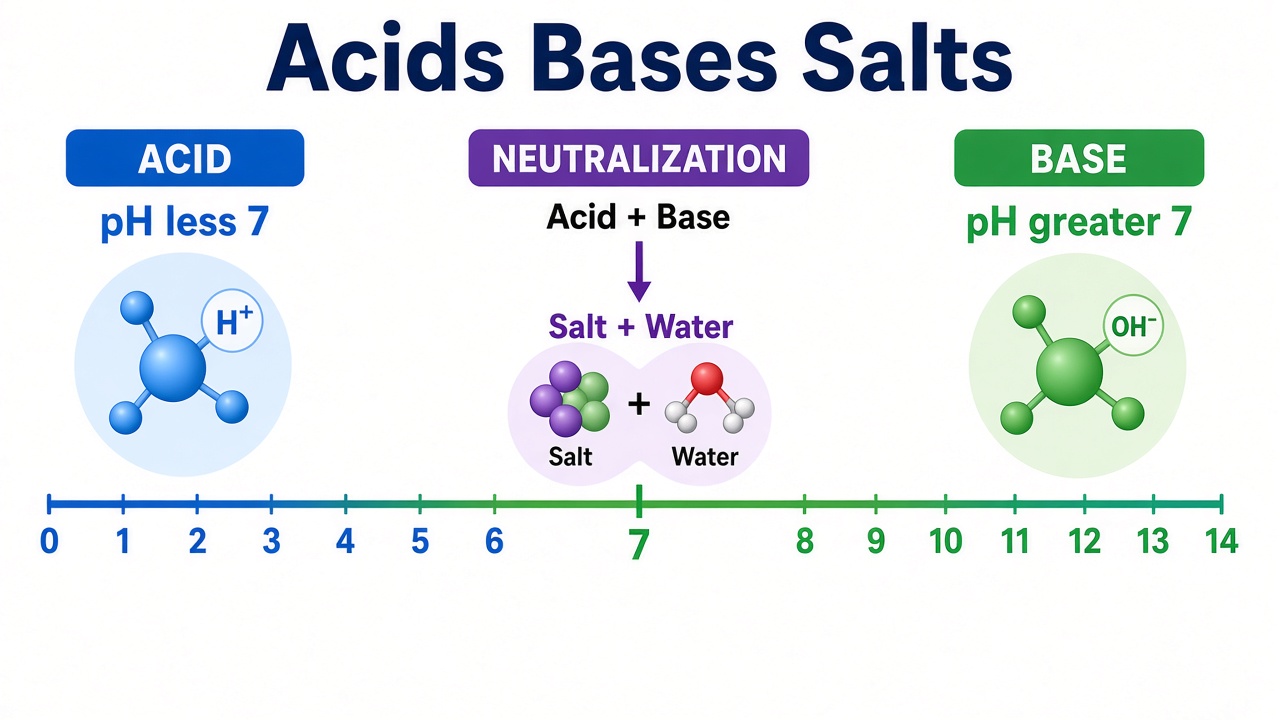
Acids release H⁺ (aq), bases release OH⁻ (aq); pH measures acidity on a 0–14 scale with 7 neutral at 25 °C. Indicators, salt preparations, and household chemicals (washing soda, baking soda, plaster of Paris, bleaching powder) dominate Class 10 numericals and application items.
Acids, Bases and Salts supplies steady marks through pathways, comparison tables and diagram labels in Class 10 · CBSE papers.
Field and clinical applications reuse Acids, Bases and Salts whenever the underlying process is measured, imaged or controlled.
Acid–Base Theories (Class 10)
In water, acids give H⁺, bases give OH⁻; alkaline solutions feel soapy; acids sour.
In short: Acidic solutions have extra H⁺; basic have extra OH⁻.
Think about it
NEET/boards repeatedly test Acid–Base Theories (Class 10) via definitions, diagrams and contrasts inside Acids, Bases and Salts. Applications of Acid–Base Theories (Class 10) appear in medicine, agriculture, ecology or technology whenever Acids, Bases and Salts concepts are measured or controlled.
Dilution caution; strong vs weak qualitative; olfactory and taste tests unsafe — use indicators.
Exam pathway for Acid–Base Theories (Class 10): write site → inputs → steps → products → regulation/failure mode.
Contrast Acid–Base Theories (Class 10) with the nearest confused neighbour before committing to an MCQ.
Keep one numeric landmark from Acids, Bases and Salts on your revision sheet and attach units.
Redraw the standard diagram for Acid–Base Theories (Class 10) from memory, then check labels.
In assertion–reason, demand that the reason actually explains the assertion.
Ordered recall beats scattered keywords: list intermediates, name the tissue or organelle, and state the condition (aerobic, illuminated, diploid, hormone-present) under which Acid–Base Theories (Class 10) applies in Acids, Bases and Salts.
Key points
- Acid–Base Theories: Core heading under Acids, Bases and Salts.
- Condition: State required for the process (site, oxygen, light, hormone, ploidy).
- Recite the pathway of Acid–Base Theories (Class 10) without looking at notes.
- Attach one named example or numeric cue (7) where relevant.
- Write one cause
→effect sentence suitable as an assertion.
Indicators and pH
Litmus, methyl orange, phenolphthalein; universal indicator; pH scale.
In short: Colour tells acid or base; pH number ranks strength.
Think about it
NEET/boards repeatedly test Indicators and pH via definitions, diagrams and contrasts inside Acids, Bases and Salts. Applications of Indicators and pH appear in medicine, agriculture, ecology or technology whenever Acids, Bases and Salts concepts are measured or controlled.
pH 7 neutral water 25 °C; <7 acid; >7 base.
Soil/body pH relevance.
Exam pathway for Indicators and pH: write site → inputs → steps → products → regulation/failure mode.
Contrast Indicators and pH with the nearest confused neighbour before committing to an MCQ.
Keep one numeric landmark from Acids, Bases and Salts on your revision sheet and attach units.
Redraw the standard diagram for Indicators and pH from memory, then check labels.
In assertion–reason, demand that the reason actually explains the assertion.
Ordered recall beats scattered keywords: list intermediates, name the tissue or organelle, and state the condition (aerobic, illuminated, diploid, hormone-present) under which Indicators and pH applies in Acids, Bases and Salts.
Key points
- Indicators and: Core heading under Acids, Bases and Salts.
- Condition: State required for the process (site, oxygen, light, hormone, ploidy).
- Recite the pathway of Indicators and pH without looking at notes.
- Attach one named example or numeric cue (7) where relevant.
- Write one cause
→effect sentence suitable as an assertion.
Acid–Base Reactions
Neutralisation; reaction with metals, carbonates, hydrogen carbonates.
In short: Acid + base → salt + water; acids free H₂ from some metals.
Think about it
NEET/boards repeatedly test Acid–Base Reactions via definitions, diagrams and contrasts inside Acids, Bases and Salts. Applications of Acid–Base Reactions appear in medicine, agriculture, ecology or technology whenever Acids, Bases and Salts concepts are measured or controlled.
Write ionic forms mentally; CO₂ limewater test milky.
Exam pathway for Acid–Base Reactions: write site → inputs → steps → products → regulation/failure mode.
Contrast Acid–Base Reactions with the nearest confused neighbour before committing to an MCQ.
Keep one numeric landmark from Acids, Bases and Salts on your revision sheet and attach units.
Redraw the standard diagram for Acid–Base Reactions from memory, then check labels.
In assertion–reason, demand that the reason actually explains the assertion.
Ordered recall beats scattered keywords: list intermediates, name the tissue or organelle, and state the condition (aerobic, illuminated, diploid, hormone-present) under which Acid–Base Reactions applies in Acids, Bases and Salts.
Key points
- Acid–Base Reactions: Core heading under Acids, Bases and Salts.
- Condition: State required for the process (site, oxygen, light, hormone, ploidy).
- Recite the pathway of Acid–Base Reactions without looking at notes.
- Attach one named example or numeric cue (7) where relevant.
- Write one cause
→effect sentence suitable as an assertion.
Salts and Families
Family of salts from same acid/base; acidic/basic/neutral salts; water of crystallisation.
In short: Salts remember their parent acid/base.
Think about it
NEET/boards repeatedly test Salts and Families via definitions, diagrams and contrasts inside Acids, Bases and Salts. Applications of Salts and Families appear in medicine, agriculture, ecology or technology whenever Acids, Bases and Salts concepts are measured or controlled.
NaCl, Na₂CO₃·10H₂O, CuSO₄·5H₂O; gypsum CaSO₄·2H₂O. Exam pathway for Salts and Families: write site → inputs → steps → products → regulation/failure mode.
Contrast Salts and Families with the nearest confused neighbour before committing to an MCQ.
Keep one numeric landmark from Acids, Bases and Salts on your revision sheet and attach units.
Redraw the standard diagram for Salts and Families from memory, then check labels.
In assertion–reason, demand that the reason actually explains the assertion.
Ordered recall beats scattered keywords: list intermediates, name the tissue or organelle, and state the condition (aerobic, illuminated, diploid, hormone-present) under which Salts and Families applies in Acids, Bases and Salts.
Key points
- Salts and: Core heading under Acids, Bases and Salts.
- Condition: State required for the process (site, oxygen, light, hormone, ploidy).
- Recite the pathway of Salts and Families without looking at notes.
- Attach one named example or numeric cue (7) where relevant.
- Write one cause
→effect sentence suitable as an assertion.
Important Compounds
NaOH, bleaching powder, baking soda, washing soda, plaster of Paris — prep and uses.
In short: Factory and home chemicals from salt chemistry.
Think about it
NEET/boards repeatedly test Important Compounds via definitions, diagrams and contrasts inside Acids, Bases and Salts. Applications of Important Compounds appear in medicine, agriculture, ecology or technology whenever Acids, Bases and Salts concepts are measured or controlled.
Chlor-alkali; CaOCl₂; NaHCO₃; Na₂CO₃·10H₂O; CaSO₄·½H₂O sets with water.
Exam pathway for Important Compounds: write site → inputs → steps → products → regulation/failure mode.
Contrast Important Compounds with the nearest confused neighbour before committing to an MCQ.
Keep one numeric landmark from Acids, Bases and Salts on your revision sheet and attach units.
Redraw the standard diagram for Important Compounds from memory, then check labels.
In assertion–reason, demand that the reason actually explains the assertion.
Ordered recall beats scattered keywords: list intermediates, name the tissue or organelle, and state the condition (aerobic, illuminated, diploid, hormone-present) under which Important Compounds applies in Acids, Bases and Salts.
Key points
- Important Compounds: Core heading under Acids, Bases and Salts.
- Condition: State required for the process (site, oxygen, light, hormone, ploidy).
- Recite the pathway of Important Compounds without looking at notes.
- Attach one named example or numeric cue (7) where relevant.
- Write one cause
→effect sentence suitable as an assertion.
pH in Daily Life
Tooth enamel, acid rain, soil treatment, antacids, fire extinguisher NaHCO₃.
In short: pH control protects teeth, crops, stomach, fires.
Think about it
NEET/boards repeatedly test pH in Daily Life via definitions, diagrams and contrasts inside Acids, Bases and Salts. Applications of pH in Daily Life appear in medicine, agriculture, ecology or technology whenever Acids, Bases and Salts concepts are measured or controlled.
Enamel dissolves below ~5.5; liming soil; baking soda + acid extinguisher CO₂.
Exam pathway for pH in Daily Life: write site → inputs → steps → products → regulation/failure mode.
Contrast pH in Daily Life with the nearest confused neighbour before committing to an MCQ.
Keep one numeric landmark from Acids, Bases and Salts on your revision sheet and attach units.
Redraw the standard diagram for pH in Daily Life from memory, then check labels.
In assertion–reason, demand that the reason actually explains the assertion.
Ordered recall beats scattered keywords: list intermediates, name the tissue or organelle, and state the condition (aerobic, illuminated, diploid, hormone-present) under which pH in Daily Life applies in Acids, Bases and Salts.
Key points
- pH in: Core heading under Acids, Bases and Salts.
- Condition: State required for the process (site, oxygen, light, hormone, ploidy).
- Recite the pathway of pH in Daily Life without looking at notes.
- Attach one named example or numeric cue (7) where relevant.
- Write one cause
→effect sentence suitable as an assertion.
Comparisons
Acid vs base vs salt
| Acid | Base | Salt | |
|---|---|---|---|
| Ion in water | H⁺ | OH⁻ | Cation+anion |
| Litmus | Blue→red | Red→blue | Often neutral |
| pH | <7 | >7 | ~7 if neutral salt |
| Example | HCl | NaOH | NaCl |
Educational Significance: Classify the substance before predicting indicator colour.
Solved examples
State one defining feature of Acid–Base Theories (Class 10) and one standard example from Acids, Bases and Salts.
Feature + example
Formula Applied:—Approach note: Named examples carry marks.
Compare Acid–Base Theories (Class 10) with Indicators and pH on site and product (2 points each).
4 points
Formula Applied:—Approach note: Tables beat paragraphs in timed revision.
A linear flowchart of Acid–Base Reactions shows 4 ordered boxes. How many arrows connect them?
Number of arrows
Formula Applied:—Approach note: Flowchart arrow count is a quick numeric check.
Give one digit-bearing landmark used while revising Acids, Bases and Salts (include the digit 7).
Landmark with digit
Formula Applied:\mathrm{pH}=-\log_{10}[H^+]Approach note: Keep a one-page number bank per chapter.
Real-world applications
Acids, Bases and Salts outside the classroom
Field and clinical applications reuse Acids, Bases and Salts whenever the underlying process is measured, imaged or controlled.
Common mistakes
❌ Myth: pH 7 is always neutral in any solvent/temperature.
Why this is wrong: Defined for water at stated T.
✅ Verified Truth: Quote 25 °C water.
⚠️ Exam Tip: Board answers mention 7 for pure water.
❌ Myth: All salts are neutral to litmus.
Why this is wrong: Hydrolysis can make acidic/basic salts.
✅ Verified Truth: Check parent acid/base strength.
⚠️ Exam Tip: CuSO₄ solution acidic feel in texts.
❌ Myth: Diluting acid means pour water into concentrated acid.
Why this is wrong: Unsafe; acid into water with care.
✅ Verified Truth: Lab safety rule.
⚠️ Exam Tip: Exothermic dilution.
❌ Myth: Plaster of Paris is CaSO₄·2H₂O.
Why this is wrong: That is gypsum; PoP is hemihydrate.
✅ Verified Truth: CaSO₄·½H₂O.
⚠️ Exam Tip: Sets by reforming hydrate.
Revision notes
Acids release H⁺ (aq), bases release OH⁻ (aq); pH measures acidity on a 0–14 scale with 7 neutral at 25 °C. Indicators, salt preparations, and household chemicals (washing soda, baking soda, plaster of Paris, bleaching powder) dominate Class 10 numericals and application items.
High-Yield Quick Revision Points
- Acid–Base Theories (Class 10): definition → site → steps → example → contrast.
- Indicators and pH: definition → site → steps → example → contrast.
- Acid–Base Reactions: definition → site → steps → example → contrast.
- Salts and Families: definition → site → steps → example → contrast.
- Important Compounds: definition → site → steps → example → contrast.
- pH in Daily Life: definition → site → steps → example → contrast.
- pH 7 neutral
Master Formula Cheat Sheet
Practice questions
pH of pure water at 25 °C?
Phenolphthalein in base is:
Bleaching powder formula often written:
Tooth enamel damage risk rises when mouth pH falls below about:
Washing soda is:
Acid + base → salt + ?