Chapter 03 · NCERT
Life Processes
4 topics · 1 sections · beginner-friendly study notes · Updated
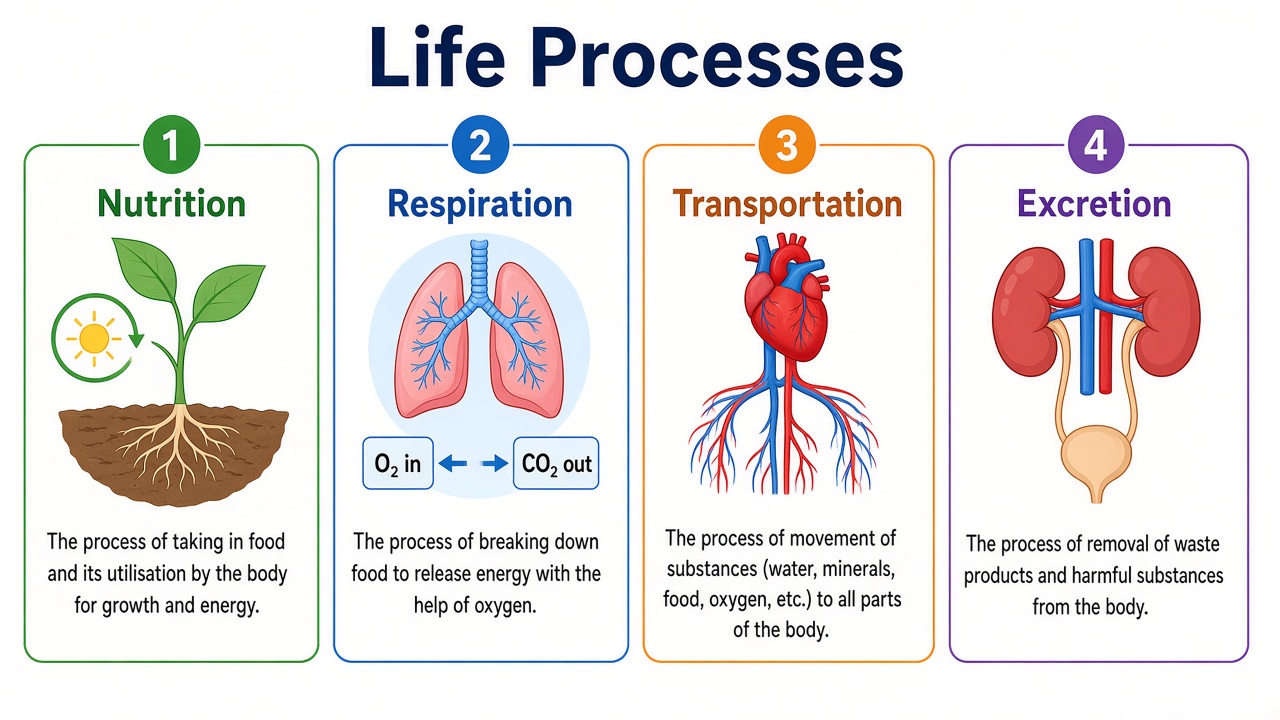
Life processes keep organisms alive: nutrition, respiration, transportation and excretion in plants and humans.
Class 10 emphasises autotroph vs heterotroph nutrition, stomatal gas exchange, human digestive/respiratory/circulatory/excretory outlines, and the glucose respiration equation.
Life Processes supplies steady marks through pathways, comparison tables and diagram labels in Class 10 · CBSE papers.
Field and clinical applications reuse Life Processes whenever the underlying process is measured, imaged or controlled.
Nutrition
Autotrophic photosynthesis vs heterotrophic (holozoic, saprophytic, parasitic) modes.
In short: Make food or take food.
Think about it
NEET/boards repeatedly test Nutrition via definitions, diagrams and contrasts inside Life Processes. Applications of Nutrition appear in medicine, agriculture, ecology or technology whenever Life Processes concepts are measured or controlled.
Stomata; raw materials CO₂/H₂O; human alimentary outline; villi absorption; intracellular vs extracellular digestion examples.
Exam pathway for Nutrition: write site → inputs → steps → products → regulation/failure mode.
Contrast Nutrition with the nearest confused neighbour before committing to an MCQ.
Keep one numeric landmark from Life Processes on your revision sheet and attach units.
Redraw the standard diagram for Nutrition from memory, then check labels.
In assertion–reason, demand that the reason actually explains the assertion.
Ordered recall beats scattered keywords: list intermediates, name the tissue or organelle, and state the condition (aerobic, illuminated, diploid, hormone-present) under which Nutrition applies in Life Processes.
Key points
- Nutrition: Core heading under Life Processes.
- Condition: State required for the process (site, oxygen, light, hormone, ploidy).
- Recite the pathway of Nutrition without looking at notes.
- Attach one named example or numeric cue (6) where relevant.
- Write one cause
→effect sentence suitable as an assertion.
Respiration
Breaking food for energy; aerobic vs anaerobic; human breathing outline.
In short: Energy from food with or without oxygen.
Think about it
NEET/boards repeatedly test Respiration via definitions, diagrams and contrasts inside Life Processes. Applications of Respiration appear in medicine, agriculture, ecology or technology whenever Life Processes concepts are measured or controlled.
C₆H₁₂O₆ + 6O₂ → 6CO₂ + 6H₂O + energy; fermentation in yeast; alveoli exchange; haemoglobin.
Exam pathway for Respiration: write site → inputs → steps → products → regulation/failure mode.
Contrast Respiration with the nearest confused neighbour before committing to an MCQ.
Keep one numeric landmark from Life Processes on your revision sheet and attach units.
Redraw the standard diagram for Respiration from memory, then check labels.
In assertion–reason, demand that the reason actually explains the assertion.
Ordered recall beats scattered keywords: list intermediates, name the tissue or organelle, and state the condition (aerobic, illuminated, diploid, hormone-present) under which Respiration applies in Life Processes.
Key points
- Respiration: Core heading under Life Processes.
- Condition: State required for the process (site, oxygen, light, hormone, ploidy).
- Recite the pathway of Respiration without looking at notes.
- Attach one named example or numeric cue (6) where relevant.
- Write one cause
→effect sentence suitable as an assertion.
Transportation in Humans
Double circulation; heart chambers; blood components; lymph.
In short: Blood highway with a four-room pump.
Think about it
NEET/boards repeatedly test Transportation in Humans via definitions, diagrams and contrasts inside Life Processes. Applications of Transportation in Humans appear in medicine, agriculture, ecology or technology whenever Life Processes concepts are measured or controlled.
Oxygenated/deoxygenated paths; platelets clotting; lymph return.
Exam pathway for Transportation in Humans: write site → inputs → steps → products → regulation/failure mode.
Contrast Transportation in Humans with the nearest confused neighbour before committing to an MCQ.
Keep one numeric landmark from Life Processes on your revision sheet and attach units.
Redraw the standard diagram for Transportation in Humans from memory, then check labels.
In assertion–reason, demand that the reason actually explains the assertion.
Ordered recall beats scattered keywords: list intermediates, name the tissue or organelle, and state the condition (aerobic, illuminated, diploid, hormone-present) under which Transportation in Humans applies in Life Processes.
Key points
- Transportation in: Core heading under Life Processes.
- Condition: State required for the process (site, oxygen, light, hormone, ploidy).
- Recite the pathway of Transportation in Humans without looking at notes.
- Attach one named example or numeric cue (6) where relevant.
- Write one cause
→effect sentence suitable as an assertion.
Transportation in Plants
Xylem water/minerals; phloem translocation; root pressure/transpiration pull.
In short: Tubes up for water, tubes around for sugar.
Think about it
NEET/boards repeatedly test Transportation in Plants via definitions, diagrams and contrasts inside Life Processes. Applications of Transportation in Plants appear in medicine, agriculture, ecology or technology whenever Life Processes concepts are measured or controlled.
Transpiration cohesion-tension idea; translocation needs energy.
Exam pathway for Transportation in Plants: write site → inputs → steps → products → regulation/failure mode.
Contrast Transportation in Plants with the nearest confused neighbour before committing to an MCQ.
Keep one numeric landmark from Life Processes on your revision sheet and attach units.
Redraw the standard diagram for Transportation in Plants from memory, then check labels.
In assertion–reason, demand that the reason actually explains the assertion.
Ordered recall beats scattered keywords: list intermediates, name the tissue or organelle, and state the condition (aerobic, illuminated, diploid, hormone-present) under which Transportation in Plants applies in Life Processes.
Key points
- Transportation in: Core heading under Life Processes.
- Condition: State required for the process (site, oxygen, light, hormone, ploidy).
- Recite the pathway of Transportation in Plants without looking at notes.
- Attach one named example or numeric cue (6) where relevant.
- Write one cause
→effect sentence suitable as an assertion.
Excretion Humans
Kidney nephron filtration/reabsorption; urine path.
In short: Clean blood, make urine.
Think about it
NEET/boards repeatedly test Excretion Humans via definitions, diagrams and contrasts inside Life Processes. Applications of Excretion Humans appear in medicine, agriculture, ecology or technology whenever Life Processes concepts are measured or controlled.
Bowman’s capsule; dialysis idea for failure.
Exam pathway for Excretion Humans: write site → inputs → steps → products → regulation/failure mode.
Contrast Excretion Humans with the nearest confused neighbour before committing to an MCQ.
Keep one numeric landmark from Life Processes on your revision sheet and attach units.
Redraw the standard diagram for Excretion Humans from memory, then check labels.
In assertion–reason, demand that the reason actually explains the assertion.
Ordered recall beats scattered keywords: list intermediates, name the tissue or organelle, and state the condition (aerobic, illuminated, diploid, hormone-present) under which Excretion Humans applies in Life Processes.
Key points
- Excretion Humans: Core heading under Life Processes.
- Condition: State required for the process (site, oxygen, light, hormone, ploidy).
- Recite the pathway of Excretion Humans without looking at notes.
- Attach one named example or numeric cue (6) where relevant.
- Write one cause
→effect sentence suitable as an assertion.
Excretion Plants
O₂/CO₂ stomatal exchange; vacuolar storage; leaf fall; resins/gums.
In short: Plants dump wastes differently.
Think about it
NEET/boards repeatedly test Excretion Plants via definitions, diagrams and contrasts inside Life Processes. Applications of Excretion Plants appear in medicine, agriculture, ecology or technology whenever Life Processes concepts are measured or controlled.
No specialised excretory organs like kidneys.
Exam pathway for Excretion Plants: write site → inputs → steps → products → regulation/failure mode.
Contrast Excretion Plants with the nearest confused neighbour before committing to an MCQ.
Keep one numeric landmark from Life Processes on your revision sheet and attach units.
Redraw the standard diagram for Excretion Plants from memory, then check labels.
In assertion–reason, demand that the reason actually explains the assertion.
Ordered recall beats scattered keywords: list intermediates, name the tissue or organelle, and state the condition (aerobic, illuminated, diploid, hormone-present) under which Excretion Plants applies in Life Processes.
Key points
- Excretion Plants: Core heading under Life Processes.
- Condition: State required for the process (site, oxygen, light, hormone, ploidy).
- Recite the pathway of Excretion Plants without looking at notes.
- Attach one named example or numeric cue (6) where relevant.
- Write one cause
→effect sentence suitable as an assertion.
Comparisons
Plant vs human transport/excretion
| Human | Plant | |
|---|---|---|
| Transport fluid | Blood/lymph | Xylem/phloem sap |
| Pump | Heart | Transpiration pull / root pressure |
| Excretion | Kidneys | Stomata, storage, shedding |
| Respiration site | Cells + lungs exchange | Cells + stomata/lenticels |
Educational Significance: Keep plant and human pathways in separate columns.
Solved examples
State one defining feature of Nutrition and one standard example from Life Processes.
Feature + example
Formula Applied:—Approach note: Named examples carry marks.
Compare Nutrition with Respiration on site and product (2 points each).
4 points
Formula Applied:—Approach note: Tables beat paragraphs in timed revision.
A linear flowchart of Transportation in Humans shows 4 ordered boxes. How many arrows connect them?
Number of arrows
Formula Applied:—Approach note: Flowchart arrow count is a quick numeric check.
Give one digit-bearing landmark used while revising Life Processes (include the digit 6).
Landmark with digit
Formula Applied:C_6H_{12}O_6+6O_2\rightarrow 6CO_2+6H_2O+\mathrm{energy}Approach note: Keep a one-page number bank per chapter.
Real-world applications
Life Processes outside the classroom
Field and clinical applications reuse Life Processes whenever the underlying process is measured, imaged or controlled.
Common mistakes
❌ Myth: Plants only photosynthesise, never respire.
Why this is wrong: Respiration continuous.
✅ Verified Truth: Both occur; photosynthesis needs light.
⚠️ Exam Tip: Net gas exchange depends on light.
❌ Myth: All veins carry deoxygenated blood.
Why this is wrong: Pulmonary veins are oxygenated.
✅ Verified Truth: Trace double circuit.
⚠️ Exam Tip: Arteries away from heart.
❌ Myth: Transpiration is pure waste.
Why this is wrong: Drives water ascent and cooling.
✅ Verified Truth: Pull mechanism.
⚠️ Exam Tip: Wilting when excess.
❌ Myth: Dialysis cures kidneys permanently.
Why this is wrong: It substitutes filtration temporarily.
✅ Verified Truth: Transplant may be needed.
⚠️ Exam Tip: Diffusion across dialyser.
Revision notes
Life processes keep organisms alive: nutrition, respiration, transportation and excretion in plants and humans. Class 10 emphasises autotroph vs heterotroph nutrition, stomatal gas exchange, human digestive/respiratory/circulatory/excretory outlines, and the glucose respiration equation.
High-Yield Quick Revision Points
- Nutrition: definition → site → steps → example → contrast.
- Respiration: definition → site → steps → example → contrast.
- Transportation in Humans: definition → site → steps → example → contrast.
- Transportation in Plants: definition → site → steps → example → contrast.
- Excretion Humans: definition → site → steps → example → contrast.
- Excretion Plants: definition → site → steps → example → contrast.
- 6C glucose
Master Formula Cheat Sheet
Practice questions
Glucose carbon count in respiration equation?
Energy-rich product mostly stored as:
Functional unit of kidney:
Transports food in plants:
Number of chambers in human heart?
Site of maximum nutrient absorption: