Chapter 04 · NCERT
Light: Reflection & Refraction
4 topics · 1 sections · beginner-friendly study notes · Updated
Detailed notes with diagrams
A full topic lesson from this chapter — diagram, table, examples and a quick check.
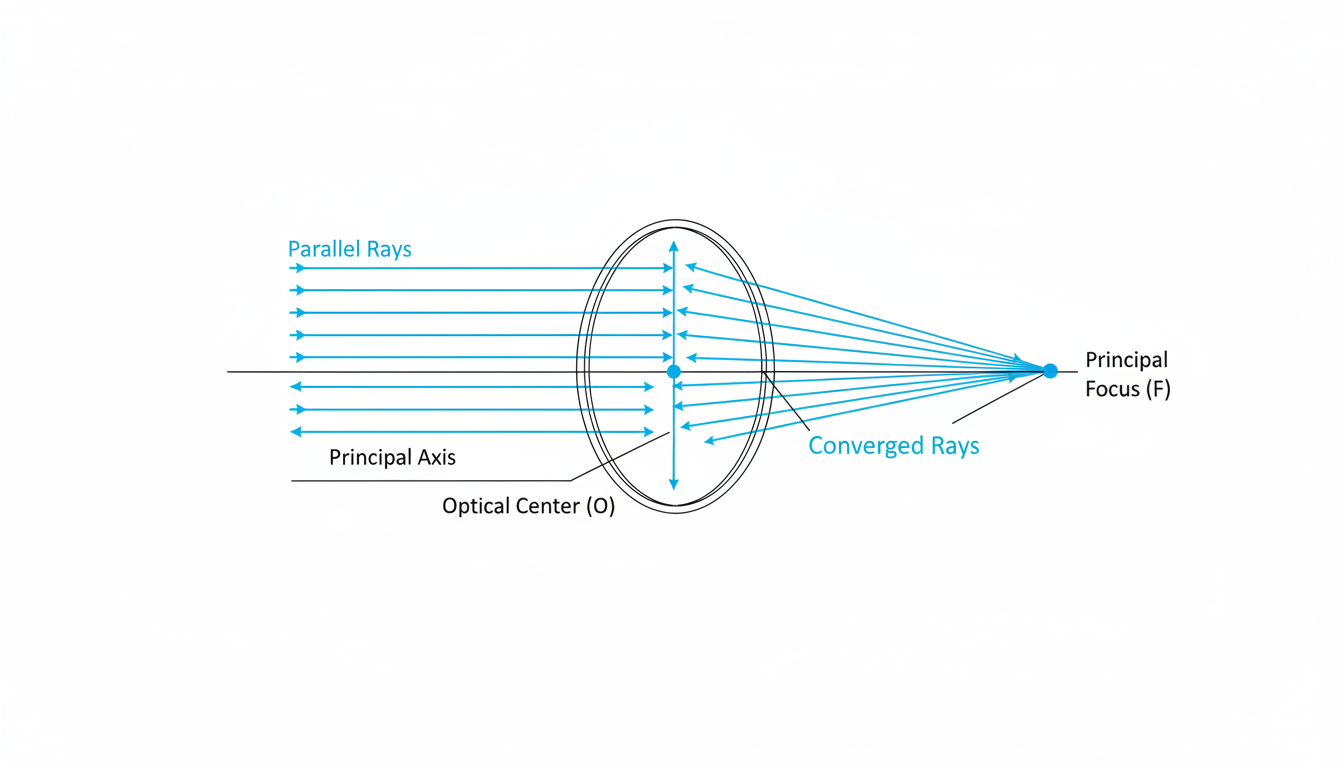
Reflection obeys equal angles; spherical mirrors use the mirror formula and magnification.
Refraction follows Snell’s law; lenses use the lens formula and power in dioptres.
Sign convention and ray diagrams dominate Class 10 numericals.
Light — Reflection and Refraction supplies steady marks through pathways, comparison tables and diagram labels in Class 10 · CBSE papers.
Field and clinical applications reuse Light — Reflection and Refraction whenever the underlying process is measured, imaged or controlled.
Reflection Laws and Mirrors
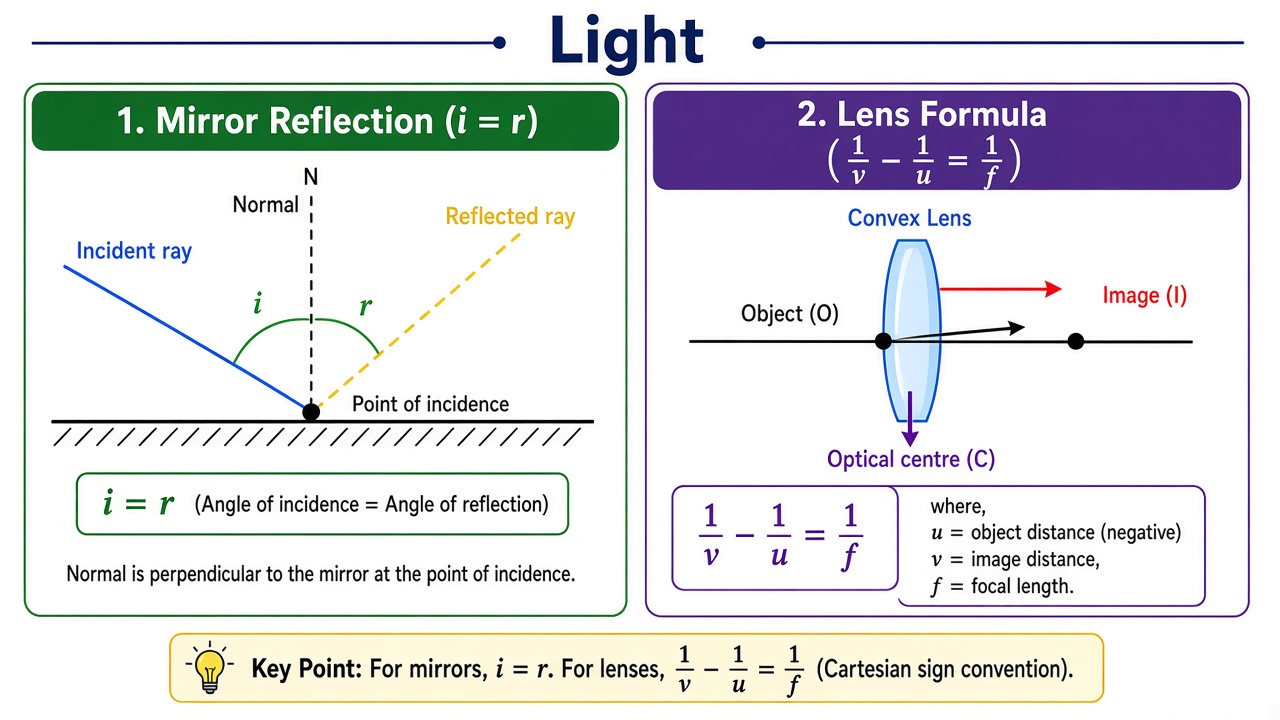
i = r; plane/spherical mirrors; focus, centre of curvature, focal length f = R/2.
In short: Light bounces with equal angles; curved mirrors focus rays.
Think about it
NEET/boards repeatedly test Reflection Laws and Mirrors via definitions, diagrams and contrasts inside Light — Reflection and Refraction. Applications of Reflection Laws and Mirrors appear in medicine, agriculture, ecology or technology whenever Light — Reflection and Refraction concepts are measured or controlled.
Real vs virtual images; ray diagrams for concave/convex.
Exam pathway for Reflection Laws and Mirrors: write site → inputs → steps → products → regulation/failure mode.
Contrast Reflection Laws and Mirrors with the nearest confused neighbour before committing to an MCQ.
Keep one numeric landmark from Light — Reflection and Refraction on your revision sheet and attach units.
Redraw the standard diagram for Reflection Laws and Mirrors from memory, then check labels.
In assertion–reason, demand that the reason actually explains the assertion.
Ordered recall beats scattered keywords: list intermediates, name the tissue or organelle, and state the condition (aerobic, illuminated, diploid, hormone-present) under which Reflection Laws and Mirrors applies in Light — Reflection and Refraction.
Key points
- Reflection Laws: Core heading under Light — Reflection and Refraction.
- Condition: State required for the process (site, oxygen, light, hormone, ploidy).
- Recite the pathway of Reflection Laws and Mirrors without looking at notes.
- Attach one named example or numeric cue (2) where relevant.
- Write one cause
→effect sentence suitable as an assertion.
Mirror Formula
1/v + 1/u = 1/f with New Cartesian signs; m = h′/h = −v/u.
In short: Relate object/image distances to f; size ratio.
Think about it
NEET/boards repeatedly test Mirror Formula via definitions, diagrams and contrasts inside Light — Reflection and Refraction. Applications of Mirror Formula appear in medicine, agriculture, ecology or technology whenever Light — Reflection and Refraction concepts are measured or controlled.
Concave f negative in the usual Class 10 sign convention (incident light left→right); practise numericals.
Exam pathway for Mirror Formula: write site → inputs → steps → products → regulation/failure mode.
Contrast Mirror Formula with the nearest confused neighbour before committing to an MCQ.
Keep one numeric landmark from Light — Reflection and Refraction on your revision sheet and attach units.
Redraw the standard diagram for Mirror Formula from memory, then check labels.
In assertion–reason, demand that the reason actually explains the assertion.
Ordered recall beats scattered keywords: list intermediates, name the tissue or organelle, and state the condition (aerobic, illuminated, diploid, hormone-present) under which Mirror Formula applies in Light — Reflection and Refraction.
Key points
- Mirror Formula: Core heading under Light — Reflection and Refraction.
- Condition: State required for the process (site, oxygen, light, hormone, ploidy).
- Recite the pathway of Mirror Formula without looking at notes.
- Attach one named example or numeric cue (2) where relevant.
- Write one cause
→effect sentence suitable as an assertion.
Refraction and Snell
n = c/v; n₁ sin i = n₂ sin r; absolute refractive index.
In short: Light bends entering a new medium.
Think about it
NEET/boards repeatedly test Refraction and Snell via definitions, diagrams and contrasts inside Light — Reflection and Refraction. Applications of Refraction and Snell appear in medicine, agriculture, ecology or technology whenever Light — Reflection and Refraction concepts are measured or controlled.
Towards normal into denser; lateral shift in slab; twinkling qualitative.
Exam pathway for Refraction and Snell: write site → inputs → steps → products → regulation/failure mode.
Contrast Refraction and Snell with the nearest confused neighbour before committing to an MCQ.
Keep one numeric landmark from Light — Reflection and Refraction on your revision sheet and attach units.
Redraw the standard diagram for Refraction and Snell from memory, then check labels.
In assertion–reason, demand that the reason actually explains the assertion.
Ordered recall beats scattered keywords: list intermediates, name the tissue or organelle, and state the condition (aerobic, illuminated, diploid, hormone-present) under which Refraction and Snell applies in Light — Reflection and Refraction.
Key points
- Refraction and: Core heading under Light — Reflection and Refraction.
- Condition: State required for the process (site, oxygen, light, hormone, ploidy).
- Recite the pathway of Refraction and Snell without looking at notes.
- Attach one named example or numeric cue (2) where relevant.
- Write one cause
→effect sentence suitable as an assertion.
Lenses
Converging/diverging; lens formula 1/v − 1/u = 1/f; power P = 1/f(m).
In short: Lenses bend light to form images; power in dioptres.
Think about it
NEET/boards repeatedly test Lenses via definitions, diagrams and contrasts inside Light — Reflection and Refraction. Applications of Lenses appear in medicine, agriculture, ecology or technology whenever Light — Reflection and Refraction concepts are measured or controlled.
Combination P = P₁ + P₂; ray diagrams; accommodation link later.
Exam pathway for Lenses: write site → inputs → steps → products → regulation/failure mode.
Contrast Lenses with the nearest confused neighbour before committing to an MCQ.
Keep one numeric landmark from Light — Reflection and Refraction on your revision sheet and attach units.
Redraw the standard diagram for Lenses from memory, then check labels.
In assertion–reason, demand that the reason actually explains the assertion.
Ordered recall beats scattered keywords: list intermediates, name the tissue or organelle, and state the condition (aerobic, illuminated, diploid, hormone-present) under which Lenses applies in Light — Reflection and Refraction.
Key points
- Lenses: Core heading under Light — Reflection and Refraction.
- Condition: State required for the process (site, oxygen, light, hormone, ploidy).
- Recite the pathway of Lenses without looking at notes.
- Attach one named example or numeric cue (2) where relevant.
- Write one cause
→effect sentence suitable as an assertion.
Image Scenarios
Object position vs image nature for mirrors/lenses tables.
In short: Where you put the object decides the image.
Think about it
NEET/boards repeatedly test Image Scenarios via definitions, diagrams and contrasts inside Light — Reflection and Refraction. Applications of Image Scenarios appear in medicine, agriculture, ecology or technology whenever Light — Reflection and Refraction concepts are measured or controlled.
Memorise beyond C, at C, between C–F, at F, between F–P cases.
Exam pathway for Image Scenarios: write site → inputs → steps → products → regulation/failure mode.
Contrast Image Scenarios with the nearest confused neighbour before committing to an MCQ.
Keep one numeric landmark from Light — Reflection and Refraction on your revision sheet and attach units.
Redraw the standard diagram for Image Scenarios from memory, then check labels.
In assertion–reason, demand that the reason actually explains the assertion.
Ordered recall beats scattered keywords: list intermediates, name the tissue or organelle, and state the condition (aerobic, illuminated, diploid, hormone-present) under which Image Scenarios applies in Light — Reflection and Refraction.
Key points
- Image Scenarios: Core heading under Light — Reflection and Refraction.
- Condition: State required for the process (site, oxygen, light, hormone, ploidy).
- Recite the pathway of Image Scenarios without looking at notes.
- Attach one named example or numeric cue (2) where relevant.
- Write one cause
→effect sentence suitable as an assertion.
Applications
Torch reflectors, shaving mirrors, vehicle mirrors, spectacles qualitative.
In short: Curved mirrors/lenses in daily devices.
Think about it
NEET/boards repeatedly test Applications via definitions, diagrams and contrasts inside Light — Reflection and Refraction. Applications of Applications appear in medicine, agriculture, ecology or technology whenever Light — Reflection and Refraction concepts are measured or controlled.
Convex mirror wide field; concave for focus/makeup.
Exam pathway for Applications: write site → inputs → steps → products → regulation/failure mode.
Contrast Applications with the nearest confused neighbour before committing to an MCQ.
Keep one numeric landmark from Light — Reflection and Refraction on your revision sheet and attach units.
Redraw the standard diagram for Applications from memory, then check labels.
In assertion–reason, demand that the reason actually explains the assertion.
Ordered recall beats scattered keywords: list intermediates, name the tissue or organelle, and state the condition (aerobic, illuminated, diploid, hormone-present) under which Applications applies in Light — Reflection and Refraction.
Key points
- Applications: Core heading under Light — Reflection and Refraction.
- Condition: State required for the process (site, oxygen, light, hormone, ploidy).
- Recite the pathway of Applications without looking at notes.
- Attach one named example or numeric cue (2) where relevant.
- Write one cause
→effect sentence suitable as an assertion.
Comparisons
Mirror vs lens formulas
| Spherical mirror | Thin lens | |
|---|---|---|
| Formula | 1/v+1/u=1/f | 1/v−1/u=1/f |
| Magnification | m=−v/u | m=h′/h=v/u (sign rules) |
| Power | — | P=1/f (metre⁻¹ = D) |
| f link | f=R/2 | Depends on R, n (maker’s formula later) |
Educational Significance: Pick mirror vs lens formula before substituting signs.
Solved examples
State one defining feature of Reflection Laws and Mirrors and one standard example from Light — Reflection and Refraction.
Feature + example
Formula Applied:—Approach note: Named examples carry marks.
Compare Reflection Laws and Mirrors with Mirror Formula on site and product (2 points each).
4 points
Formula Applied:—Approach note: Tables beat paragraphs in timed revision.
A linear flowchart of Refraction and Snell shows 4 ordered boxes. How many arrows connect them?
Number of arrows
Formula Applied:—Approach note: Flowchart arrow count is a quick numeric check.
Give one digit-bearing landmark used while revising Light — Reflection and Refraction (include the digit 2).
Landmark with digit
Formula Applied:1/v+1/u=1/fApproach note: Keep a one-page number bank per chapter.
Real-world applications
Light — Reflection and Refraction outside the classroom
Field and clinical applications reuse Light — Reflection and Refraction whenever the underlying process is measured, imaged or controlled.
Common mistakes
❌ Myth: Signs can be ignored if magnitudes look right.
Why this is wrong: Boards mark sign convention.
✅ Verified Truth: Draw optical axis and apply New Cartesian.
⚠️ Exam Tip: State assumed convention.
❌ Myth: Convex mirror always magnifies.
Why this is wrong: It gives diminished erect virtual images for real objects.
✅ Verified Truth: Field of view reason for vehicles.
⚠️ Exam Tip: Ray diagram check.
❌ Myth: m is always positive.
Why this is wrong: Sign encodes erect/inverted.
✅ Verified Truth: Interpret sign after calculating.
⚠️ Exam Tip: Invert → negative m usually.
❌ Myth: Power unit is watt here.
Why this is wrong: Optical power is dioptre.
✅ Verified Truth: P=1/f with f in metres.
⚠️ Exam Tip: Two lenses add powers.
Revision notes
Reflection obeys equal angles; spherical mirrors use the mirror formula and magnification. Refraction follows Snell’s law; lenses use the lens formula and power in dioptres. Sign convention and ray diagrams dominate Class 10 numericals.
High-Yield Quick Revision Points
- Reflection Laws and Mirrors: definition → site → steps → example → contrast.
- Mirror Formula: definition → site → steps → example → contrast.
- Refraction and Snell: definition → site → steps → example → contrast.
- Lenses: definition → site → steps → example → contrast.
- Image Scenarios: definition → site → steps → example → contrast.
- Applications: definition → site → steps → example → contrast.
- P=1/f
Master Formula Cheat Sheet
Practice questions
f in terms of R for spherical mirror?
Mirror formula:
Power of lens with f = 0.5 m (in D)?
Snell’s law involves:
SI unit of power of lens:
m = −v/u for mirrors; if |m|=2 image is: