Chapter 01 · NCERT
Chemical Reactions and Equations
2 topics · 1 sections · beginner-friendly study notes · Updated
Detailed notes with diagrams
2 full topic lessons from this chapter — diagram, table, examples and a quick check.
Chemical reactions rearrange atoms; balanced equations conserve mass.
Class 10 sorts combination, decomposition, displacement and double displacement (including neutralisation), flags redox by oxygen/hydrogen gain-loss, and links corrosion and rancidity to everyday redox.
Chemical Reactions and Equations supplies steady marks through pathways, comparison tables and diagram labels in Class 10 · CBSE papers.
Field and clinical applications reuse Chemical Reactions and Equations whenever the underlying process is measured, imaged or controlled.
Chemical Equations and Balancing
Symbolic equations must be balanced so atom counts match on both sides (mass conservation).
In short: Same atoms before and after; only regrouped.
Think about it
NEET/boards repeatedly test Chemical Equations and Balancing via definitions, diagrams and contrasts inside Chemical Reactions and Equations. Applications of Chemical Equations and Balancing appear in medicine, agriculture, ecology or technology whenever Chemical Reactions and Equations concepts are measured or controlled.
Hit-and-trial by atoms; never change formulas, only coefficients.
State symbols (s,l,g,aq) matter in board answers.
Skeleton → balanced → information-rich equation.
Exam pathway for Chemical Equations and Balancing: write site → inputs → steps → products → regulation/failure mode.
Contrast Chemical Equations and Balancing with the nearest confused neighbour before committing to an MCQ.
Keep one numeric landmark from Chemical Reactions and Equations on your revision sheet and attach units.
Redraw the standard diagram for Chemical Equations and Balancing from memory, then check labels.
In assertion–reason, demand that the reason actually explains the assertion.
Ordered recall beats scattered keywords: list intermediates, name the tissue or organelle, and state the condition (aerobic, illuminated, diploid, hormone-present) under which Chemical Equations and Balancing applies in Chemical Reactions and Equations.
Key points
- Chemical Equations: Core heading under Chemical Reactions and Equations.
- Condition: State required for the process (site, oxygen, light, hormone, ploidy).
- Recite the pathway of Chemical Equations and Balancing without looking at notes.
- Attach one named example or numeric cue (4) where relevant.
- Write one cause
→effect sentence suitable as an assertion.
Types of Reactions
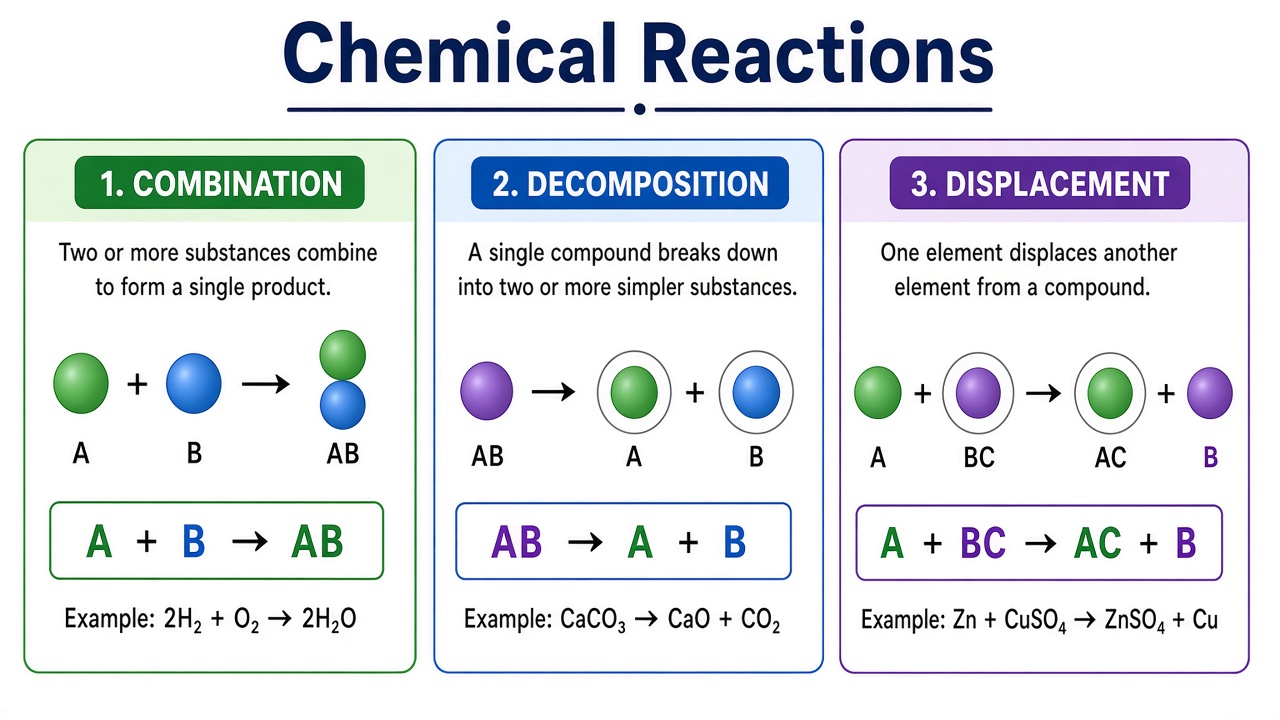
Combination, decomposition, displacement, double displacement (precipitate/gas/neutralisation).
In short: Four common pattern boxes for Class 10.
Think about it
NEET/boards repeatedly test Types of Reactions via definitions, diagrams and contrasts inside Chemical Reactions and Equations. Applications of Types of Reactions appear in medicine, agriculture, ecology or technology whenever Chemical Reactions and Equations concepts are measured or controlled.
Combination A+B→AB; thermal/electric/photolytic decomposition; Zn + CuSO₄ displacement; AgNO₃+NaCl precipitate.
Neutralisation is acid+base double displacement.
Exam pathway for Types of Reactions: write site → inputs → steps → products → regulation/failure mode.
Contrast Types of Reactions with the nearest confused neighbour before committing to an MCQ.
Keep one numeric landmark from Chemical Reactions and Equations on your revision sheet and attach units.
Redraw the standard diagram for Types of Reactions from memory, then check labels.
In assertion–reason, demand that the reason actually explains the assertion.
Ordered recall beats scattered keywords: list intermediates, name the tissue or organelle, and state the condition (aerobic, illuminated, diploid, hormone-present) under which Types of Reactions applies in Chemical Reactions and Equations.
Key points
- Types of: Core heading under Chemical Reactions and Equations.
- Condition: State required for the process (site, oxygen, light, hormone, ploidy).
- Recite the pathway of Types of Reactions without looking at notes.
- Attach one named example or numeric cue (4) where relevant.
- Write one cause
→effect sentence suitable as an assertion.
Redox in Class 10 Language
Oxidation: gain oxygen / loss hydrogen; reduction opposite; redox couples both.
In short: Rusting is oxidation; removing oxygen is reduction.
Think about it
NEET/boards repeatedly test Redox in Class 10 Language via definitions, diagrams and contrasts inside Chemical Reactions and Equations. Applications of Redox in Class 10 Language appear in medicine, agriculture, ecology or technology whenever Chemical Reactions and Equations concepts are measured or controlled.
Still useful before electronic concept.
Oxidising vs reducing agents from the partner’s change.
Examples
- 1CuO + H₂
- 2corrosion of iron
Exam pathway for Redox in Class 10 Language: write site → inputs → steps → products → regulation/failure mode.
Contrast Redox in Class 10 Language with the nearest confused neighbour before committing to an MCQ.
Keep one numeric landmark from Chemical Reactions and Equations on your revision sheet and attach units.
Redraw the standard diagram for Redox in Class 10 Language from memory, then check labels.
In assertion–reason, demand that the reason actually explains the assertion.
Ordered recall beats scattered keywords: list intermediates, name the tissue or organelle, and state the condition (aerobic, illuminated, diploid, hormone-present) under which Redox in Class 10 Language applies in Chemical Reactions and Equations.
Key points
- Redox in: Core heading under Chemical Reactions and Equations.
- Condition: State required for the process (site, oxygen, light, hormone, ploidy).
- Recite the pathway of Redox in Class 10 Language without looking at notes.
- Attach one named example or numeric cue (4) where relevant.
- Write one cause
→effect sentence suitable as an assertion.
Effects of Oxidation
Corrosion of metals; rancidity of oils/fats.
In short: Metals spoil in air; chips taste off when fats oxidise.
Think about it
NEET/boards repeatedly test Effects of Oxidation via definitions, diagrams and contrasts inside Chemical Reactions and Equations. Applications of Effects of Oxidation appear in medicine, agriculture, ecology or technology whenever Chemical Reactions and Equations concepts are measured or controlled.
Painting, galvanising, alloying, inert packing, refrigerating, antioxidants slow damage.
Exam pathway for Effects of Oxidation: write site → inputs → steps → products → regulation/failure mode.
Contrast Effects of Oxidation with the nearest confused neighbour before committing to an MCQ.
Keep one numeric landmark from Chemical Reactions and Equations on your revision sheet and attach units.
Redraw the standard diagram for Effects of Oxidation from memory, then check labels.
In assertion–reason, demand that the reason actually explains the assertion.
Ordered recall beats scattered keywords: list intermediates, name the tissue or organelle, and state the condition (aerobic, illuminated, diploid, hormone-present) under which Effects of Oxidation applies in Chemical Reactions and Equations.
Key points
- Effects of: Core heading under Chemical Reactions and Equations.
- Condition: State required for the process (site, oxygen, light, hormone, ploidy).
- Recite the pathway of Effects of Oxidation without looking at notes.
- Attach one named example or numeric cue (4) where relevant.
- Write one cause
→effect sentence suitable as an assertion.
Displacement Series Use
A more reactive metal displaces a less reactive metal from salt solution.
In short: Stronger metal kicks out weaker metal.
Think about it
NEET/boards repeatedly test Displacement Series Use via definitions, diagrams and contrasts inside Chemical Reactions and Equations. Applications of Displacement Series Use appear in medicine, agriculture, ecology or technology whenever Chemical Reactions and Equations concepts are measured or controlled.
Activity series links to which displacement reactions occur; write observations (colour change, deposits).
Exam pathway for Displacement Series Use: write site → inputs → steps → products → regulation/failure mode.
Contrast Displacement Series Use with the nearest confused neighbour before committing to an MCQ.
Keep one numeric landmark from Chemical Reactions and Equations on your revision sheet and attach units.
Redraw the standard diagram for Displacement Series Use from memory, then check labels.
In assertion–reason, demand that the reason actually explains the assertion.
Ordered recall beats scattered keywords: list intermediates, name the tissue or organelle, and state the condition (aerobic, illuminated, diploid, hormone-present) under which Displacement Series Use applies in Chemical Reactions and Equations.
Key points
- Displacement Series: Core heading under Chemical Reactions and Equations.
- Condition: State required for the process (site, oxygen, light, hormone, ploidy).
- Recite the pathway of Displacement Series Use without looking at notes.
- Attach one named example or numeric cue (4) where relevant.
- Write one cause
→effect sentence suitable as an assertion.
Exothermic vs Endothermic
Heat released vs absorbed during reaction.
In short: Feels hot vs feels cold.
Think about it
NEET/boards repeatedly test Exothermic vs Endothermic via definitions, diagrams and contrasts inside Chemical Reactions and Equations. Applications of Exothermic vs Endothermic appear in medicine, agriculture, ecology or technology whenever Chemical Reactions and Equations concepts are measured or controlled.
Respiration/combustion exothermic; photosynthesis endothermic overall; decomposition often needs heat.
Exam pathway for Exothermic vs Endothermic: write site → inputs → steps → products → regulation/failure mode.
Contrast Exothermic vs Endothermic with the nearest confused neighbour before committing to an MCQ.
Keep one numeric landmark from Chemical Reactions and Equations on your revision sheet and attach units.
Redraw the standard diagram for Exothermic vs Endothermic from memory, then check labels.
In assertion–reason, demand that the reason actually explains the assertion.
Ordered recall beats scattered keywords: list intermediates, name the tissue or organelle, and state the condition (aerobic, illuminated, diploid, hormone-present) under which Exothermic vs Endothermic applies in Chemical Reactions and Equations.
Key points
- Exothermic vs: Core heading under Chemical Reactions and Equations.
- Condition: State required for the process (site, oxygen, light, hormone, ploidy).
- Recite the pathway of Exothermic vs Endothermic without looking at notes.
- Attach one named example or numeric cue (4) where relevant.
- Write one cause
→effect sentence suitable as an assertion.
Comparisons
Reaction-type flowchart
| Combination | Decomposition | Displacement | Double displacement | |
|---|---|---|---|---|
| Pattern | A+B→AB | AB→A+B | A+BC→AC+B | AB+CD→AD+CB |
| Cue | One product | Energy splits | Metal/halogen swap | Ions swap |
| Example cue | Mg+O₂ | CaCO₃ heat | Zn+CuSO₄ | Na₂SO₄+BaCl₂ |
Educational Significance: Identify pattern first, then balance.
Solved examples
State one defining feature of Chemical Equations and Balancing and one standard example from Chemical Reactions and Equations.
Feature + example
Formula Applied:—Approach note: Named examples carry marks.
Compare Chemical Equations and Balancing with Types of Reactions on site and product (2 points each).
4 points
Formula Applied:—Approach note: Tables beat paragraphs in timed revision.
A linear flowchart of Redox in Class 10 Language shows 4 ordered boxes. How many arrows connect them?
Number of arrows
Formula Applied:—Approach note: Flowchart arrow count is a quick numeric check.
Give one digit-bearing landmark used while revising Chemical Reactions and Equations (include the digit 4).
Landmark with digit
Formula Applied:—Approach note: Keep a one-page number bank per chapter.
Real-world applications
Chemical Reactions and Equations outside the classroom
Field and clinical applications reuse Chemical Reactions and Equations whenever the underlying process is measured, imaged or controlled.
Common mistakes
❌ Myth: You may change subscripts to balance.
Why this is wrong: Subscripts fix identity.
✅ Verified Truth: Change coefficients only.
⚠️ Exam Tip: MgO not Mg₂O₂.
❌ Myth: All reactions need oxygen.
Why this is wrong: Many redox/non-redox lack O₂.
✅ Verified Truth: Use pattern classification.
⚠️ Exam Tip: Displacement in solution example.
❌ Myth: Precipitation is combination.
Why this is wrong: It is double displacement.
✅ Verified Truth: Ions exchange.
⚠️ Exam Tip: AgCl ppt classic.
❌ Myth: Rusting is only physical.
Why this is wrong: New substance Fe₂O₃·xH₂O forms.
✅ Verified Truth: Chemical corrosion.
⚠️ Exam Tip: Prevention methods.
Revision notes
Chemical reactions rearrange atoms; balanced equations conserve mass. Class 10 sorts combination, decomposition, displacement and double displacement (including neutralisation), flags redox by oxygen/hydrogen gain-loss, and links corrosion and rancidity to everyday redox.
High-Yield Quick Revision Points
- Chemical Equations and Balancing: definition → site → steps → example → contrast.
- Types of Reactions: definition → site → steps → example → contrast.
- Redox in Class 10 Language: definition → site → steps → example → contrast.
- Effects of Oxidation: definition → site → steps → example → contrast.
- Displacement Series Use: definition → site → steps → example → contrast.
- Exothermic vs Endothermic: definition → site → steps → example → contrast.
- 4 reaction types
Practice questions
Balancing changes:
Zn + CuSO₄ is:
Minimum reaction types often listed in Class 10 (combination, decomposition, displacement, double displacement)?
Rancidity affects:
CaCO₃ heat → CaO + CO₂ is:
Atoms of C in balanced CH₄ + 2O₂ → CO₂ + 2H₂O (left side)?