Chapter 05 · NCERT
Electricity
3 topics · 1 sections · beginner-friendly study notes · Updated
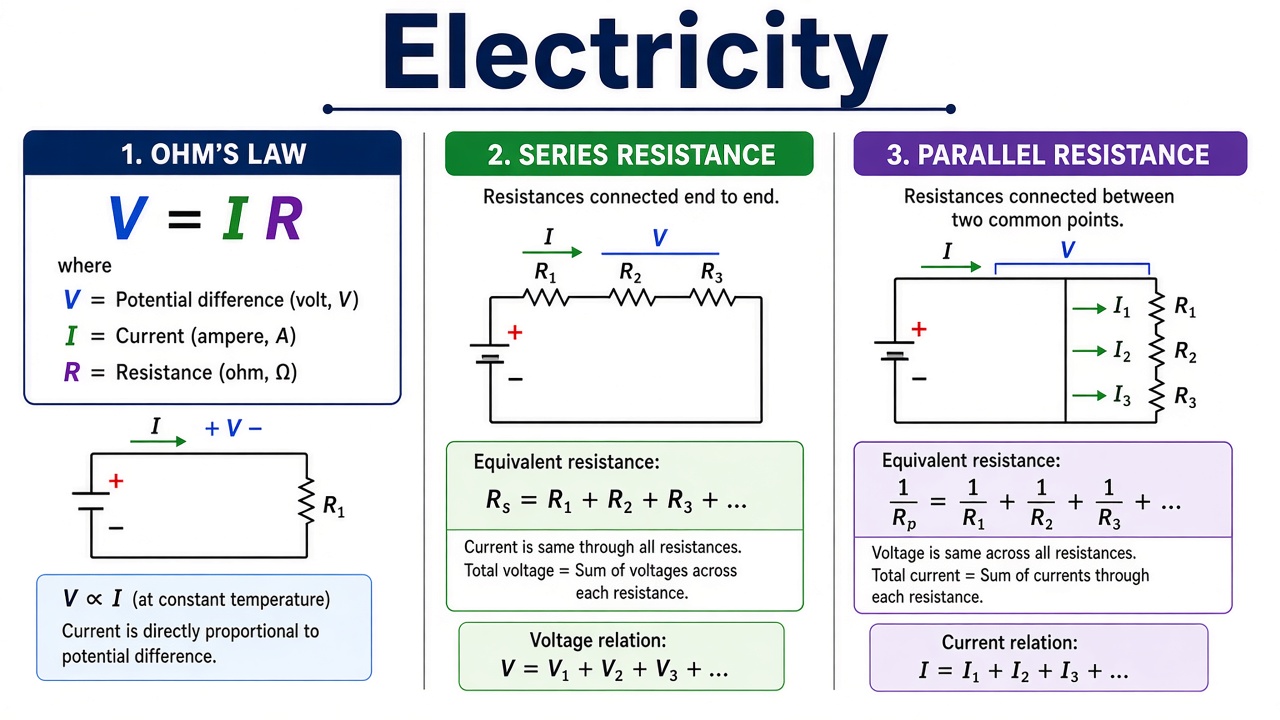
Electric current is charge flow; Ohm’s law V = IR links voltage, current and resistance.
Series and parallel combinations, resistivity, heating effect and electric power P = VI organise Class 10 circuit numericals.
Electricity supplies steady marks through pathways, comparison tables and diagram labels in Class 10 · CBSE papers.
Field and clinical applications reuse Electricity whenever the underlying process is measured, imaged or controlled.
Current Potential Resistance
I = Q/t; potential difference drives flow; R opposes; Ohm’s law V = IR for ohmic conductors.
In short: Voltage pushes, resistance resists, current results.
Think about it
NEET/boards repeatedly test Current Potential Resistance via definitions, diagrams and contrasts inside Electricity. Applications of Current Potential Resistance appear in medicine, agriculture, ecology or technology whenever Electricity concepts are measured or controlled.
Ammeter series; voltmeter parallel; linear V–I ohmic graph through origin.
Exam pathway for Current Potential Resistance: write site → inputs → steps → products → regulation/failure mode.
Contrast Current Potential Resistance with the nearest confused neighbour before committing to an MCQ.
Keep one numeric landmark from Electricity on your revision sheet and attach units.
Redraw the standard diagram for Current Potential Resistance from memory, then check labels.
In assertion–reason, demand that the reason actually explains the assertion.
Ordered recall beats scattered keywords: list intermediates, name the tissue or organelle, and state the condition (aerobic, illuminated, diploid, hormone-present) under which Current Potential Resistance applies in Electricity.
Key points
- Current Potential: Core heading under Electricity.
- Condition: State required for the process (site, oxygen, light, hormone, ploidy).
- Recite the pathway of Current Potential Resistance without looking at notes.
- Attach one named example or numeric cue (1) where relevant.
- Write one cause
→effect sentence suitable as an assertion.
Resistivity
R = ρℓ/A; ρ material property; factors length/area/material/temperature.
In short: Fat short good conductors resist less.
Think about it
NEET/boards repeatedly test Resistivity via definitions, diagrams and contrasts inside Electricity. Applications of Resistivity appear in medicine, agriculture, ecology or technology whenever Electricity concepts are measured or controlled.
Unit ohm-metre; alloys for heating elements; semiconductors/insulators qualitative.
Exam pathway for Resistivity: write site → inputs → steps → products → regulation/failure mode.
Contrast Resistivity with the nearest confused neighbour before committing to an MCQ.
Keep one numeric landmark from Electricity on your revision sheet and attach units.
Redraw the standard diagram for Resistivity from memory, then check labels.
In assertion–reason, demand that the reason actually explains the assertion.
Ordered recall beats scattered keywords: list intermediates, name the tissue or organelle, and state the condition (aerobic, illuminated, diploid, hormone-present) under which Resistivity applies in Electricity.
Key points
- Resistivity: Core heading under Electricity.
- Condition: State required for the process (site, oxygen, light, hormone, ploidy).
- Recite the pathway of Resistivity without looking at notes.
- Attach one named example or numeric cue (1) where relevant.
- Write one cause
→effect sentence suitable as an assertion.
Series Circuits
Same I; V splits; R_s = R₁+R₂+…
In short: One path; resistances add.
Think about it
NEET/boards repeatedly test Series Circuits via definitions, diagrams and contrasts inside Electricity. Applications of Series Circuits appear in medicine, agriculture, ecology or technology whenever Electricity concepts are measured or controlled.
Weakest for current same; used for high resistance needs.
Exam pathway for Series Circuits: write site → inputs → steps → products → regulation/failure mode.
Contrast Series Circuits with the nearest confused neighbour before committing to an MCQ.
Keep one numeric landmark from Electricity on your revision sheet and attach units.
Redraw the standard diagram for Series Circuits from memory, then check labels.
In assertion–reason, demand that the reason actually explains the assertion.
Ordered recall beats scattered keywords: list intermediates, name the tissue or organelle, and state the condition (aerobic, illuminated, diploid, hormone-present) under which Series Circuits applies in Electricity.
Key points
- Series Circuits: Core heading under Electricity.
- Condition: State required for the process (site, oxygen, light, hormone, ploidy).
- Recite the pathway of Series Circuits without looking at notes.
- Attach one named example or numeric cue (1) where relevant.
- Write one cause
→effect sentence suitable as an assertion.
Parallel Circuits
Same V; I splits; 1/R_p = Σ1/Rᵢ
In short: Branches share voltage; more paths less net R.
Think about it
NEET/boards repeatedly test Parallel Circuits via definitions, diagrams and contrasts inside Electricity. Applications of Parallel Circuits appear in medicine, agriculture, ecology or technology whenever Electricity concepts are measured or controlled.
Household wiring parallel so each appliance gets full V. Exam pathway for Parallel Circuits: write site → inputs → steps → products → regulation/failure mode.
Contrast Parallel Circuits with the nearest confused neighbour before committing to an MCQ.
Keep one numeric landmark from Electricity on your revision sheet and attach units.
Redraw the standard diagram for Parallel Circuits from memory, then check labels.
In assertion–reason, demand that the reason actually explains the assertion.
Ordered recall beats scattered keywords: list intermediates, name the tissue or organelle, and state the condition (aerobic, illuminated, diploid, hormone-present) under which Parallel Circuits applies in Electricity.
Key points
- Parallel Circuits: Core heading under Electricity.
- Condition: State required for the process (site, oxygen, light, hormone, ploidy).
- Recite the pathway of Parallel Circuits without looking at notes.
- Attach one named example or numeric cue (1) where relevant.
- Write one cause
→effect sentence suitable as an assertion.
Heating Effect
H = I²Rt = VIt = V²t/R; Joule’s law applications.
In short: Current through resistance makes heat.
Think about it
NEET/boards repeatedly test Heating Effect via definitions, diagrams and contrasts inside Electricity. Applications of Heating Effect appear in medicine, agriculture, ecology or technology whenever Electricity concepts are measured or controlled.
Heaters, irons, fuses; fuse melts on overcurrent.
Exam pathway for Heating Effect: write site → inputs → steps → products → regulation/failure mode.
Contrast Heating Effect with the nearest confused neighbour before committing to an MCQ.
Keep one numeric landmark from Electricity on your revision sheet and attach units.
Redraw the standard diagram for Heating Effect from memory, then check labels.
In assertion–reason, demand that the reason actually explains the assertion.
Ordered recall beats scattered keywords: list intermediates, name the tissue or organelle, and state the condition (aerobic, illuminated, diploid, hormone-present) under which Heating Effect applies in Electricity.
Key points
- Heating Effect: Core heading under Electricity.
- Condition: State required for the process (site, oxygen, light, hormone, ploidy).
- Recite the pathway of Heating Effect without looking at notes.
- Attach one named example or numeric cue (1) where relevant.
- Write one cause
→effect sentence suitable as an assertion.
Electric Power
P = VI = I²R = V²/R; commercial unit kWh.
In short: Power is energy per time; bill uses kilowatt-hour.
Think about it
NEET/boards repeatedly test Electric Power via definitions, diagrams and contrasts inside Electricity. Applications of Electric Power appear in medicine, agriculture, ecology or technology whenever Electricity concepts are measured or controlled.
1 kWh = 3.6×10⁶ J; rating of bulbs in watts.
Exam pathway for Electric Power: write site → inputs → steps → products → regulation/failure mode.
Contrast Electric Power with the nearest confused neighbour before committing to an MCQ.
Keep one numeric landmark from Electricity on your revision sheet and attach units.
Redraw the standard diagram for Electric Power from memory, then check labels.
In assertion–reason, demand that the reason actually explains the assertion.
Ordered recall beats scattered keywords: list intermediates, name the tissue or organelle, and state the condition (aerobic, illuminated, diploid, hormone-present) under which Electric Power applies in Electricity.
Key points
- Electric Power: Core heading under Electricity.
- Condition: State required for the process (site, oxygen, light, hormone, ploidy).
- Recite the pathway of Electric Power without looking at notes.
- Attach one named example or numeric cue (1) where relevant.
- Write one cause
→effect sentence suitable as an assertion.
Comparisons
Series vs parallel
| Series | Parallel | |
|---|---|---|
| Current | Same | Splits |
| Voltage | Splits | Same |
| Equivalent R | Sum | Reciprocal sum |
| If one opens | All stop | Others can work |
Educational Significance: Household loads → parallel; choose formula before algebra.
Solved examples
State one defining feature of Current Potential Resistance and one standard example from Electricity.
Feature + example
Formula Applied:—Approach note: Named examples carry marks.
Compare Current Potential Resistance with Resistivity on site and product (2 points each).
4 points
Formula Applied:—Approach note: Tables beat paragraphs in timed revision.
A linear flowchart of Series Circuits shows 4 ordered boxes. How many arrows connect them?
Number of arrows
Formula Applied:—Approach note: Flowchart arrow count is a quick numeric check.
Give one digit-bearing landmark used while revising Electricity (include the digit 1).
Landmark with digit
Formula Applied:V=IRApproach note: Keep a one-page number bank per chapter.
Real-world applications
Electricity outside the classroom
Field and clinical applications reuse Electricity whenever the underlying process is measured, imaged or controlled.
Common mistakes
❌ Myth: R_p is always larger than each R.
Why this is wrong: Parallel R_p is smaller than the smallest branch.
✅ Verified Truth: More paths ⇒ less opposition.
⚠️ Exam Tip: Compute 1/R_p.
❌ Myth: Ammeter has high resistance.
Why this is wrong: Ideal ammeter resistance ≈0; series.
✅ Verified Truth: Voltmeter high R parallel.
⚠️ Exam Tip: Meter placement errors.
❌ Myth: P = VI only for DC special cases.
Why this is wrong: Used throughout Class 10 for circuits.
✅ Verified Truth: Combine with Ohm for I²R.
⚠️ Exam Tip: Check units W = J/s.
❌ Myth: Fuse should have very high melting point.
Why this is wrong: Fuse wire melts early to protect.
✅ Verified Truth: Low MP, fair conductivity.
⚠️ Exam Tip: Series with live.
Revision notes
Electric current is charge flow; Ohm’s law V = IR links voltage, current and resistance. Series and parallel combinations, resistivity, heating effect and electric power P = VI organise Class 10 circuit numericals.
High-Yield Quick Revision Points
- Current Potential Resistance: definition → site → steps → example → contrast.
- Resistivity: definition → site → steps → example → contrast.
- Series Circuits: definition → site → steps → example → contrast.
- Parallel Circuits: definition → site → steps → example → contrast.
- Heating Effect: definition → site → steps → example → contrast.
- Electric Power: definition → site → steps → example → contrast.
- V=IR
Master Formula Cheat Sheet
Practice questions
Ohm’s law:
Two 4 Ω in series equivalent?
Two 4 Ω in parallel equivalent?
SI unit of resistivity:
1 kWh in joules?
Heat ∝ I²Rt; if I doubles, H becomes: