Chapter 29 · Class 11-12 & JEE/NEET
Amines
60 topics · 12 sections · beginner-friendly study notes · Updated
Amines are organic derivatives of ammonia with distinctive basicity, H-bonding and nucleophilicity.
Preparation (reduction, Gabriel, Hofmann), classification tests (Hinsberg), diazonium chemistry of aromatic primary amines, and electrophilic substitution on aniline dominate Class 12 JEE organic nitrogen chemistry.
Basicity order, Hinsberg identification and diazonium conversions are among the most examined amine topics.
Aniline → dyes via azo coupling; drugs (amphetamines, local anaesthetics); nylon monomers (hexamethylenediamine) — amines everywhere in tech and medicine.
Classification, Structure and Basicity
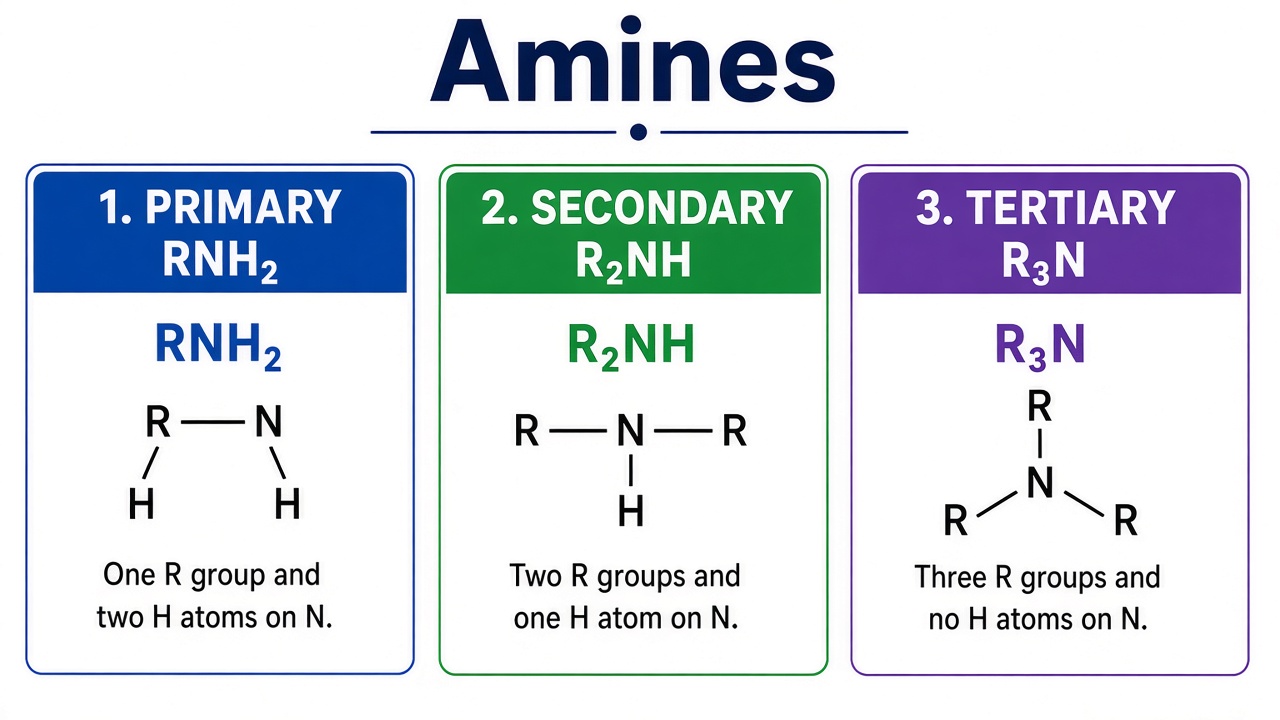
Amines: RNH₂ (1°), R₂NH (2°), R₃N (3°); aryl amines ArNH₂. N is pyramidal sp³. Basicity: aliphatic amines > NH₃ > aryl amines in water; among aliphatic, 2° often strongest in aqueous solution due to inductive vs solvation balance.
In short: Amines are nitrogen bases. Alkyl groups help, but aniline’s nitrogen lone pair is busy with the ring so it is a weaker base.
Think about it
Basicity ranking is a guaranteed exam theme. Local anaesthetics (lidocaine-type) tune amine pKa for membrane activity.
pKb aniline high (weak base); p-nitroaniline weaker still.
Gas-phase basicity rises with alkylation more regularly.
Heterocyclic pyridine vs pyrrole: pyridine uses sp² N lone pair in plane (basic); pyrrole lone pair in aromatic sextet (not basic).
Quaternary ammonium salts NR₄⁺ not basic like amines.
H-bonding: 1°/2° raise BP vs hydrocarbons; 3° cannot H-bond to themselves similarly.
Key points
- Aryl amine: NH₂ attached directly to aromatic ring.
- Quaternary ammonium: NR₄⁺ salt — no N lone pair.
- Anilinium ion: lone pair used in bonding to H⁺ — ring loses resonance donation.
- Ortho-substituted anilines may show steric inhibition of resonance — basicity up.
Preparations of Amines
Reduce ArNO₂ (Sn/HCl, Fe/HCl, catalytic H₂); reduce RCN / RCONH₂ / RX via excess NH₃ (mixture); Gabriel phthalimide for pure 1° aliphatic; Hofmann bromamide for 1° with one less C; reductive amination (Advanced).
In short: Shrink nitro groups, cut amides with Hofmann, or use phthalimide (Gabriel) when you need a clean primary alkyl amine.
Think about it
Choosing Gabriel vs Hofmann vs nitro reduction is a planning skill. Aniline from nitrobenzene reduction is a bulk chemical for MDI/polyurethanes and dyes.
Ammonolysis of RX gives mixtures — over-alkylation to 2°/3°/NR₄⁺.
Gabriel avoids that for 1°.
Aryl halides usually cannot Gabriel/SN2 — use nitro reduction instead.
Hoffmann vs Curtius/Lossen occasionally named.
Mendius reduction of nitriles with Na/alcohol classic.
Key points
- Gabriel synthesis: Phthalimide anion + RX
→1° amine after hydrolysis. - Hoffmann bromamide: RCONH₂
→RNH₂ (one C less). - Gabriel fails for ArX under usual SN2 conditions.
- Excess NH₃ favours 1° in ammonolysis but still impure.
Chemical Reactions and Identification
Alkylation, acylation (acetanilide), carbylamine test (1° only, foul RNC), Hinsberg (1° soluble sulphonamide salt after alkali; 2° insoluble; 3° no reaction with Hinsberg reagent), reaction with HNO₂ (1° aliphatic → N₂ + alcohol; aromatic 1° → diazonium at 0–5 °C).
In short: Hinsberg and carbylamine tell 1°/2°/3° apart; nitrous acid is gentle with aromatic 1° (diazonium) but destroys aliphatic 1° with bubbles of N₂.
Think about it
Identification tables + protecting-group logic for p-nitroaniline synthesis. Acetanilide historically was an analgesic — acylation chemistry with human impact.
Hinsberg reagent: PhSO₂Cl.
Acetanilide protects NH₂ during ring nitration (moderates activation, reduces oxidation/polysubstitution) then hydrolyse.
Mustard oil reaction for 1° aliphatic with CS₂.
Electrophilic substitution on aniline: strongly o/p; Br₂ water → 2,4,6-tribromoaniline.
Key points
- Hinsberg test: PhSO₂Cl classification of amines.
- Carbylamine test: 1° amine + CHCl₃/KOH
→isocyanide. - 3° aliphatic amine dissolves in HCl but shows no Hinsberg product.
- Keep diazotisation at 0–5 °C — warmer decomposes ArN₂⁺.
Diazonium Salt Chemistry
ArN₂⁺X⁻ from ArNH₂ + NaNO₂/HCl at 0–5 °C. Replacements: Sandmeyer (CuX → ArX), Gattermann (Cu/HX), ArN₂⁺ → ArCN (CuCN), ArOH (warm water), ArH (H₃PO₂), ArI (KI), azo coupling with activated aromatics (phenols/anilines) to azo dyes.
In short: Diazonium is a temporary “universal adapter” on the benzene ring — swap N₂⁺ for OH, halogen, CN or couple to make colourful azo dyes.
Think about it
Diazonium is the gateway from aniline to many Ar–Z compounds unavailable by direct SN. Azo dye industry (textiles, food colourants historically) is applied diazonium coupling.
Stability: aromatic diazonium resonance-stabilised vs aliphatic (lose N₂ instantly).
Coupling is EAS where ArN₂⁺ is electrophile — needs activated ring, usually alkaline for phenols.
Methyl orange synthesis classic.
Balancing Sandmeyer equations appears in numerical-free MCQs.
Key points
- Sandmeyer reaction: ArN₂⁺ + CuX
→ArX. - Azo coupling: ArN₂⁺ + activated Ar′–H
→Ar–N=N–Ar′. - KI replacement needs no Cu catalyst typically.
- Phenol coupling often para to OH if free.
EAS on Aniline and Protecting Strategies
—NH₂ strongly activates o/p; uncontrolled bromination/nitration occurs. Acetylation to acetanilide moderates; after EAS, hydrolyse to restore NH₂. In acid, anilinium (−NH₃⁺) is meta-directing — nitration of aniline in strong acid gives significant meta product.
In short: Naked aniline is too hot for selective EAS — put an acetyl “glove” on nitrogen, substitute, then remove the glove.
Think about it
Multi-step aniline functionalisation is a favourite conversion. Paracetamol (acetaminophen) is an N-acetylated aminophenol — same protecting idea in a drug.
This explains the textbook route to p-nitroaniline.
Sulphonation similarly controlled.
Contrast with phenol which also activates strongly but is handled via phenoxide/solvent control.
Key points
- Anilinium meta direction in strong acid is a subtle MCQ trap.
- Always state 0–5 °C for diazotisation after discussing aniline.
Comparisons
Hinsberg test outcomes
| 1° amine | 2° amine | 3° amine | |
|---|---|---|---|
| Product with PhSO₂Cl | Sulphonamide | Sulphonamide | No reaction |
| Behaviour in alkali | Soluble (acidic H on N) | Insoluble | Amine dissolves if acid present separately |
| Carbylamine | Positive | Negative | Negative |
Educational Significance: Combine Hinsberg with carbylamine for airtight 1°/2°/3° ID.
Solved examples
Which is stronger base in water: aniline or methylamine?
- PhNH₂ vs CH₃NH₂
Order + reason
Formula Applied:—Approach note: Aryl amines are weaker than ammonia; alkyl amines stronger.
Write Sandmeyer product of benzenediazonium chloride with CuCN.
- PhN₂⁺Cl⁻, CuCN
Product
Formula Applied:—Approach note: CuX variants: Cl, Br, CN; KI needs no Cu.
Why acetylate aniline before nitration to prepare p-nitroaniline?
- Synthetic strategy
Explain
Formula Applied:—Approach note: Also avoids anilinium meta problem in strong acid.
Gabriel phthalimide on bromobenzene — expected result?
- ArBr + phthalimide anion
Outcome
Formula Applied:—Approach note: Gabriel is for aliphatic 1° amines.
Aniline is treated with NaNO₂/HCl at 0–5 °C, then the diazonium salt is warmed with water. What is the organic product, and why must the diazotisation temperature stay near 0 °C?
- PhNH₂ → PhN₂⁺ → ?
Product and T constraint
Formula Applied:—Approach note: Sandmeyer uses the cold diazonium; phenol path needs controlled warming with water.
Real-world applications
Amines outside the classroom
Aniline → dyes via azo coupling; drugs (amphetamines, local anaesthetics); nylon monomers (hexamethylenediamine) — amines everywhere in tech and medicine.
Common mistakes
❌ Myth: 3° amines are always the strongest bases in water.
Why this is wrong: Solvation often makes 2° strongest among methyl/ethyl amines in water.
✅ Verified Truth: State aqueous vs gas-phase orders separately.
⚠️ Exam Tip: NCERT aqueous order: 2° > 1° > 3° > NH₃ for methyl amines (approx).
❌ Myth: All amines give carbylamine test.
Why this is wrong: Only primary amines give isocyanides.
✅ Verified Truth: Carbylamine = 1° specific.
⚠️ Exam Tip: Use with Hinsberg for full ID.
❌ Myth: Aliphatic and aromatic diazonium salts are equally stable.
Why this is wrong: Only aromatic diazonium salts are usefully stable at 0–5 °C.
✅ Verified Truth: Aliphatic lose N₂ immediately.
⚠️ Exam Tip: Never propose isolating ethyldiazonium.
Revision notes
Amines are organic derivatives of ammonia with distinctive basicity, H-bonding and nucleophilicity. Preparation (reduction, Gabriel, Hofmann), classification tests (Hinsberg), diazonium chemistry of aromatic primary amines, and electrophilic substitution on aniline dominate Class 12 JEE organic nitrogen chemistry.
High-Yield Quick Revision Points
- Basicity: alkyl amines > NH₃ > aniline; aqueous 2° often highest.
- Prep: reduce NO₂/CN; Gabriel (1° alkyl); Hofmann (−1 C).
- Hinsberg + carbylamine identify 1°/2°/3°.
- Diazonium 0–5 °C: Sandmeyer, OH, H, azo dyes.
- Acetylate aniline before controlled EAS.
Practice questions
Weakest base among the following is
Gabriel synthesis is best for
Carbylamine test is given by
Diazotisation temperature range lower bound in °C (0–5)? Enter 0.
Azo dyes form by coupling of ArN₂⁺ with
Hinsberg reagent is