Chapter 01 · Class 11-12 & JEE/NEET
Some Basic Concepts of Chemistry
58 topics · 12 sections · beginner-friendly study notes · Updated
Chemistry begins with measuring matter precisely: the mole counts particles, molar mass converts grams to moles, and stoichiometric ratios from balanced equations convert moles of reactants into moles of products.
Laws of chemical combination (conservation of mass, definite proportions, multiple proportions, Gay-Lussac, Avogadro) explain why formulas and equations work.
Concentration units (molarity, molality, mole fraction) describe solutions, while limiting reagents and percentage yield decide how much product you actually get in the lab or in an exam numerical.
Almost every physical and inorganic numerical in JEE/NEET starts from moles, stoichiometry or concentration.
Weakness here cascades into equilibrium, kinetics and electrochemistry.
Industrial batch sizing, pharmaceutical dosing, titration calculations and air–fuel ratios in engines all rest on stoichiometric accounting.
Mole Concept and Avogadro Number
One mole is the amount of substance that contains exactly 6.02214076 × 10²³ elementary entities (Avogadro constant N_A). The molar mass M is the mass of one mole in g mol⁻¹ and numerically equals the relative molecular (or formula) mass. Number of moles n = m/M = N/N_A = V/V_m for an ideal gas at a stated T, P.
In short: A mole is a chemist’s “dozen” — a huge fixed count of particles. Weigh the molar mass in grams and you hold one mole of that substance.
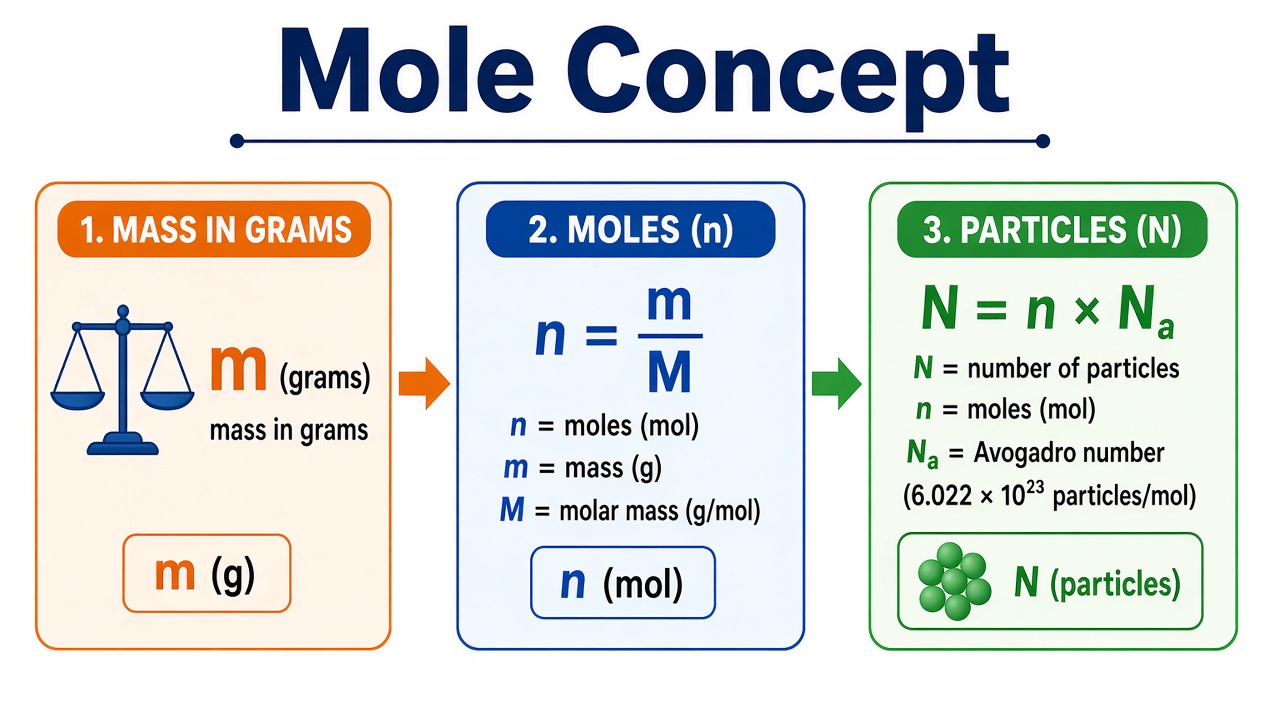
Think about it
Every stoichiometric ratio in a balanced equation is a mole ratio, so the mole is the universal currency of chemical amount. A 500 mg paracetamol tablet contains a definite number of moles of C₈H₉NO₂ calculated from its molar mass 151 g mol⁻¹.
Use the mole as the bridge between the macroscopic lab scale and the microscopic particle scale.
For O₂, M = 32 g mol⁻¹, so 8 g is 0.25 mol and contains 0.25 × 6.022 × 10²³ molecules.
At STP (0 °C, 1 bar in modern tables, or 1 atm in many school texts) one mole of ideal gas occupies about 22.4 L; at 25 °C and 1 bar the molar volume is closer to 24.8 L — always check which STP/SATP the question adopts.
Atomic mass unit: 1 u = 1/12 the mass of a ¹²C atom; molar mass in g mol⁻¹ equals mass in u per formula unit.
For ions and formula units (NaCl, CaCl₂) count formula units, not “molecules”.
Key points
- Elementary entity: Atom, molecule, ion, electron, or specified formula unit.
- Molar mass: Mass per mole; unit g mol⁻¹.
- n = m/M = N/N_A = C × V (for solutions, with V in litres if C is molarity).
- 1 mol electrons = 1 faraday ≈ 96500 C in electrochemistry.
- Do not confuse atomic mass (u) with molar mass (g mol⁻¹); they share the number but differ in unit.
Read more
Amount of substance
- n — Amount of substance (mol)
- N_A — Avogadro constant (mol⁻¹)
Laws of Chemical Combination
Conservation of mass: total mass of reactants equals total mass of products in a closed system. Law of definite proportions: a pure compound always contains the same elements in the same mass ratio. Law of multiple proportions: when two elements form more than one compound, the masses of one element that combine with a fixed mass of the other are in small whole-number ratios. Gay-Lussac: gases react in simple volume ratios at the same T, P. Avogadro: equal volumes of gases at the same T, P contain equal numbers of molecules.
In short: Mass is never created or destroyed in ordinary chemistry. A given compound always has the same recipe by mass, and gas volumes add up in neat ratios like 2:1:2 for H₂ + ½O₂ → H₂O(g).
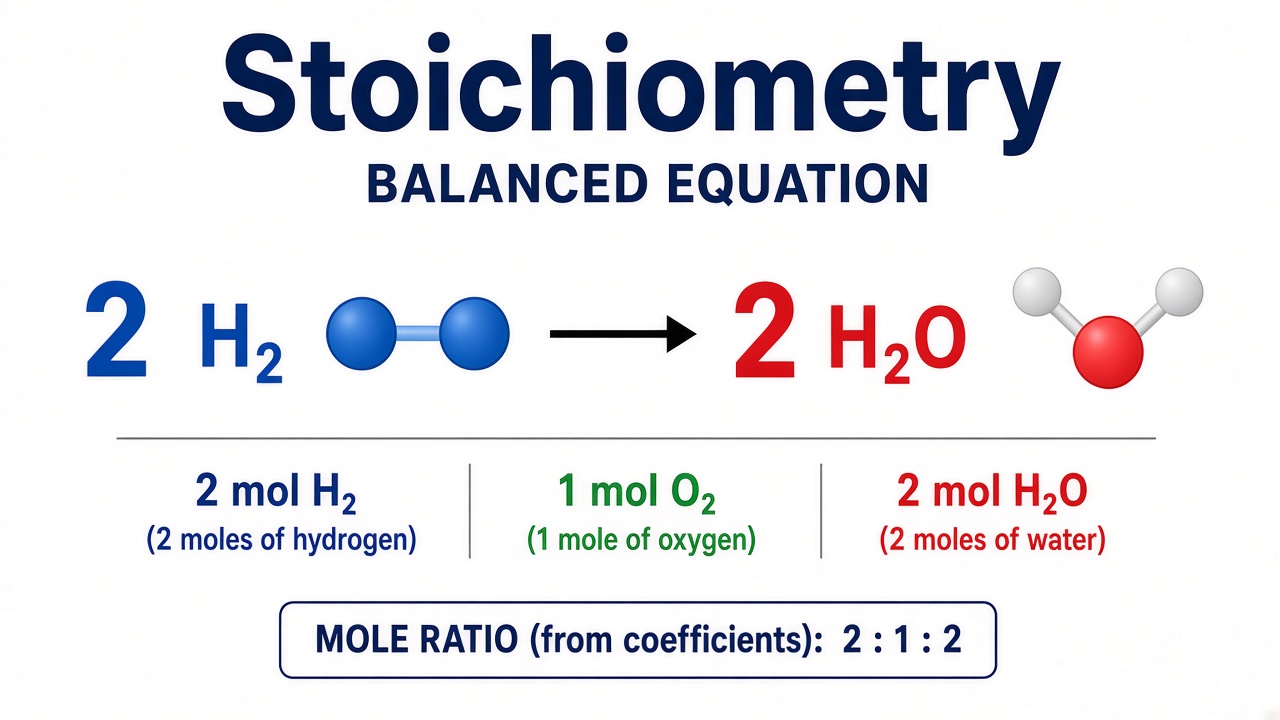
Think about it
They justify why chemical formulas are fixed and why balanced equations with integer coefficients describe reality.
Definite proportions distinguishes compounds from mixtures: water is always ~8:1 oxygen to hydrogen by mass, while sugar water can have any ratio.
Multiple proportions explains CO vs CO₂: for a fixed mass of carbon the oxygen masses are in the ratio 1:2.
Gay-Lussac’s volume data forced chemists to accept diatomic molecules (H₂, O₂, N₂) once Avogadro’s hypothesis was adopted — otherwise volume ratios would contradict Dalton’s atomic picture.
These laws are the historical backbone of formulas; exam questions often ask which law a data set illustrates.
Key points
- Closed system: No matter crosses the boundary; mass is conserved.
- Gay-Lussac’s law of combining volumes: Gaseous reactants/products show simple volume ratios at same T, P.
- Mass conservation fails for open systems that lose gas; always define the system.
- Volume ratios apply only to gases under comparable conditions, not to solids or liquids.
- Equivalent mass ideas historically grew from definite proportions.
Empirical and Molecular Formulas
The empirical formula is the simplest whole-number ratio of atoms in a compound. The molecular formula is the actual number of atoms in a molecule and is an integer multiple of the empirical formula: molecular formula = (empirical formula) × n, where n = M_molecular / M_empirical.
In short: Empirical formula is the recipe in lowest terms (CH₂O for glucose); molecular formula is the real molecule (C₆H₁₂O₆).
Think about it
Analytical data arrive as percentages or combustion masses; formulas are what you report and use in equations.
From percentage composition: assume 100 g, convert each element’s mass to moles, divide by the smallest mole number, and multiply to clear fractions (×2, ×3, …).
Combustion analysis of organics gives CO₂ and H₂O masses from which C and H percentages follow; oxygen is often found by difference.
For ionic solids the “molecular” formula is really the formula unit (empirical).
Hydrates: include water of crystallisation carefully (CuSO₄·5H₂O).
Isomers share molecular formula but differ in structure — formula alone does not fix connectivity.
Key points
- Percentage composition: (mass of element in 1 mol / molar mass) × 100%.
- Combustion analysis: Burn organic sample; weigh CO₂ and H₂O to find C and H.
- Always check that percentages sum to ~100%; leftover is often oxygen.
- n must be an integer; if M is approximate, round carefully.
- Empirical formula mass for CH₂O is 30; glucose M = 180 ⇒ n = 6.
Stoichiometry and Limiting Reagent
Stoichiometry uses the mole ratios of a balanced chemical equation to relate amounts of reactants and products. The limiting reagent is the reactant that is completely consumed first and thus limits the amount of product. Theoretical yield is the amount of product predicted from the limiting reagent; percentage yield = (actual yield / theoretical yield) × 100%.
In short: If a sandwich needs 2 bread slices and 1 cheese slice, 10 bread + 3 cheese make only 3 sandwiches — cheese limits. Chemistry works the same way with mole ratios.
Think about it
Industrial and exam numericals rarely supply reactants in exact stoichiometric amounts; limiting reagent decides the answer.
Method: convert all given reactant masses to moles, divide each by its stoichiometric coefficient, and the smallest quotient identifies the limiting reagent.
Excess reagent leftover = initial moles − moles consumed.
For sequential reactions, carry the limiting product of step 1 into step 2.
Percentage purity: only the pure fraction of a sample participates — multiply mass by purity fraction before finding moles.
In competing reactions, product distribution needs kinetics or equilibrium, not stoichiometry alone.
Volume stoichiometry for gases at the same T, P can use volume ratios equal to mole ratios (Avogadro).
Key points
- Theoretical yield: Maximum product from limiting reagent assuming 100% conversion.
- Side reaction: Consumes reactant without making the desired product; lowers yield.
- Never compare grams directly across different substances; always compare moles via coefficients.
- For 2H₂ + O₂
→2H₂O, 2 mol H₂ need 1 mol O₂; extra O₂ is excess. - Atom economy = (mass of desired product / total mass of reactants) × 100% (green chemistry).
Read more
Percentage yield
- yield — Usually in mass or moles of product (—)
Concentration Units
Molarity M = moles of solute / litres of solution. Molality m = moles of solute / kg of solvent. Mole fraction χ_i = n_i / n_total. Mass percent = (mass solute / mass solution) × 100%. Normality N = equivalents / litre; for acids/bases, equivalents = moles × n-factor (H⁺ or OH⁻ per formula unit). Dilution: M₁V₁ = M₂V₂ for conserved solute moles.
In short: Molarity is moles per litre of solution (changes with temperature). Molality is moles per kilogram of solvent (temperature-independent). Mole fraction is a pure number between 0 and 1.
Think about it
Equilibrium constants, rate laws and colligative formulas all need a clearly defined concentration scale.
Molarity depends on solution volume, which expands with temperature; molality does not — prefer molality in colligative-property derivations.
For dilute aqueous solutions, M ≈ m numerically when density ≈ 1 g mL⁻¹, but they diverge for concentrated solutions.
Mole fraction of solvent in a binary solution is 1 − χ_solute; Raoult’s law uses mole fractions.
ppm and ppb are mass-based for traces (1 ppm ≈ 1 mg L⁻¹ in dilute water).
Normality is discouraged in modern SI but still appears in titration problems: N = M × n-factor.
When mixing solutions of the same solute, total moles = Σ M_i V_i and final M = total moles / total volume (volumes approximately additive for dilute aqueous mixes).
Key points
- n-factor: H⁺/e⁻/charge exchanged per formula unit in the reaction of interest.
- Formality: Moles of formula units dissolved per litre, ignoring speciation.
- Label every concentration with its unit; “0.1” alone is ambiguous.
- Convert mL
→L before using molarity formulas. - χ is dimensionless; sum of mole fractions in a mixture equals 1.
Molarity and dilution
- M — Molarity (mol L⁻¹)
- V — Solution volume (L)
Equivalent Mass and Titration Stoichiometry
Equivalent mass of a substance is molar mass divided by n-factor for the reaction considered. In titration, milliequivalents of acid equal milliequivalents of base at the equivalence point: N_a V_a = N_b V_b. For redox titrations the n-factor is the electrons transferred per formula unit.
In short: Equivalents let you match “reactive capacity” — one equivalent of acid neutralises one equivalent of base, regardless of whether the acid is HCl or H₂SO₄.
Think about it
Volumetric analysis remains a core lab and JEE skill; normality shortcuts many acid–base and redox numericals.
For H₂SO₄ in acid–base titration n-factor = 2; for HCl it is 1.
For KMnO₄ in acidic medium MnO₄⁻ → Mn²⁺ and n-factor = 5; in neutral/weakly alkaline medium n-factor = 3 (MnO₂); in strong alkali n-factor = 1 (MnO₄²⁻).
Always state the medium.
Mohr’s salt FeSO₄·(NH₄)₂SO₄·6H₂O has n-factor 1 for Fe²⁺ → Fe³⁺.
Primary standards (oxalic acid, Na₂CO₃, KHP) are used to standardise titrants because they are pure and stable.
Back titration: excess reagent is added, then residual reagent is titrated — useful when the direct reaction is slow.
Key points
- Equivalence point: Stoichiometrically complete reaction of analyte with titrant.
- Primary standard: High-purity solid used to standardise a solution.
- meq = N ×
V(mL)= (mass / equivalent mass) × 1000. - For same n-factor reactions, mole ratio equals coefficient ratio from the balanced equation.
- Do not mix n-factors from different media for the same oxidant.
Comparisons
Molarity vs molality vs mole fraction
| Molarity (M) | Molality (m) | Mole fraction (χ) | |
|---|---|---|---|
| Definition | mol / L solution | mol / kg solvent | n_i / n_total |
| T dependence | Yes (volume changes) | No | No |
| Typical use | Titrations, rates | Colligative properties | Raoult’s law, vapours |
| Unit | mol L⁻¹ | mol kg⁻¹ | dimensionless |
Educational Significance: Choose the scale that matches the formula you will apply next.
Solved examples
How many molecules are in 4.4 g of CO₂? (M = 44 g mol⁻¹, N_A = 6.022 × 10²³)
- m = 4.4 g
- M = 44 g mol⁻¹
Number of molecules
Formula Applied:N = (m/M) N_AApproach note: 0.1 mol is one-tenth of Avogadro’s number of particles.
A compound is 40% C, 6.7% H, 53.3% O by mass. Molar mass ≈ 60 g mol⁻¹. Find empirical and molecular formulas.
- %C = 40
- %H = 6.7
- %O = 53.3
- M ≈ 60
Empirical and molecular formulas
Formula Applied:—Approach note: Acetic acid and methyl formate share this molecular formula — structure needs more data.
For N₂ + 3H₂ → 2NH₃, 28 g N₂ and 6 g H₂ are mixed. Find limiting reagent and mass of NH₃ formed (100% yield).
- m(N₂) = 28 g
- m(H₂) = 6 g
Limiting reagent and m(NH₃)
Formula Applied:Mole ratio N₂:H₂ = 1:3Approach note: If H₂ were only 4 g (2 mol), H₂ would limit and NH₃ = (2/3)×2×17 g.
25 mL of 0.1 M H₂SO₄ is diluted to 500 mL. Find final molarity and normality.
- M₁ = 0.1 M
- V₁ = 25 mL
- V₂ = 500 mL
M₂ and N₂
Formula Applied:M₁V₁ = M₂V₂; N = 2MApproach note: Dilution conserves moles (and equivalents); only volume changes.
Real-world applications
Dose calculation
Tablet strength in mg converts to moles of active ingredient for metabolic dosing studies.
Batch reactor feed
Limiting-reagent analysis sizes reactant feeds to minimise waste of the expensive reagent.
Common mistakes
❌ Myth: One mole of any gas always occupies 22.4 L at any temperature and pressure.
Why this is wrong: 22.4 L mol⁻¹ applies only near STP for ideal gases; V_m = RT/P otherwise.
✅ Verified Truth: Use PV = nRT whenever T or P differ from the stated STP.
⚠️ Exam Tip: Check whether the question says STP, SATP or gives T and P explicitly.
❌ Myth: The reactant present in smaller mass is always the limiting reagent.
Why this is wrong: Limiting reagent depends on moles relative to stoichiometric coefficients, not on grams alone.
✅ Verified Truth: Convert to moles, divide by coefficients, compare quotients.
⚠️ Exam Tip: Never compare raw masses of different compounds.
❌ Myth: Molarity and molality are always nearly equal, so they are interchangeable.
Why this is wrong: They coincide only for dilute aqueous solutions with density ≈ 1 g mL⁻¹.
✅ Verified Truth: Use molality for colligative formulas and when temperature varies.
⚠️ Exam Tip: Read whether K_b/K_f equations ask for m, not M.
❌ Myth: Empirical and molecular formulas are always different.
Why this is wrong: For many compounds (H₂O, CH₄, NaCl formula unit) they are identical (n = 1).
✅ Verified Truth: n = M_mol / M_emp; if n = 1 the formulas match.
⚠️ Exam Tip: Compute n; do not assume multiplication is needed.
Revision notes
Chemistry begins with measuring matter precisely: the mole counts particles, molar mass converts grams to moles, and stoichiometric ratios from balanced equations convert moles of reactants into moles of products. Laws of chemical combination (conservation of mass, definite proportions, multiple proportions, Gay-Lussac, Avogadro) explain why formulas and equations work. Concentration units (molarity, molality, mole fraction) describe solutions, while limiting reagents and percentage yield decide how much product you actually get in the lab or in an exam numerical.
High-Yield Quick Revision Points
- n = m/M = N/N_A = V/V_m (ideal gas at stated conditions).
- Empirical = simplest ratio; molecular = n × empirical.
- Limiting reagent: smallest (moles / coefficient).
- % yield = actual/theoretical × 100%.
- M = n/V_L; m = n/kg solvent; χ_i = n_i/n_tot; M₁V₁ = M₂V₂.
- N = M × n-factor; meq acid = meq base at equivalence.
Master Formula Cheat Sheet
Practice questions
Number of moles in 11.2 L of ideal O₂ at STP (use 22.4 L mol⁻¹) is:
Mass of 0.2 mol CaCO₃ (M = 100 g mol⁻¹) in grams?
Which concentration unit is independent of temperature?
Moles of H₂SO₄ in 250 mL of 0.4 M solution?
In 2A + B → C, starting with 4 mol A and 3 mol B, limiting reagent is:
Dilute 50 mL of 2 M HCl to 0.5 M. Final volume in mL?