Chapter 19 · Class 11-12 & JEE/NEET
Metallurgy
54 topics · 18 sections · beginner-friendly study notes · Updated
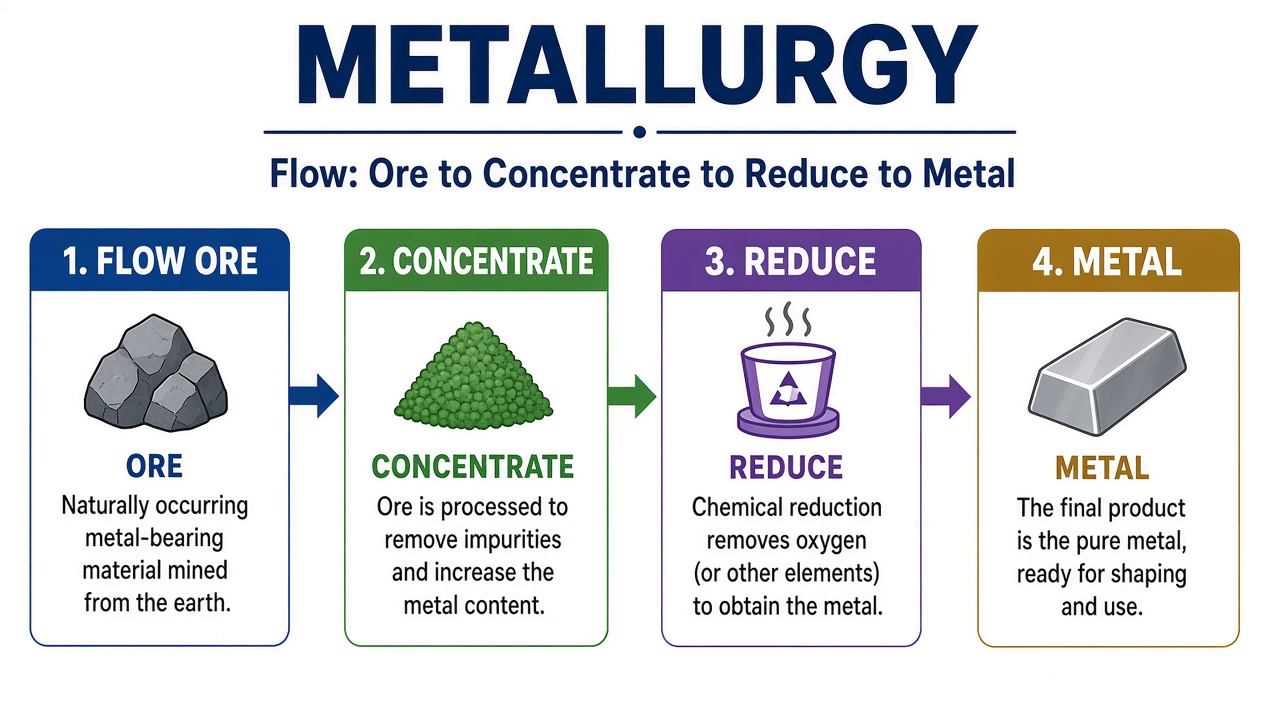
Metallurgy extracts metals from ores via concentration, conversion to oxide, reduction and refining.
Ellingham diagrams decide feasible reductants; thermodynamics of ΔG° = −RT ln K links to roasting, smelting and electrolytic refining — a compact but concept-heavy JEE topic.
Ellingham-based reasoning and named refining processes are standard JEE Main assertion–reason and matching-list items.
Blast furnaces, aluminium smelters, copper electrorefining for electrical grade Cu, and semiconductor-grade Si/Ge via zone refining keep modern industry running.
Ores, Gangue, Flux and Concentration
An ore is a mineral from which metal can be extracted profitably. Gangue is unwanted earthy matter. A flux combines with gangue to form fusible slag. Concentration (beneficiation) raises the metal content before reduction.
In short: Dig rock, remove dirt, add a helper chemical so leftover junk melts away as slag, then reduce.
Think about it
Method choice questions dominate metallurgy MCQs. Froth flotation plants process millions of tonnes of CuFeS₂ ore for electrical copper.
Ore classes: oxide (bauxite, haematite), sulphide (copper pyrites, zinc blende), carbonate (calamine, limestone as flux source), halide (cryolite).
Gravity separation for dense cassiterite; magnetic for Fe₃O₄/FeWO₄; froth flotation for sulphides using collectors (pine oil, xanthates) and frothing agents — ore in froth, gangue sinks (or reverse flotation).
Leaching: Bayer process Al₂O₃ with NaOH; cyanide leach for Au/Ag; acid leach for low-grade Cu.
Depressants (NaCN) separate ZnS from PbS in flotation — classic JEE detail.
Key points
- Slag: Fusible waste: e.g. CaSiO₃ in iron extraction.
- Collector: Surfactant that makes ore particles hydrophobic.
- Sulphides
→froth flotation; oxides often gravity/magnetic. - Flux acidic (SiO₂) for basic gangue and vice versa.
Calcination, Roasting and Reduction
Calcination heats ore in limited air to drive off CO₂/H₂O (carbonates/hydrates → oxides). Roasting heats sulphides in excess air to oxides/SO₂. Reduction converts metal oxide to metal using C, CO, Al, H₂ or electrolysis.
In short: Cook carbonates gently, cook sulphides in air, then steal oxygen from the oxide with carbon or electricity.
Think about it
Distinguishing calcination/roasting is a perennial one-mark favourite. Thermite welding joins railway tracks using Al reduction of iron oxide.
Self-reduction: 2Cu₂S + 3O₂ → 2Cu₂O + 2SO₂; Cu₂S + 2Cu₂O → 6Cu + SO₂ (copper matte conversion).
Pb similarly.
Thermite: 2Al + Fe₂O₃ → 2Fe + Al₂O₃ (Goldschmidt) — Al’s high oxide affinity.
Smelting in blast furnace: coke provides heat and CO; limestone → CaO flux.
Partial reduction equilibria CO₂ + C ⇌ 2CO (Boudouard) control the stack chemistry.
Key points
- Matte: Cu₂S·FeS molten mixture in copper extraction.
- Gangue vs slag: Gangue is impurity in ore; slag is fused after flux reaction.
- Calcination: limited air; roasting: excess air on sulphides.
- SO₂ from roasting feeds contact process historically.
Ellingham Diagrams
Ellingham diagrams plot ΔG° of formation of oxides (per mole O₂) versus T. A metal oxide can be reduced by another element if the ΔG° line of the reductant’s oxide lies below that of the metal oxide at that T (more negative ΔG°).
In short: Lower line on the Ellingham chart wins: that metal holds oxygen more tightly and can steal it from oxides above it.
Think about it
Conceptual backbone for “why this reductant?” questions. Industrial furnace temperatures are chosen near Ellingham crossover regions for coke reduction of Fe oxides.
Most lines slope upward (ΔS° < 0 for M + O₂ → MO because gas consumed).
2C + O₂ → 2CO slopes downward (gas moles increase).
Intersection temperatures mark where C or CO becomes a feasible reductant for a given oxide.
Al reduces Cr₂O₃/Fe₂O₃ below those intersections — thermite.
Ellingham ignores kinetics; rates may still be slow.
Diagrams explain why Mg/Al are hard to reduce with C at moderate T and need electrolysis.
Key points
- Compare per mole O₂ consistently.
- Downward CO line is why carbon is a versatile high-T reductant.
Feasibility link
- K — Equilibrium constant of reduction reaction (—)
Extraction of Fe, Cu, Zn, Al
Iron: blast furnace reduction of haematite with coke/CO and limestone flux. Copper: froth flotation of chalcopyrite → roasting/smelting to matte → Bessemerisation → electrorefining. Zinc: roast ZnS → ZnO → reduce with coke and distill. Aluminium: Bayer purify bauxite → Hall–Héroult electrolysis of Al₂O₃ in cryolite.
In short: Each metal has a signature flowsheet: furnace for Fe, flotation+matte for Cu, distill for Zn, electricity for Al.
Think about it
Named process outlines are direct recall + equation marks. Recycled Al uses ~5% of the energy of Hall–Héroult primary metal — sustainability angle in modern exams.
Blast furnace zones: reduction of Fe₂O₃ stepwise by CO; slag CaSiO₃ floats; pig iron absorbs C/S/P/Si.
Copper electrorefining: impure Cu anode dissolves, pure Cu deposits on cathode; anode mud holds Au/Ag.
Zn boiling point ~907 °C allows distillation from roasted ore reduction.
Hall–Héroult: Al₂O₃ in Na₃AlF₆ at ~950 °C; cathode Al(l), anode C → CO/CO₂; cryolite lowers melting point of alumina.
Energy intensity of Al smelting is why recycling aluminium matters.
Key points
- Pig iron: Blast-furnace iron with ~2–4% C.
- Cryolite: Na₃AlF₆ solvent for alumina electrolysis.
- Cryolite lowers MP and increases conductivity of electrolyte.
- Anode mud = precious metal byproduct in Cu refining.
Refining Methods
Refining removes remaining impurities. Methods: liquation (low-MP Sn), distillation (Zn, Hg), electrolytic refining (Cu, Zn, Al), zone refining (Si, Ge, Ga — ultrapure), vapour phase Mond process (Ni via Ni(CO)₄) and van Arkel (Ti/Zr via iodide).
In short: Finish by melting, boiling, plating, or making a volatile compound that decomposes back to pure metal.
Think about it
Matching metals to refining methods is a high-frequency pattern. Semiconductor wafers need zone-refined Si with impurities at ppb levels.
Zone refining: impure solid rod; moving molten zone prefers impurities in liquid (distribution coefficient k < 1); impurities sweep to the end.
Mond: Ni + 4CO ⇌ Ni(CO)₄ (volatile) at 330 K; decompose at 450 K to pure Ni.
Van Arkel: Ti + 2I₂ → TiI₄ (vapour) then filament decomposition to Ti crystal bar.
Poling for Cu₂O-contaminated blister copper uses green wood hydrocarbons as reductant — historical but still mentioned.
Key points
- Distribution coefficient k: C_solid/C_liquid for an impurity.
- Crystal bar: Pure Ti/Zr deposited on tungsten filament in van Arkel.
- Mond = Ni; van Arkel = Ti/Zr; zone = semiconductors.
- Electrorefining needs aqueous ions that plate cleanly (Cu²⁺).
Comparisons
Calcination vs Roasting
| Calcination | Roasting | |
|---|---|---|
| Atmosphere | Limited air | Excess air |
| Typical ore | Carbonate / hydroxide | Sulphide |
| Gas evolved | CO₂, H₂O | SO₂ (mainly) |
| Goal | Oxide + dry ore | Oxide + remove S/As/Sb |
Educational Significance: One glance tells you which thermal pretreatment an ore needs.
Solved examples
Which concentration method suits ZnS mixed with PbS, and what depressant is used?
- Sulphide mixture ZnS + PbS
Method + depressant
Formula Applied:—Approach note: Depressant ≠ collector; collectors make ore hydrophobic.
Why is aluminium extracted by electrolysis rather than carbon reduction in a blast furnace?
- Ellingham Al₂O₃ line very low
Thermodynamic reason
Formula Applied:—Approach note: Lower Ellingham line ⇒ harder to reduce that oxide.
Write the key Mond process equilibria for nickel refining.
- Ni impure
Formation and decomposition of Ni(CO)₄
Formula Applied:Ni + 4CO ⇌ Ni(CO)₄Approach note: Only Ni among common metals forms such an easily cycled carbonyl here.
In zone refining, impurity has k = 0.1. Qualitatively, where do impurities end up and why?
- k = C_s/C_l = 0.1
Impurity segregation direction
Formula Applied:—Approach note: If k > 1, impurity would enrich the solid — rare for these systems.
Real-world applications
General Principles of Metallurgy outside the classroom
Blast furnaces, aluminium smelters, copper electrorefining for electrical grade Cu, and semiconductor-grade Si/Ge via zone refining keep modern industry running.
Common mistakes
❌ Myth: Roasting and calcination are interchangeable terms.
Why this is wrong: They differ in atmosphere and typical ores.
✅ Verified Truth: Calcination = limited air on carbonates/hydrates; roasting = excess air on sulphides.
⚠️ Exam Tip: Always mention air supply in definitions.
❌ Myth: Carbon can reduce any metal oxide if heated enough.
Why this is wrong: Kinetics and Ellingham intersections may make T impractical; Al₂O₃ needs electrolysis.
✅ Verified Truth: Check Ellingham before claiming carbon reduction.
⚠️ Exam Tip: Al, Mg, Na are classic electrolysis metals.
❌ Myth: Cryolite is the source of aluminium in Hall–Héroult.
Why this is wrong: Cryolite is solvent; alumina is the feedstock.
✅ Verified Truth: Al₂O₃ dissolves in Na₃AlF₆; Al comes from alumina.
⚠️ Exam Tip: Questions often test this misconception directly.
Revision notes
Metallurgy extracts metals from ores via concentration, conversion to oxide, reduction and refining. Ellingham diagrams decide feasible reductants; thermodynamics of ΔG° = −RT ln K links to roasting, smelting and electrolytic refining — a compact but concept-heavy JEE topic.
High-Yield Quick Revision Points
- Concentration: gravity / magnetic / froth / leaching.
- Calcination vs roasting; slag = flux + gangue.
- Ellingham: lower oxide line reduces upper; CO line slopes down.
- Fe blast furnace; Cu matte; Zn distill; Al Hall–Héroult.
- Refine: Mond (Ni), van Arkel (Ti/Zr), zone (Si/Ge), electro (Cu).
Master Formula Cheat Sheet
Practice questions
Froth flotation is typically used for
van Arkel method is used for
In Ellingham diagram, the line for 2C + O₂ → 2CO slopes
Oxidation number of Al in cryolite Na₃AlF₆?
Anode mud during Cu electrorefining contains
Self-reduction is important in extraction of