Chapter 31 · Class 11-12 & JEE/NEET
Polymers
16 topics · 8 sections · beginner-friendly study notes · Updated
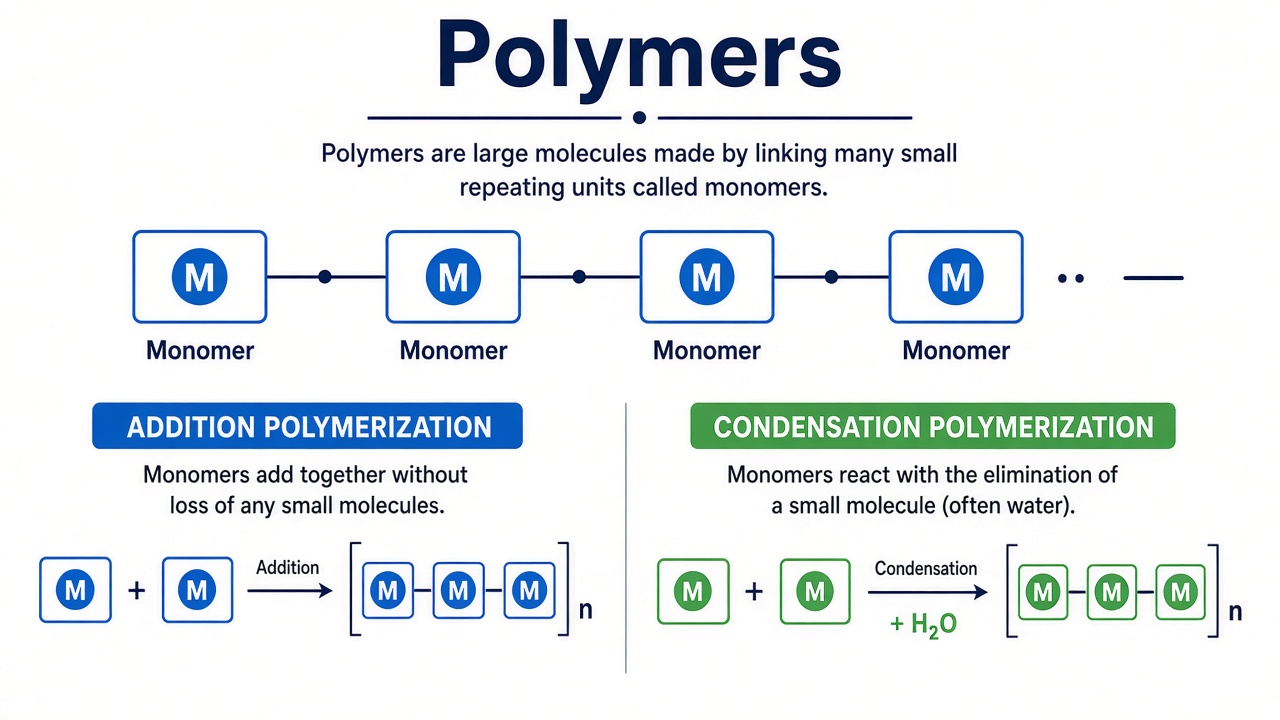
Polymers are giant molecules built from repeating monomers via addition or condensation polymerisation.
Classification (homo/copolymer; elastomers, fibres, thermoplastics, thermosets), named commercial polymers, and biodegradable ideas form a compact but factual JEE/NEET chapter.
Matching polymer↔monomer↔type is a high-accuracy MCQ pattern in both JEE and NEET.
Packaging, tyres, clothing fibres, non-stick cookware (PTFE), electrical insulation (PVC) and medical sutures (biodegradable polyesters) are polymer applications.
Addition and Condensation Polymerisation
Addition (chain-growth) polymers form by successive addition of unsaturated monomers without loss of small molecules (PE, PVC, polystyrene). Condensation (step-growth) polymers form with elimination of H₂O/HCl etc. (nylon, polyester, bakelite).
In short: Addition: monomers click together keeping all atoms. Condensation: monomers join and spit out water or similar.
Think about it
First branch in every polymer classification question. Ziegler–Natta catalysts earned a Nobel Prize — stereochemistry controls plastic properties.
Free-radical initiation (benzoyl peroxide) for many vinyl polymers; Ziegler–Natta for stereoregular polypropene (isotactic).
Copolymers: Buna-S (butadiene + styrene), Buna-N (butadiene + acrylonitrile).
Degree of polymerisation and molecular weight distribution conceptual.
Cross-linking converts linear chains to network solids.
In exam language, first ask whether a small molecule is lost: if yes, condensation; if the monomer is a simple alkene/diene keeping all atoms in the chain, addition — then name the commercial product from the monomer list.
Key points
- Monomer: Repeating small-molecule building block.
- Copolymer: Polymer from ≥2 different monomers.
- PTFE from tetrafluoroethene — addition.
- Nylon-6,6 from hexamethylenediamine + adipic acid — condensation.
Classification by Force and Thermal Behaviour
Elastomers: weak intermolecular forces, stretchable (natural rubber, buna). Fibres: strong H-bonding/dipole, high tensile (nylon, polyester). Thermoplastics: intermolecular forces intermediate; remeltable (PE, PVC, PS). Thermosetting: cross-linked network; char on heating (bakelite, melamine-formaldehyde).
In short: Soft stretchy, strong threadlike, remeltable plastic, or permanently set — four application classes.
Think about it
Thermo vs thermoset + elastomer/fibre buckets are standard match-lists. Tyre rubber is vulcanised elastomer; PET bottles are thermoplastic polyester.
LDPE vs HDPE: branching vs linear packing — density and strength.
Vulcanisation of rubber with S cross-links improves elasticity/temperature range.
Bakelite from phenol + HCHO is cross-linked phenolic resin.
Matching questions often pair “can be remoulded on heating” with thermoplastics and “infusible network after curing” with thermosets — keep intermolecular-force strength as the physical reason behind elastomer vs fibre behaviour.
Key points
- Vulcanisation: Sulphur cross-linking of rubber.
- Thermoplastic: Softens on heating; reshaped repeatedly.
- Thermosets cannot be remoulded after curing.
- H-bonding in nylon explains fibre strength and moisture absorption.
Important Commercial Polymers
PE (ethene), PP (propene), PVC (vinyl chloride), PTFE (tetrafluoroethene), polystyrene (styrene), PMMA (methyl methacrylate), Buna-S/N, nylon-6 (caprolactam), nylon-6,6 (HMDA+adipic), PET/terylene (ethylene glycol + terephthalic), bakelite (phenol+HCHO), neoprene (chloroprene).
In short: Match the everyday plastic/fibre/rubber name to its monomer — that is most of the exam.
Think about it
Monomer–polymer matching is the densest factual scoring cluster. Global PE/PP production dwarfs most other organic chemicals — polymer age.
Uses: PE packaging; PVC pipes/insulation; PTFE non-stick/chemically inert; PS foam; PMMA acrylic glass; nylon ropes/textiles; PET bottles/fabrics; bakelite switches.
Writing repeating units matters as much as monomer names.
LDPE (high-pressure, branched, flexible films) differs from HDPE (Ziegler-type, denser bottles/crates).
PVC needs plasticisers for flexible tubing; without them it is rigid for pipes.
Polystyrene can be expanded with blowing agents into Styrofoam.
Melamine–formaldehyde gives unbreakable crockery (thermoset like bakelite).
Memorise at least one use per polymer for board-style questions and be ready to sketch the repeat unit for nylon-6,6 and PET in JEE Advanced long answers.
Key points
- Nylon-6,6: Polyamide from C6 diamine + C6 diacid.
- PET: Polyethylene terephthalate polyester.
- Nylon-6 from single monomer caprolactam (ring opening).
- Neoprene = polychloroprene — oil-resistant rubber.
- PMMA (perspex) is transparent thermoplastic — aircraft windows historically.
Natural Rubber and Biopolymers
Natural rubber is cis-1,4-polyisoprene harvested from Hevea latex; gutta-percha is the corresponding trans isomer with different crystallinity and hardness. Proteins, starch, cellulose and nucleic acids are natural biopolymers linked by peptide, glycosidic or phosphodiester bonds respectively, so the same polymer vocabulary spans both rubber chemistry and biomolecules.
In short: Trees make stretchy cis-polyisoprene rubber from isoprene units, while living cells build proteins and sugar polymers as natural macromolecules with different linkers.
Think about it
cis vs trans polyisoprene and vulcanisation are short conceptual favourites. Surgical gloves and vehicle tyres still depend heavily on natural/synthetic rubber blends.
Isoprene monomer CH₂=C(CH₃)–CH=CH₂ polymerises in plants to long cis-1,4 chains that coil and recoil, giving elasticity; the trans gutta-percha packing is more ordered and less rubbery.
Vulcanisation (Goodyear) introduces sulphur cross-links that widen the useful temperature window and stop sticky flow.
Cellulose β-1,4 versus starch α-1,4 glycosidic geometry explains why humans digest starch but not wood fibre — reinforce the biomolecules chapter without repeating every sugar proof.
Key points
- cis rubber elastic; trans more crystalline/hard.
- Latex coagulation with acid — processing note.
Biodegradable Polymers and Green Angle
Biodegradable polymers break down via microbial enzymes: PHBV (3-hydroxybutanoic + 3-hydroxypentanoic acids), nylon-2-nylon-6 (glycine + aminocaproic), polyglycolic/polylactic acid sutures. They address plastic persistence pollution.
In short: Some designed plastics can be eaten by microbes — useful for stitches and eco-packaging.
Think about it
PHBV/nylon-2-nylon-6 names appear in NCERT exemplar-style items. Absorbable surgical sutures disappear after healing — medical biodegradable polymers.
Contrast with persistent PE/PP/PS that fragment into microplastics rather than mineralising quickly.
PHBV is a bacterial polyester copolymer whose hydroxyacid monomers determine flexibility; nylon-2-nylon-6 alternates glycine and aminocaproic units so peptide-like bonds invite enzymatic attack.
Polylactic acid (PLA) from fermented sugars is compostable under industrial conditions but not a magic litter solution in cold oceans.
Not all “bio-based” polymers are biodegradable — exam questions may probe that feedstock origin ≠ end-of-life fate.
Green-chemistry atom-economy ideas favour catalytic polymerisations with less stoichiometric waste when designing next-generation materials.
Key points
- PHBV is a polyester copolymer.
- Biodegradable ≠ automatically non-toxic during degradation.
- Link to environmental chemistry: persistent plastics vs designed-to-degrade materials.
Comparisons
Addition vs condensation polymers
| Addition | Condensation | |
|---|---|---|
| Monomer feature | Unsaturated (C=C) typically | Bifunctional (–OH/–COOH/–NH₂ etc.) |
| Byproduct | None | H₂O, HCl, … |
| Examples | PE, PVC, PTFE, PS | Nylon, PET, bakelite |
| Growth style | Chain growth | Step growth |
Educational Significance: First decide which mechanism, then name monomers.
Solved examples
Monomer of PVC?
- PVC
Name
Formula Applied:—Approach note: Poly(X) ⇒ monomer X for simple vinyl polymers.
Classify nylon-6,6: addition/condensation; fibre/elastomer?
- Nylon-6,6
Classification
Formula Applied:—Approach note: Polyamides/polyesters with H-bond/dipole → fibres.
Role of sulphur in vulcanisation of rubber?
- Natural rubber + S + heat
Explain
Formula Applied:—Approach note: Unvulcanised rubber is sticky and temperature-sensitive.
Why is bakelite thermosetting while polyethylene is thermoplastic?
- Network vs linear
Structural reason
Formula Applied:—Approach note: Thermal behaviour follows intermolecular architecture.
Nylon-6,6 is made from hexamethylenediamine and adipic acid. How many carbon atoms are in each monomer, and what small molecule is eliminated per amide link?
- H₂N(CH₂)₆NH₂ + HOOC(CH₂)₄COOH
Carbon counts and byproduct
Formula Applied:—Approach note: The two numbers in nylon-6,6 are the carbon counts of the two monomers.
Real-world applications
Polymers outside the classroom
Packaging, tyres, clothing fibres, non-stick cookware (PTFE), electrical insulation (PVC) and medical sutures (biodegradable polyesters) are polymer applications.
Common mistakes
❌ Myth: All polymers are addition polymers.
Why this is wrong: Nylons, polyesters, bakelite are condensation polymers.
✅ Verified Truth: Check for small-molecule loss.
⚠️ Exam Tip: Write the polymerisation equation mentally.
❌ Myth: Thermoplastics and thermosets both remould easily.
Why this is wrong: Only thermoplastics remelt; thermosets char.
✅ Verified Truth: Cross-linking decides remouldability.
⚠️ Exam Tip: Bakelite switch housings are thermoset.
❌ Myth: Biodegradable polymers are always made from biological monomers only.
Why this is wrong: Classification is about degradability pathway, not solely feedstock.
✅ Verified Truth: PHBV is biodegradable polyester copolymer example from NCERT.
⚠️ Exam Tip: Read the adjective: bio-based ≠ biodegradable.
Revision notes
Polymers are giant molecules built from repeating monomers via addition or condensation polymerisation. Classification (homo/copolymer; elastomers, fibres, thermoplastics, thermosets), named commercial polymers, and biodegradable ideas form a compact but factual JEE/NEET chapter.
High-Yield Quick Revision Points
- Addition: no byproduct; condensation: loses small molecule.
- Elastomer / fibre / thermo / thermoset by forces & cross-links.
- Memorise monomers: PE, PVC, PTFE, PS, nylon, PET, bakelite, buna.
- Vulcanisation = S cross-links in rubber.
- PHBV, nylon-2-nylon-6 biodegradable examples.
Practice questions
PTFE monomer is
Bakelite is
Buna-S is a copolymer of
Number of distinct monomers in nylon-6,6?
Natural rubber repeating unit derives from
PHBV is